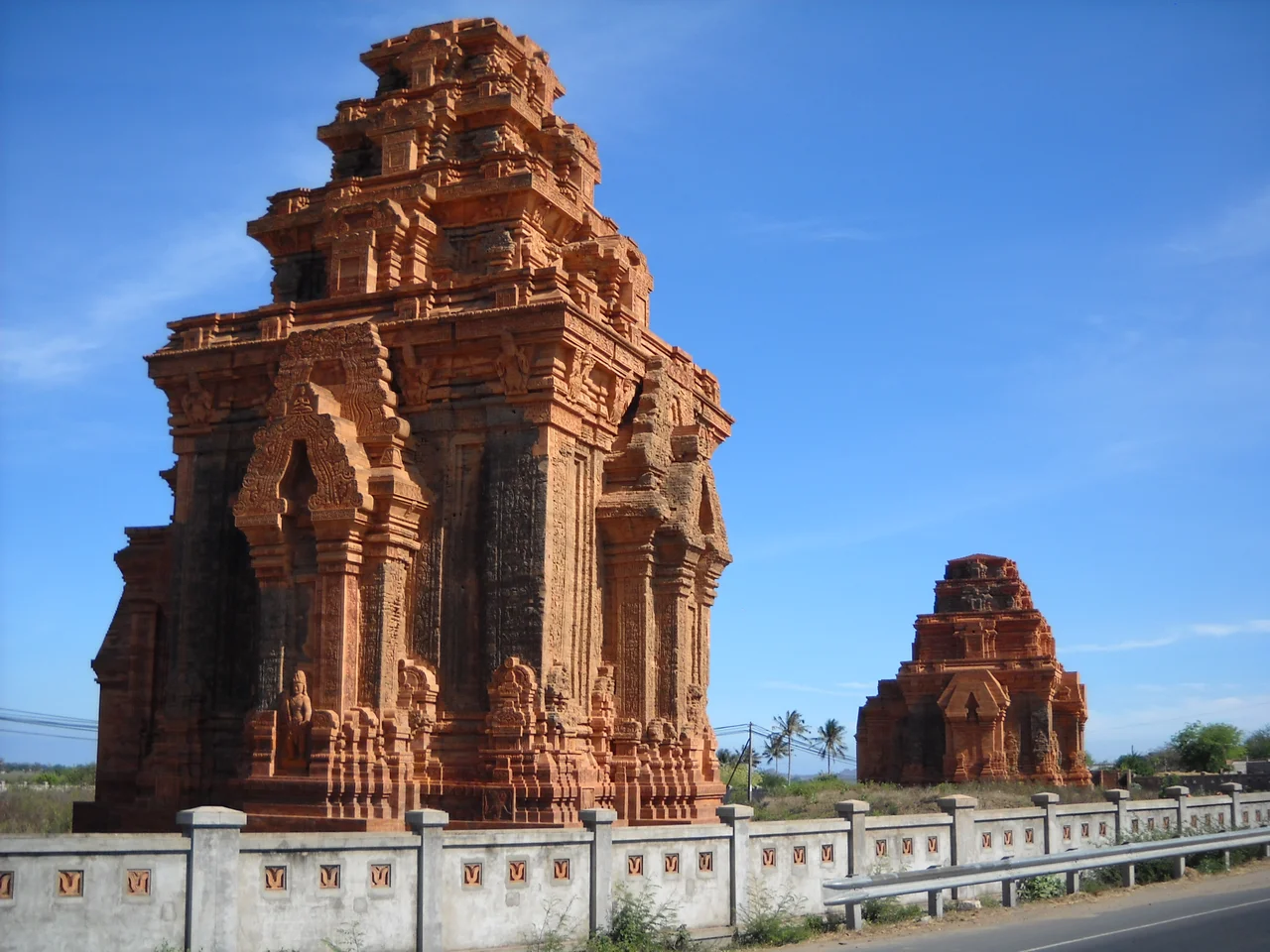

Principality of Thuận Thành
A civilization does not usually end on a single date. Champa — the Indianized Hindu-Buddhist-Islamic kingdom that dominated the central and southern Vietnamese coast for nearly two thousand years — faded across generations of erosion: territory lost, trade routes severed, seafaring traditions forgotten, royal courts reduced to client status. But there is a date. On a day in August 1832, three days after the death of the one Vietnamese official who had shielded the Cham from direct annexation, Emperor Minh Mang ordered the absorption of Panduranga into the Vietnamese empire. The last king of Champa, Po Phaok The, was taken as a royal hostage to the court at Huế. A civilization that had built magnificent brick towers, commanded maritime trade across the South China Sea, and absorbed both Hindu and Islamic influences over two millennia was gone — not in conquest but in administrative decree.
The Long Narrowing
The Principality of Thuận Thành was not a proud independent state. It was what remained of Champa after centuries of Vietnamese southward expansion — a rump territory centered on modern-day Phan Rang, surviving as a client of the Nguyen lords from 1695 onward. The Cham kings retained nominal sovereignty and administered their own people, but Vietnamese settlers — the Kinh — flooded into Panduranga under the protection of the Nguyen court. By 1695 roughly 200 Kinh villages had appeared inside Cham territory. Some settlers operated above Cham law, immune to the Cham judiciary. Usury at 150 percent annual interest stripped Cham families of their land and savings. The seafaring traditions that had connected Champa to the Malay world, to Islamic trading networks, to ports from India to China — these eroded as Panduranga turned inward, isolated, steadily impoverished. Rebellion flared in 1728 and again in 1746. Both were suppressed by Vietnamese garrison forces.
The Tay Son Interlude
The civil war that overthrew the Nguyen lords in the 1770s gave Panduranga a brief and turbulent space to breathe — and to fragment. The Tay Son rebellion split the Cham elite into pro-Tay Son and pro-Nguyen factions, turning the principality into a secondary theater of an intra-Vietnamese conflict. Prince Po Cei Brei governed for the Tay Son from 1783 to 1786; his brother Po Tisuntiraidapuran then ruled a pro-Tay Son Panduranga until 1793, when Nguyen Anh's loyalists retook the territory. Tisuntiraidapuran was captured, convicted of anti-Nguyen behavior, and executed. The pattern was becoming clear: Cham kings who aligned with the wrong Vietnamese faction paid with their lives. The ones who survived did so by serving the Nguyen — which meant, gradually, ceasing to serve their own people.
The Slow Erasure Under Minh Mang
Gia Long, the first Nguyen emperor, at least honored the fiction of Cham autonomy. His son Minh Mang did not. Beginning in the 1820s, Minh Mang — described by the source material as a Confucian student and a rigidly centralizing autocrat — tightened his grip on Panduranga. The Cham were conscripted into road-building and timber extraction, forced to provide corvée labor for palaces in Huế, taxed with harvest levies that left families in debt or starvation. Those who evaded taxes were tortured publicly — held outdoors in heat for three days, dehydrated — until they submitted. Men and women were ordered to clear forests for military garrisons. The coast was placed under complete Vietnamese control by 1822. Cham people were forbidden to build ships or make sails, severing what remained of their maritime heritage.
The one obstacle to outright annexation was Le Van Duyet, the powerful Viceroy of Saigon, who maintained a sphere of influence that included Panduranga and used it as leverage against Minh Mang's centralizing ambitions. When Duyet died in August 1832, Minh Mang moved within three days.
The End and Its Aftermath
The annexation unleashed what the source material describes without euphemism as cultural genocide. Mosques were razed. The Ramawan and Waha (Eid al-Adha) were forbidden. Cham Bani and Balamon religious practices were outlawed. The traditional social hierarchy was ordered erased. Minh Mang's officials permitted Kinh militias to kill three Cham people per day with rewards and no legal consequences. When the Cham rose in rebellion — a multi-ethnic uprising led by Ja Thak Wa that briefly seized large areas of central Vietnam by spring 1835 — the response was a reign of terror. Cham cemeteries and royal tombs were vandalized. Temples were demolished and burned. Seven to twelve coastal villages were razed. A Cham document from the period records: "If you go along the coast from Panrang to Parik, you will see, Prince and Lord, that there are no more Cham houses on the coast." Former king Po Phaok The was executed in July 1835 by slow-slicing. His vice-king was killed the same way. By the time the French arrived in the late 1880s, only some 40,000 Cham people remained in the old Panduranga. The French, for whatever their own reasons, prohibited Kinh discrimination against the Cham — putting an end to the most systematic phase of suppression, though not to the inequalities that persisted.
Memory and Its Keepers
The Cham today are recognized as one of Vietnam's 54 official ethnic minorities — an administrative category that implicitly defines them as a component of the Vietnamese national story rather than as the inheritors of a separate civilization. Cham temples, some of them twelve hundred years old, have been repurposed as tourist sites, their sacred architecture marketed as part of Vietnam's broader cultural heritage. The akhar thrah script — the traditional Cham writing system — is maintained by a dwindling number of scholars and religious practitioners. In Cambodia, the Khmer Rouge of the late 1970s murdered up to 200,000 Cambodian Cham — approximately half of Cambodia's Cham population — in an attempt to annihilate their identity entirely. The full scale of that particular genocide remains insufficiently acknowledged in international memory.
What survives is more than the ruins. The Cham diaspora in the Mekong Delta, in Cambodia, in Southeast Asian port cities, carried forward a religious and cultural tradition that had once stretched across an ocean. The brick towers still stand on hilltops along the Vietnamese coast, more durable than the kingdoms that built them, catching the light of a coast the Cham knew before it had any other name.
From the Air
The Principality of Thuận Thành was centered on the area around modern Phan Rang–Tháp Chàm at approximately 11.57°N, 108.99°E, extending north along the south-central Vietnamese coast. The coordinates for this article (11.17°N, 108.57°E) correspond to the Phan Rí area, the northern edge of the principality's territory. Ancient Cham brick towers — Thap Po Klong Garai and Thap Po Rome — are visible on elevated ground near Phan Rang from the air. The coastline is dry and sandy, characteristic of Vietnam's most arid region. Nearest airport: Cam Ranh International (CXR), approximately 90 km northeast of Phan Rang. Recommended altitude for viewing the coastal terrain and tower sites: 2,000–5,000 feet.
Nearby Stories
- Phan Rang–Tháp Chàm 15 km away
- Bao Loc 20 km away
- Operation Byrd 21 km away
- Núi Chúa National Park 63 km away
- Phú Quý Island 67 km away
- Cát Tiên Archaeological Site 71 km away
- Ile des Cendres 82 km away
- Battle of Long Tan 83 km away