
Parque Rodó
A small castle sits beside a lake here, and inside it children read. That single detail tells you much about Parque Rodo, a park that has spent more than a century blurring the line between grand civic gesture and simple delight. Laid out near the southern coast of Montevideo at the dawn of the twentieth century, it was first known plainly as the Urban Park. Only later did it take the name of Jose Enrique Rodo, the Uruguayan essayist whose monument stands on the park's southern edge and whose book Ariel shaped how a generation of Latin Americans thought about their own culture.
The Making of a Park
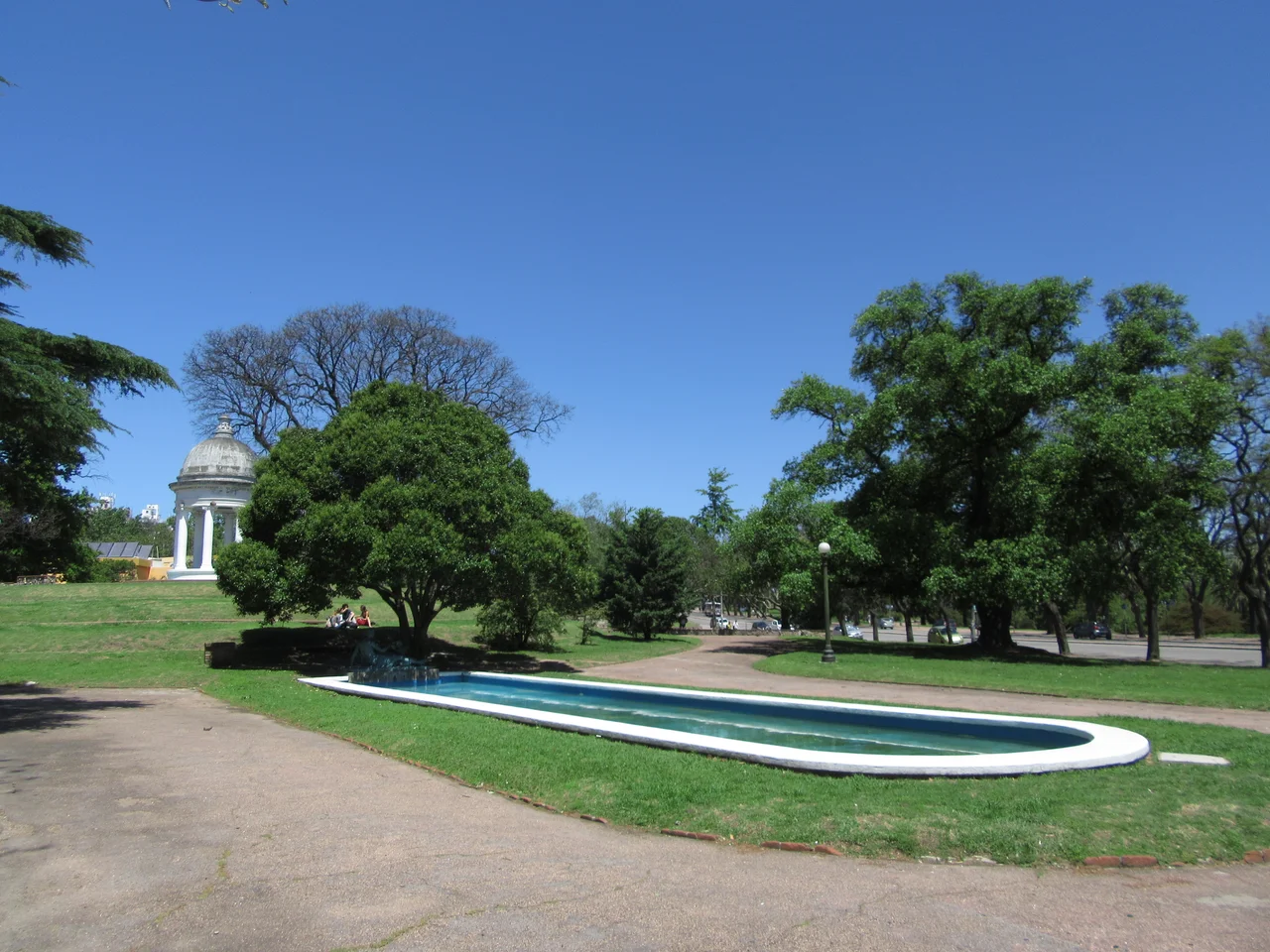
The park did not appear all at once. Preliminary work on the Urban Park began between 1900 and 1902, and over the following years it took shape under the hand of French landscape designers, including Carlos Thays, the same school of designers who reshaped green spaces across the River Plate region. The artificial lake was dug between 1903 and 1904, edged with rustic imitation-stone bridges and crossed by a central avenue. On the north side of the main park, that lake still curves around the little castle that today houses a municipal library for children. Nearby, an open-air gallery turns a stretch of pathway into a rotating exhibition of photography, art set loose from any wall.
Lights and Laughter by the Sea
Parque Rodo has long been Montevideo's place to play. Its amusement park traces a surprisingly deep history; mechanical thrills arrived here as early as the late nineteenth century, and carousels followed in the years that the park itself was being built. Today the rides still turn within the park's boundaries, a working fairground rather than a museum piece. Spread across the grounds are an open-air theatre, the Teatro de Verano, a former quarry now folded into the landscape, and the lake that gives the place its calm center. Generations of Montevideo families have measured their summers in this park, between the coast and the city.
A Park Inside a Neighborhood
Confusingly and charmingly, Parque Rodo is also a barrio, a Montevideo neighborhood that shares its name but not quite its borders. The park spills mostly into the adjacent district of Punta Carretas, while the barrio itself wraps around it, bounded by Palermo, Cordon, and Pocitos. Within those streets stand the Faculty of Engineering and the Faculty of Architecture of the Universidad de la Republica, their students crossing the same lawns that picnickers claim on weekends. Just west of the park rises the former Parque Hotel, a stately old building that now serves as the Mercosur headquarters, home to the secretariat of the regional bloc's parliament.
The Writer in the Name
The park honors a man whose words once echoed across a continent. Jose Enrique Rodo, born in Montevideo in 1871, was an essayist and philosopher whose 1900 work Ariel became one of the most influential books in Latin American letters. In it he urged the youth of the region to cherish their own spiritual and cultural values rather than imitate the materialism he associated with the rising power to the north. A whole intellectual movement, arielismo, took its name from that single slim volume. His monument stands on the southern side of the park, near where Sarmiento Avenue marks the boundary, so that the green space named for him keeps his memory in daily circulation, claimed less by scholars than by families on a Sunday walk.
Art, Faith, and Everyday Life
The neighborhood holds more than recreation. On the eastern flank of the main park stands the National Museum of Visual Arts, Uruguay's principal collection of painting and sculpture, so that culture and leisure occupy the same few blocks. Places of worship thread through the district too, among them the Roman Catholic church run by the Salesians of Don Bosco and a German Evangelical congregation, reminders of the immigrant communities that helped build modern Montevideo. The pocket neighborhood of Barrio Jardin tucks itself into the larger barrio, a quiet enclave within an already gentle quarter. All of it orbits the park, the green heart that gave the place its name and its rhythm.
From the Air
Parque Rodo lies along Montevideo's southern coast at approximately 34.914 degrees south, 56.167 degrees west, between the neighborhoods of Punta Carretas and Pocitos. From the air, look for a band of green pressed against the Rio de la Plata shoreline, with the small dark oval of the artificial lake near its center and the dense grid of Montevideo spreading inland to the north. The estuary's wide brown water lies to the south. The nearest major airport is Carrasco International (ICAO: SUMU), roughly 9 to 10 nautical miles east along the coast; Angel S. Adami Airport (ICAO: SUAA) sits to the northwest. Clear weather and low sun angles best reveal the contrast between the park's canopy and the surrounding city.
Nearby Stories
- Piriápolis 24 km away
- Minas 40 km away
- Tronador (rocket) 67 km away
- Nueva Helvecia 69 km away
- La Plata Museum 122 km away
- Battle of Sarandí 126 km away
- Mundo Marino 145 km away
- South Georgia Island 2584 km away