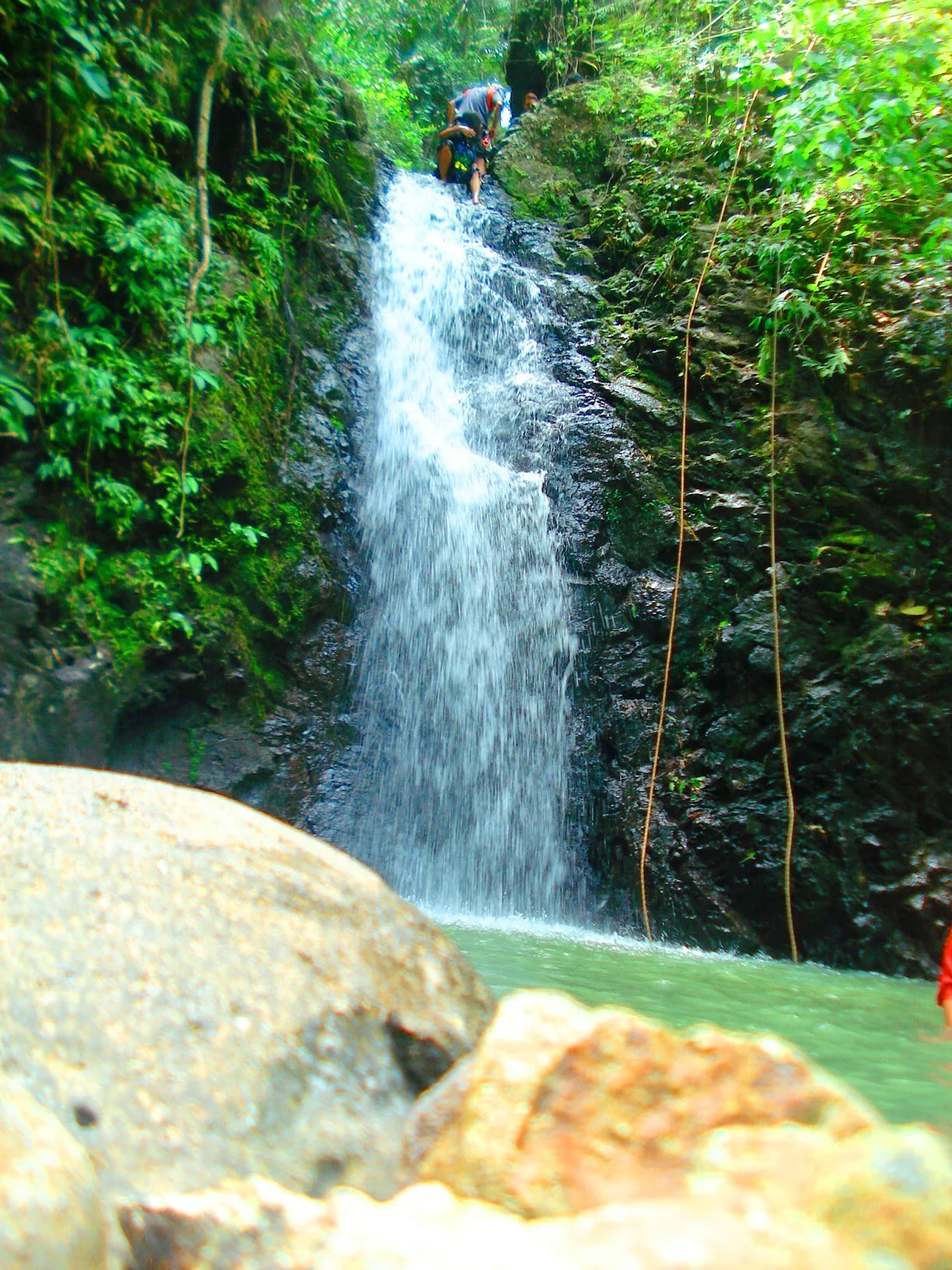
.JPG)
Pasonanca Natural Park
Somewhere in the low-elevation gallery forests of the Zamboanga Cordillera, a gecko that science did not know existed until 2010 clings to a mossy trunk. Cyrtodactylus jambangan -- its holotype collected within these mountains -- is common here, in the kind of pristine habitat that has vanished from most of the Philippines. The Pasonanca Natural Park protects 12,107 hectares of this forest, including the largest remaining block of old-growth lowland dipterocarp trees on the entire Zamboanga Peninsula. It also provides the drinking water for roughly 800,000 residents of Zamboanga City, making it that rare thing: a wilderness whose survival is a matter of daily urban necessity.
The Watershed That Runs a City
The Tumaga River and its tributaries flow from the park's mountain headwaters to a diversion dam that feeds the Zamboanga City Water District. This is not a scenic amenity -- it is the bulk of the city's water supply. The park sits in the southern end of the Zamboanga Cordillera, the mountain spine that runs north to south along the peninsula, and its watershed encompasses the local government areas of Pasonanca, Lunzuran, Lumayang Cacao, Lapacan, Lamisan, Bungiao, La Paz, Balurno, and Dulian in Zamboanga City, extending into parts of the municipality of Sibuco in Zamboanga del Norte. Mount Pulong Bato, a prominent peak within the park, rises to 360 meters. The relationship between the park and the city is direct: if the forest goes, the water goes with it.
Creatures of a Single Mountain
The park is the sole known location for adult specimens of the Zamboanga false gecko, and the place where the holotype of Cyrtodactylus jambangan was first collected. Other endemic reptiles include the Mindanao keelback and the Philippine small-disked frog. The Philippine eagle, the country's national bird, and the Mindanao bleeding-heart, a dove species found only on this island, both use the park as habitat and refugia. This concentration of endemic species in a relatively compact area reflects the deep isolation of Mindanao's mountain forests, where evolution has produced communities of organisms adapted to conditions that exist nowhere else.
Flora That Rewrites the Field Guides
Scientists are still discovering species within the park's boundaries. Sonerila mapelo, described in 2022, is one of only three Sonerila species in the entire Philippines, and it was first identified from specimens collected inside the park. Amomum zamboangense, described as recently as 2025, is one of only two Amomum species in the country, also first found here. At least 18 Philippine endemic tree species grow in the park, including white lauan, katmon, antipolo, balakat, Celtis luzonica, Hopea acuminata, and Myristica philippensis. The old-growth dipterocarp forest that shelters them is irreplaceable: these trees take centuries to reach maturity, and once logged, the ecosystem they support does not recover on any human timescale.
From Reserve to Heritage Park
The park's protected status has been strengthened in stages. In 1987, President Corazon Aquino declared the Pasonanca Watershed Forest Reserve through Proclamation No. 199, encompassing 10,560 hectares. In 1999, President Joseph Estrada enlarged and reclassified the area as a natural park through Proclamation No. 132. Then, on May 13, 2024, the park was inaugurated as the 52nd ASEAN Heritage Park in a ceremony led by Environment Secretary Toni Yulo-Loyzaga and Zamboanga Mayor John M. Dalipe. The ASEAN Center for Biodiversity unveiled a pyramid-Philippine eagle monument at the site, recognizing the park as the first old-growth dipterocarp forest protected under this designation in the Zamboanga Peninsula. A buffer zone of 5,307 hectares surrounds the core park area, adding another layer of protection.
From the Air
Pasonanca Natural Park is centered at approximately 7.074N, 122.078E in the mountains north of Zamboanga City. From altitude, the park appears as a dense, unbroken block of forest canopy in the southern Zamboanga Cordillera, contrasting sharply with the urban development of Zamboanga City to the south. Zamboanga International Airport (RPMZ) is approximately 15 km to the south-southeast. Mount Pulong Bato at 360 m is a visible peak within the park. Dulian Falls and the Tumaga River drainage are landmarks within the protected area.
Nearby Stories
- 2018 Lamitan Bombing 25 km away
- SuperFerry 9 31 km away
- 1955 Lanao Earthquake 59 km away
- Patikul Massacre 106 km away
- 2021 Philippine Air Force C-130 Crash 137 km away
- Jose Rizal's Farm 167 km away
- Tubbataha Reef 262 km away
- November 2023 Mindanao Earthquake 296 km away