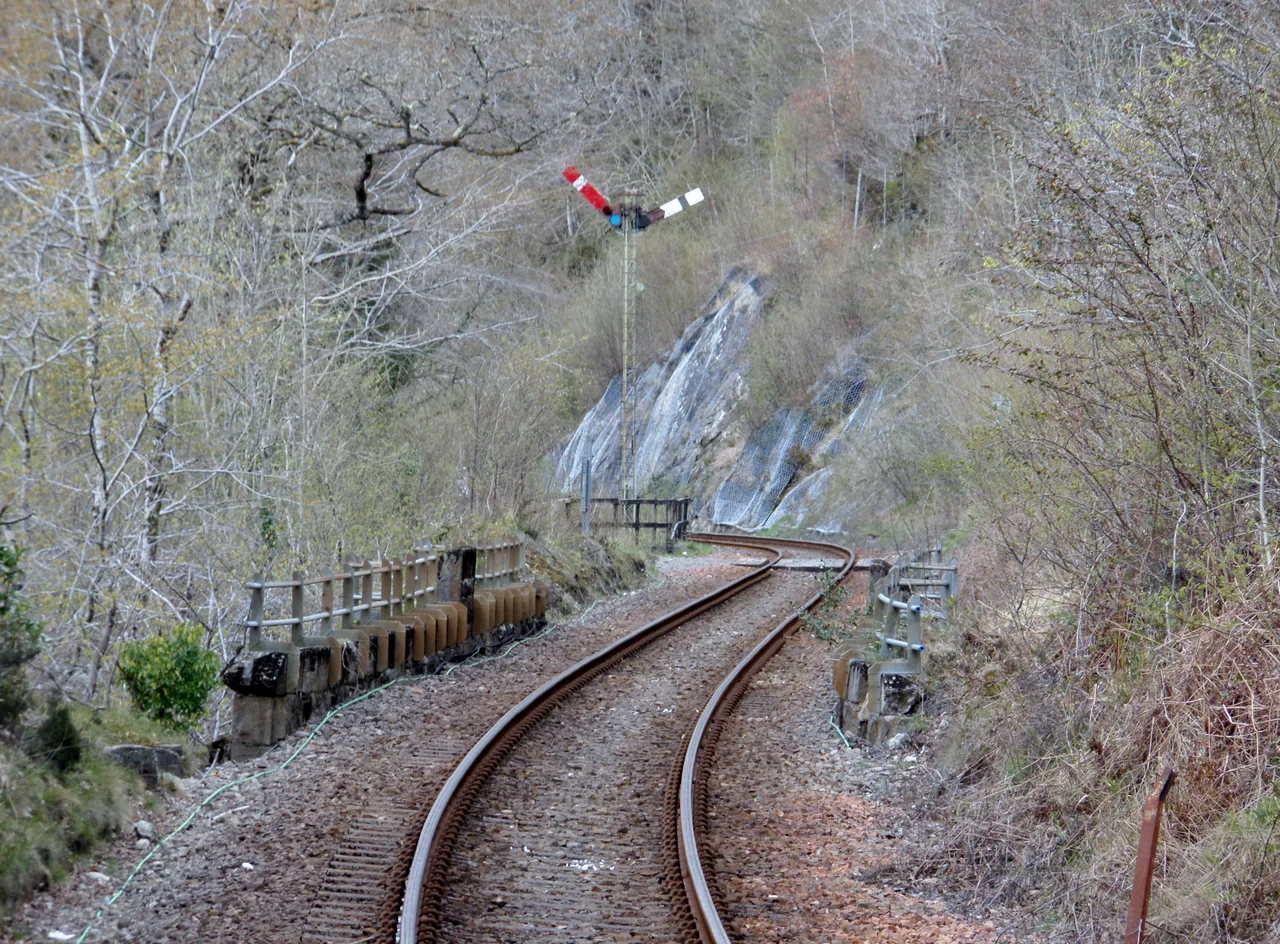

Pass of Brander stone signals
It is called Anderson's Piano, and the joke is that the wires hum in the wind like piano strings. Strung along the south side of the railway track through the Pass of Brander, between Loch Awe and Loch Etive, the wires form a four-mile fence at waist height across the steep slopes of Ben Cruachan. They are linked to seventeen semaphore signals. If a falling rock breaks any wire, every signal in both directions automatically drops to danger. The system was designed in 1881 by John Anderson, secretary of the Callander and Oban Railway, after a boulder hit a train in this same gorge. It is now 145 years old, entirely mechanical, and still in service - the oldest working trip-wire railway signalling system in the world.
The Problem With The Pass
The Pass of Brander is a narrow gorge cut by the River Awe between two mountain bulks - Ben Cruachan to the north, the hills of Glen Nant to the south. There is barely room for the river, a road, and a single-track railway, and the slopes of Ben Cruachan press straight up from the railbed at angles that ought to be unbuildable. The Callander and Oban Railway pushed through here in July 1880 because there was no easier route to Oban; the alternative was to go around Loch Awe entirely. Almost as soon as trains started running, boulders started falling. In 1881 a falling rock hit a train. John Anderson, the railway secretary, had a problem to solve - one with no obvious precedent, because nobody had built a railway through quite this kind of geology before.
Anderson's Solution
Anderson's idea was almost embarrassingly simple. String a fence of wires across the slope above the track. Connect the wires to the signal arms through a tension system that holds the signals in the clear position. When something heavy enough to be dangerous - a boulder, a rockfall, a tree torn loose by a storm - breaks the wires, the tension releases and the signals automatically fall to danger. There is no electricity involved. No sensors, no microprocessors. Gravity holds the signals up, the wire tension keeps gravity at bay, and the breakage of the wire is itself the alarm. Seventeen signals were installed, numbered 1 to 17, signal 1 at the Dalmally end. All but signal 9 stand on the south side of the line. All but signals 1 and 17 carry two semaphore arms - one for trains coming each way.
Why It Still Works
Modern railways use trip-wire systems too. Around the Rocky Mountains, around airports where bird strikes are a concern, you can find electrical trip wires connected to colour-light signals. They are sophisticated and they require power. Anderson's system requires nothing but tension, and tension is what gravity provides. The signal arms are held up by counterweighted linkages connected to the wire net. A break anywhere along four miles releases that linkage. There are failure modes: a wire that snaps in a storm without an actual rockfall sets the signals to danger, which is inconvenient but safer than the alternative. There are also limitations - the fall must break a wire to register, which means a rock that bounces in from above or below the wire fence can still hit the track without warning.
The 2010 Derailment
Which is what happened on 6 June 2010. A rockfall came down at the Falls of Cruachan station and onto the track, but it started below the wires - the rocks did not break the fence on their way down because they did not pass through it. A westbound train hit the rocks at speed. The locomotive derailed. The driver, who could see the rocks ahead on the rails just before impact, was praised for slowing the train with full emergency braking before contact. There were minor injuries but no fatalities, and the line was reopened after repairs and an extensive review of the Pass of Brander signalling. The system's limitation was understood. The signals were improved, but Anderson's Piano stayed. After 140 years it had earned its place.
Listening For The Strings
Train drivers know the system intimately. They know which signals are particularly prone to false alarms in high wind, which spots are most likely to see real falls. The signals themselves are kept in working order by Network Rail engineers who carry on a maintenance tradition that goes back through generations. The wires hum in the wind, which is presumably how Anderson's Piano got its name; in a strong westerly the whole installation can sing across the gorge. Tom Scott made a YouTube video about the system in 2020. The National Transport Trust recognised it as a piece of historic engineering of national importance. The trains keep coming. The wires keep watching.
From the Air
The Pass of Brander stone signals run along the south side of the railway track for about 4 miles through the Pass of Brander, centred at 56.399 N, 5.138 W, between Loch Awe (to the east) and the River Awe gorge leading to Loch Etive (to the west). Ben Cruachan rises to 3,694 feet immediately to the north of the railway. The signals themselves are too small to spot from cruising altitude, but the railway line and the Pass of Brander gorge are clearly traceable - the West Highland Line runs along the north shore of Loch Awe and through the pass. Oban Airport (EGEO) at Connel is 8 nm west. Falls of Cruachan station and the Cruachan power station visitor centre sit in the same gorge. The whole pass funnels rapid weather changes between Loch Etive and Loch Awe.
Nearby Stories
- Easdale 5.5 km away
- Buchanan Castle 6.2 km away
- Cowal 6.8 km away
- Clachaig Inn 7.4 km away
- Loch Katrine 9.9 km away
- Lochaber 23 km away
- Ben Alder 25 km away
- Jura Distillery 34 km away