
Passaleão Incident
By the summer of 1849, notices were circulating in Guangzhou offering a reward for the head of Macau's Portuguese governor. The man who had earned that price was João Maria Ferreira do Amaral — one-armed, aggressive, and determined to sever Macau's remaining dependencies on Chinese authority. He had expelled the imperial customs houses. He had ordered Chinese residents to pay taxes to Portugal rather than the mandarins. He had proposed running a road through Chinese graves. And on 22 August, riding outside the Barrier Gate to deliver alms to an elderly Chinese woman he was personally supporting, he was killed.
The Governor Who Pushed Too Hard
Ferreira do Amaral had arrived in Macau committed to a single goal: making Portuguese sovereignty unambiguous. For centuries, Macau had operated in a zone of contested authority — technically Portuguese, but with Chinese customs officials collecting duties, Chinese mandarins governing Chinese residents, and a complex web of arrangements that suited no one perfectly but offended no one fatally. Amaral found this intolerable. Beginning with the revolt of the faitiões in October 1846, his years in office were a systematic dismantling of Chinese administrative presence in the territory. By March 1849 he had forcibly expelled the last mandarins' customs houses; by spring, foreign legations of Spain, Britain, and the United States had settled in Macau while awaiting access to China proper, a tacit acknowledgment of Amaral's success in establishing the city as an independent entrepôt. His methods, however, had made him a target. Placards in Canton offered money for his head.
Ambush at the Barrier Gate
On the morning of 22 August, Amaral and his aide-de-camp, Lieutenant Jerónimo Pereira Leite, passed through the Portas do Cerco on what was apparently a personal errand — the governor was in the habit of providing for a destitute Chinese woman living near the gate. They were only a few hundred yards inside the gate when a man frightened Amaral's horse with a bamboo pole. The governor, who had lost one arm previously, gripped the reins with his teeth to free his remaining hand for his pistol. He did not manage to draw it. Seven men, led by Shen Zhiliang and armed with bladed weapons, pulled him from his horse. Leite, also armed, was unhorsed and fled on foot. The attackers cut off Amaral's head and his remaining hand — the proof they needed to collect the reward in Guangzhou. Portuguese authorities followed a trail of blood back through the gate to recover what remained of the governor's body.
Thirty-Six Men Against a Fort
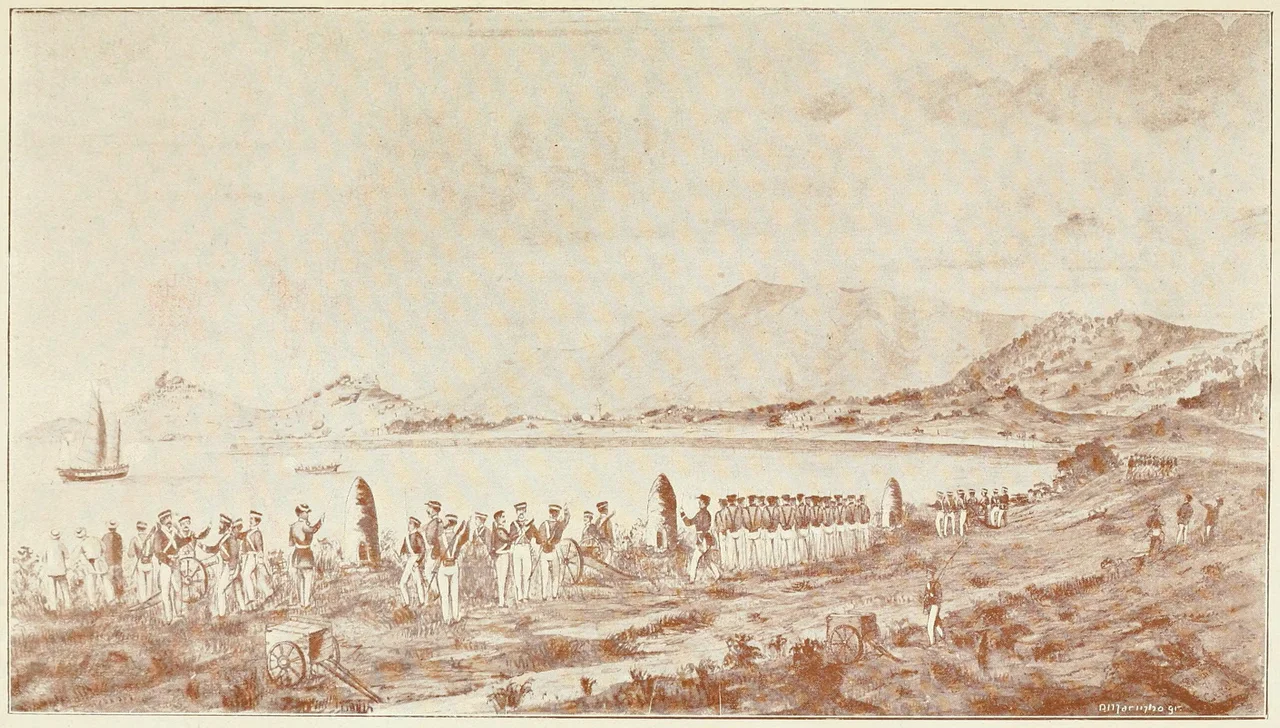
In the days after the assassination, the Chinese moved troops toward the city, sensing that the Portuguese garrison was weakened and leaderless. On 25 August, the guns of the Qing imperial fort of Latashi — known to the Portuguese as Passaleão, roughly one mile north of Macau — opened fire on the city walls. The Portuguese returned fire but made little impression on the stone fortification. The Chinese held approximately 400 men and 20 cannons. The Portuguese had far fewer. Into this imbalance stepped Vicente Nicolau de Mesquita, an artillery sub-lieutenant who volunteered to lead a company of about thirty-six men and a howitzer against the fort. The howitzer got off a single shot before its carriage broke. That shot panicked the Chinese garrison. Mesquita led his men in a charge. The Chinese troops fled. Now in possession of a fort he could not hold with three dozen soldiers, Mesquita spiked the guns, blew the powder magazines, and withdrew. One Portuguese soldier was wounded. About fifteen Chinese soldiers died. The fort was taken, destroyed, and the threat neutralized. Mesquita was not immediately recognized for the action; his reputation as a hero would grow in the following century.
The Fleet That Destroyed Itself
In the aftermath, the Portuguese position firmed quickly. Britain, France, and the United States offered support. Reinforcements arrived from Portuguese India and Lisbon. Xu Guangjin, the Viceroy of Liangguang, ordered the capture of Shen Zhiliang to satisfy the Portuguese — he was caught in Shunde County, along with Amaral's head and arm, on 12 September. Xu privately believed Amaral had deserved his fate, but had Shen Zhiliang executed at Qianshan on 15 September nonetheless. Negotiations continued through the winter, and in January 1850 Amaral's remains were formally returned. Portugal then assembled a naval flotilla for a punitive expedition: the frigate Dona Maria II, two corvettes, and several armed lorchas gathered in the harbour on 29 October 1850 to fire a salute honoring King Ferdinand II on his birthday. After the salute, moments before the local elites were to board the Dona Maria II for the celebration, the frigate exploded. The sabotage was the work of the magazine keeper, who harbored a personal grievance against the captain. Nearly 200 men died. The punitive expedition was cancelled. A memorial to those who died in the Dona Maria II explosion, erected in 1880, still stands by the site of the old fort in Taipa — the war that ended before it began, marked in stone.
From the Air
The Passaleão incident unfolded across the northern end of the Macau Peninsula, with the Barrier Gate (Portas do Cerco) at approximately 22.2158°N, 113.5492°E and the former Latashi/Passaleão fort site further north. The incident's memorial stands in Taipa, to the south on the reclaimed Cotai land. Recommended viewing altitude is 2,000–3,000 feet to take in the full peninsula and the narrow land border with Zhuhai, China, visible to the north. The nearest airport is Macau International Airport (VMMC), approximately 2.5 nautical miles south of the Barrier Gate on Taipa Island.
Nearby Stories
- 2024 Shenzhen Stabbing 0.8 km away
- Lantau Peak 1.5 km away
- Kweilin Incident 2.4 km away
- Taishan City 7 km away
- Wanshan Archipelago Campaign 38 km away
- Hong Kong 12 68 km away
- Battle of Nanpeng Island 82 km away
- Erhai Lake 1335 km away