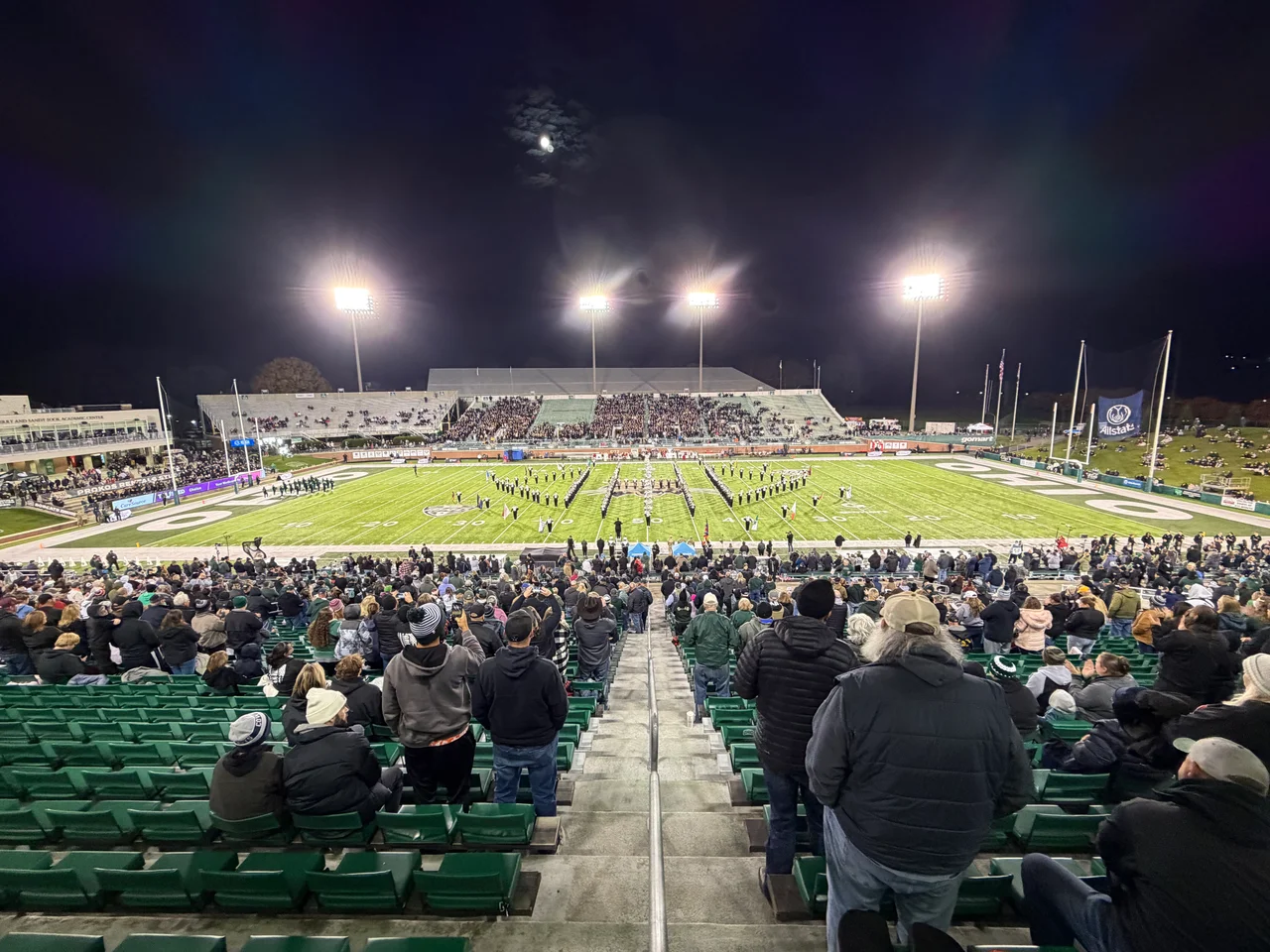

Peden Stadium
One hundred eighty-five thousand dollars. That was the construction cost in 1929 for what is now the oldest college football venue in the Mid-American Conference and the twenty-ninth oldest college stadium in the country. The original capacity was twelve thousand, with simple grandstands on either side of the field and the Hocking River curling along the south end. It was called Ohio Stadium then - which is confusing now, since the other Ohio Stadium an hour and a half away in Columbus is where Ohio State plays in front of 102,000 fans. Athens kept its original size and most of its original character. The capacity has roughly doubled, the technology has been updated, but the bones of the place are still 1929: a small Depression-era college stadium that the Bobcats simply never outgrew the way Ohio State did.
Don Peden
Don C. Peden served as a coach and athletic director at Ohio University for twenty-seven years, helping to found the Mid-American Conference in the 1940s and shaping intercollegiate athletics regionally and nationally. Born in Kewanee, Illinois, Peden died in 1970 at the age of 71. The stadium was renamed for him after his death. In August 2022, the playing surface itself got a second name: Frank Solich Field, honoring the coach who led Ohio football from 2005 through 2021 and built the program's longest sustained run of success. The full name now is Frank Solich Field at Peden Stadium - a clumsy double honor that captures something true about how college football stadiums accumulate dedications faster than they accumulate seats.
Eisenhower Landed Here
In the 1960s, when President Dwight Eisenhower visited Ohio University, his helicopter landed at Peden Stadium - the only place on campus with a flat, secure open space large enough to handle the aircraft and the security perimeter. Both Lyndon Johnson and Barack Obama also used the stadium as a staging area during their campus visits. It is one of the small infrastructural truths about American campuses that the football field doubles as a presidential helipad. Beyond presidents, the stadium has hosted high school football games, state playoff games, 5K runs that start at the 50-yard line, and concerts. The annual 'Yell Like Hell' homecoming pep rally fills the lower bowl. The space is used most weekends in fall, even when the Bobcats are not playing.
Capacity, Victory Hill, and the Sook Center
The listed seated capacity is 24,000, but the official record attendance numbers all eclipse it - because of Victory Hill, the grass embankment at the north endzone where standing-room crowds spread out to watch the game from above. The Perry and Sandy Sook Academic Center, built at the north endzone in 2018 and designed by Ohio-based MSA Sport, added 26,000 square feet of facilities: an academic advising center for student athletes, classrooms, hospitality areas, and a large observation deck overlooking the field. The Sook Center pushed potential standing capacity to roughly 28,000. In September 2025, the Bobcats set a stadium attendance record beating West Virginia 17-10 in front of a crowd of 26,740.
Football's 150th Anniversary
On November 6, 2019, Peden Stadium hosted the official game commemorating college football's 150th anniversary. The selection made sense in a way that anyone outside the sport might find strange: the first intercollegiate football game in history was played in 1869, and college football celebrated the milestone with a game between Ohio and Miami - a rivalry that traces back to the earliest decades of the sport in the Midwest. Ohio won 24-21 in front of a packed Peden Stadium with national television coverage. The choice of venue acknowledged what the building represents: a small college stadium that has been in continuous use since the Hoover administration, in a sport that has otherwise mostly moved on from 24,000-seat venues.
Flying Over the Old Bowl
From the air, Peden Stadium is a small football bowl pressed against the Hocking River on the south edge of the Ohio University campus. The river runs immediately past the south endzone, with the Walter Fieldhouse and other athletic facilities adjacent. The brick concourses, the Sook Center at the north end, the open Victory Hill grass embankment - the whole assembly fits a compact rectangle. North of the stadium, South Green's residence halls rise. Across the river, the forested foothills begin. From cruising altitude, the geometry of small-college football is visible at a glance: a stadium proportional to the school, in a town proportional to the school, on a river that defines where the campus could grow and where it could not.
From the Air
Located at 39.32°N, 82.10°W on the southern edge of the Ohio University campus, immediately along the Hocking River. The football bowl shape with the Sook Center at the north endzone is visible against the surrounding residence halls and athletic facilities of South Green. Nearest airport: Athens-Albany (KUNI) about 6 nm southwest. Best photographed from 2,000-3,500 feet AGL, where the stadium and the river bend define the south side of campus.
Nearby Stories
- Julia-Ann Square Historic District 1.9 km away
- Lakin State Hospital 7.7 km away
- Ratcliffe Mound 9.8 km away
- Burning Springs Complex 21 km away
- Hardin Village Site 41 km away
- The Y-Bridge of Zanesville 44 km away
- Columbus: The Test Market Where America Tries Things First 56 km away
- West Virginia Penitentiary 81 km away