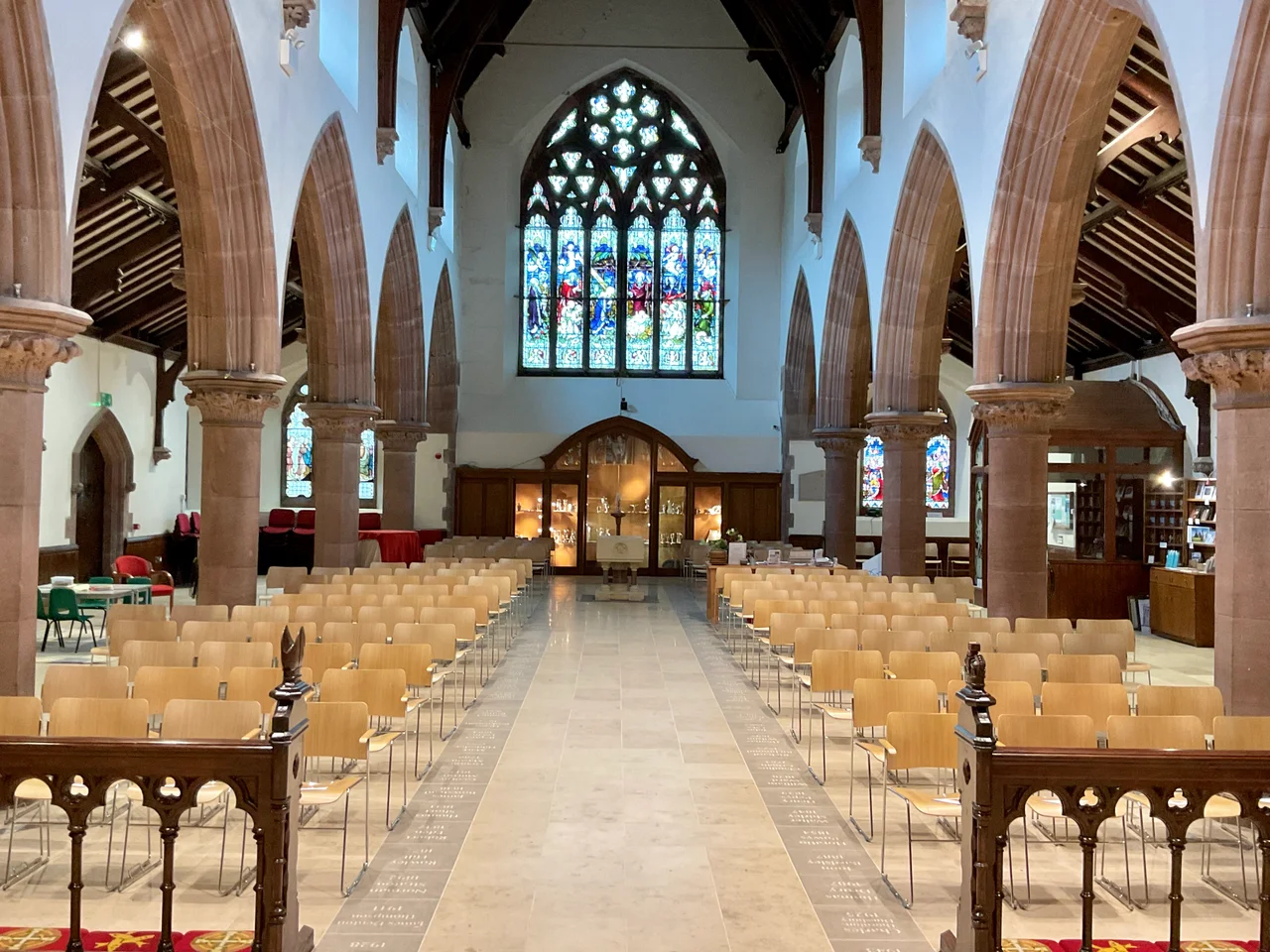

Peel Cathedral
John Betjeman once called the Bishop of Sodor and Man the luckless prelate whose cathedral was a beautiful ruin of green slate and red sandstone on an islet overlooking Peel. He was right, more or less, until 1980. For 96 years a perfectly intact stone church had stood in central Peel, built specifically with the hope of becoming the diocesan cathedral. For 96 years the title kept going elsewhere, then nowhere at all. On All Saints' Day 1980 the wait ended. The Kirk German Parish Church became, by Act of Tynwald, the cathedral church of the Diocese of Sodor and Man.
The Saint With the Confusing Name
The cathedral is dedicated to St German of Man, a Celtic missionary and holy man who lived from about 410 to 474. He is not to be confused with Germanus of Auxerre, a near-contemporary Gallic bishop, an entirely different person whose name has been confused with St German's for centuries. St German's Day is celebrated each year on 13 July. He gave his name to the medieval cathedral built sometime in the 12th century inside the walls of Peel Castle, when St Patrick's Isle was held by Norse kings. That cathedral followed the Sarum Rite, the form of worship then used throughout much of the British Isles. Around 1333 the Lords of Man refortified St Patrick's Isle and occupied the church as a fortress. William Le Scroop repaired the cathedral in 1392.
The Ruin That Made the New Church Necessary
By the 18th century the old cathedral on St Patrick's Isle was in ruin. After lengthy debate about who owned the site and what should happen to it, the decision was made not to rebuild. Instead, in 1879, work began on a new church in central Peel, intended from the start to replace the cramped St Peter's Church in Peel's market place. The Bishop, Rowley Hill, drafted a Cathedral Bill to make the new building the diocesan cathedral. He died before the Bill made its final reading in Tynwald, and his successor abandoned it. The new church was finished in 1884 as a parish church, not a cathedral. For nearly a century afterwards, the title moved around: Bishop Straton consecrated his own chapel at Bishopscourt as a pro-cathedral in 1895, and by 1960 St Nicholas' Chapel was still serving as a Cathedral Chapel.
All Saints' Day, 1980
The pro-cathedral arrangement ended abruptly when Bishopscourt was sold in 1979. The diocese was suddenly without a cathedral, and the question could no longer be deferred. After public consultation, the Kirk German Parish Church was chosen. On All Saints' Day, 1 November 1980, in a Tynwald-authorised service, the parish church became the cathedral of the Diocese of Sodor and Man. The bishop served as dean ex officio, an arrangement that persisted until 15 October 2011, when the vicar of the parish became dean instead. This is thought to be the historical arrangement that had existed from the 12th century until the late 19th century. St German's Cathedral is the mother church of a diocese that today consists only of the Isle of Man itself.
A Royal Visit and a Rainbow Flag
In July 2015, Anne, Princess Royal, attended a thanksgiving service at Peel Cathedral as patron of the development campaign. The service also marked a rebrand: Peel Cathedral was henceforth to be known as Cathedral Isle of Man. The following year, after the mass shooting at Pulse, a nightclub in Orlando, Florida, the cathedral displayed a rainbow flag at a candlelit vigil for the victims, to show solidarity with the LGBT community. The vigil was a quiet, public act in an island town more often associated with motorcycle racing than with cathedral statements. In October 2024, Princess Anne returned for another thanksgiving service, this time for the reordering of the cathedral. The seating is now fully adaptable for multiple uses, and there is underfloor heating.
Names Beneath the Floor
Beneath the new flagstones of the reordered cathedral floor lie the names and signatures of hundreds of local residents. They wrote them on terracotta tiles in 2024, as part of a time capsule buried during the building's redevelopment. It is the kind of detail that gives the building its present character. Across the harbour on St Patrick's Isle, the medieval cathedral that gave Peel its diocese remains: roofless red sandstone walls, green slate floor open to the wind, walked through each summer by visitors paying castle admission. Walk back across the bridge into town and the new cathedral is a working parish church with a dean, an organ scholar, a chapter of canons, and several hundred living names underfoot. Both belong to Peel. Both belong to one of the smallest dioceses in the Anglican Communion.
From the Air
Peel Cathedral (Cathedral Isle of Man) sits at 54.222°N, 4.691°W in the centre of Peel on the west coast of the Isle of Man, in the parish of German. From 1,500 to 3,000 ft AGL the cathedral appears as a Victorian Gothic Revival church with a square tower among the streets of Peel, distinct from the larger ruined medieval cathedral inside Peel Castle on St Patrick's Isle just to the west. Peel harbour separates the two. Nearest airport is Isle of Man (EGNS) Ronaldsway, about 17 nm to the south-southeast. Approach offers good views west to the Mournes in Northern Ireland in clear conditions.
Nearby Stories
- Ballywalter 14 km away
- Pasages (steam trawler) 15 km away
- SS Georgetown Victory 19 km away
- Celtic Array 31 km away
- Raeberry Castle 34 km away
- German submarine U-1051 36 km away
- St Bees Lifeboat Station 49 km away
- PS Rothsay Castle 73 km away