.jpg)
Penrhyn Quarry Railway
Before there were locomotives, before there was even much of an industrial railway anywhere on earth, there was a line of oval iron rails running from the slate quarry at Bethesda down to the wharves at Port Penrhyn. The first slate train rolled along it on 25 June 1801. The horses that pulled the wagons could not have known they were participating in something that would remake the world, but they were. The Penrhyn Quarry Railway was among the very first overground narrow-gauge railways ever built, and the principles worked out on its six-mile route would soon be exported wherever there were mountains and minerals.
The Engineer's Idea
William Jessop, the great canal and railway engineer of the age, looked at the Penrhyn quarry in 1793 and saw a problem the country was solving by force. Slate left the workings on horseback, panniers strapped to the animal's flanks, taking slow and difficult mountain paths down to the sea. Jessop proposed a tramway. His partner Benjamin Outram was already building the Little Eaton Gangway in Derbyshire, and Benjamin Wyatt, the Penrhyn estate manager, was the brother of Samuel Wyatt who worked on that project. The connections lined up. Construction began on 2 September 1800 under Benjamin Wyatt's direction. Within ten months the first train ran. The line cost £170,000 to build, an enormous sum, but the economics were unanswerable. Transport that had cost four shillings a ton by horse now cost one shilling by rail.
Inclines and Iron
The early railway was a hybrid contraption that suited the terrain. Horses pulled the wagons on level stretches. Gravity took them down three balanced inclines, Port at the seaward end, Dinas northeast of Tregarth, and Cilgeraint above Bethesda. Heavy loaded wagons going down hauled empty wagons coming up, the cable passing over a vertical winding drum at the top. The longest incline ran two hundred and twenty yards. Wyatt's oval iron rails, idiosyncratic by modern standards, lasted thirty years until they were replaced with conventional T-rails in 1832. The gauge, somewhere between modern measurements depending on whether you measured between the rail centres or the rail edges, was narrow enough to suit the cramped quarry workings and wide enough to take useful loads. It became one of the defining narrow gauges of the British industrial railway era.
Steam Arrives, and Names That Lasted
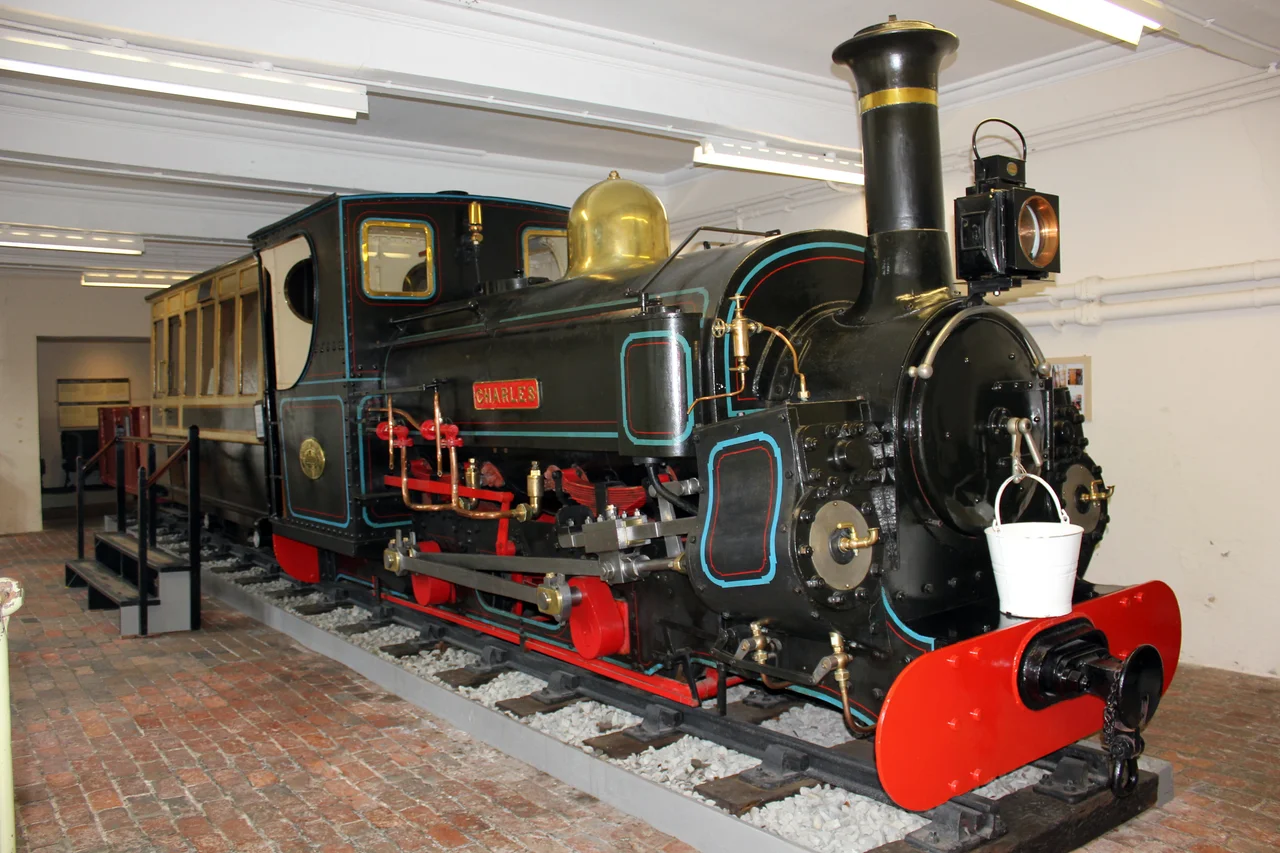
By the late 1860s the horse-and-gravity arrangement was struggling. Charles Easton Spooner, the man who had put steam locomotives on the nearby Festiniog Railway, wrote to Lord Penrhyn proposing the same for Penrhyn. The 1874 strike delayed matters but did not stop them. In 1878 contractor Richard Parry and engineer Robert Algeo began building a completely new line that took a longer, gentler route to avoid the inclines. The first De Winton locomotives, with their distinctive horizontal boilers, were not powerful enough for the traffic. In 1882 Hunslet of Leeds delivered Charles, a small 0-4-0 saddle tank, and Charles changed everything. Blanche and Linda followed in 1893 to the same basic design, and these three names became the railway. Linda and Blanche still run today on the Ffestiniog Railway, where they went on loan in 1962 and were sold outright in 1963. They have been rebuilt and modified far beyond their original specification, but their numbers are intact and their work continues.
Quarrymen's Carriages
The line carried slate, principally, but it also carried men. Workmen's trains ran morning and evening, dropping the quarrymen at the workings and bringing them home. The carriages were not the polished saloons of the main-line railways. They were open trucks with bench seats and lettered identifiers running A through P, sixteen of them built between 1878 and 1908. No roofs. No doors. No springs. In Welsh weather, and there was a lot of Welsh weather, the men covered themselves with empty sacks. Twenty-four to a carriage, at a pinch. Lord Penrhyn rode in a private saloon that has survived in preservation at the Penrhyn Castle Railway Museum. The contrast between his comfort and his workforce's exposure was not subtle, and the strikers of 1900 to 1903 had not forgotten it. The workmen's service ran until 9 February 1951.
Closure and a Second Life
The slate industry recovered briefly after the Second World War, then collapsed under cheap imports and new roofing materials. Road haulage finished what economics started. The last slate train ran in June 1962, with a few unofficial movements lingering into the summer of 1963. The track came up in 1965 and was sold to the Ffestiniog Railway, which used it to extend its own restoration. In 2012 a section of the original alignment was rebuilt at Felin Fawr in Bethesda by Penrhyn Quarries Ltd. Steam galas ran from 2016. The original Hunslet George Sholto, brought back to celebrate the line's fiftieth anniversary of closure, hauled passengers along restored track. Then in July 2017 the operation shut down abruptly. The rolling stock was removed. The line's second act lasted barely five years. The first lasted a hundred and sixty-one.
From the Air
Penrhyn Quarry Railway's original route runs from Port Penrhyn on the coast at 53.23 north 4.13 west, southeast through Tregarth and the Cegin valley, ending at the Penrhyn quarry workings near Bethesda at 53.18 north 4.07 west. The restored section at Felin Fawr sits at the quarry end. Recommended viewing altitude 2,000 to 4,000 feet to trace the alignment along the western flank of the Ogwen valley. The line follows the contours and reads clearly from the air, especially the gentle horseshoe bend at Dinas. Nearest airports EGCK Caernarfon to the south, EGOV Valley on Anglesey to the northwest.
Nearby Stories
- Tudweiliog 3.6 km away
- Denbigh Castle and Town Walls 6.4 km away
- Rhoscolyn Lifeboat Station 7.6 km away
- Butlin's Pwllheli 20 km away
- East–West Interconnector 20 km away
- New Brighton Lifeboat Station 31 km away
- Battle of Oswestry 31 km away
- Celtic Array 44 km away