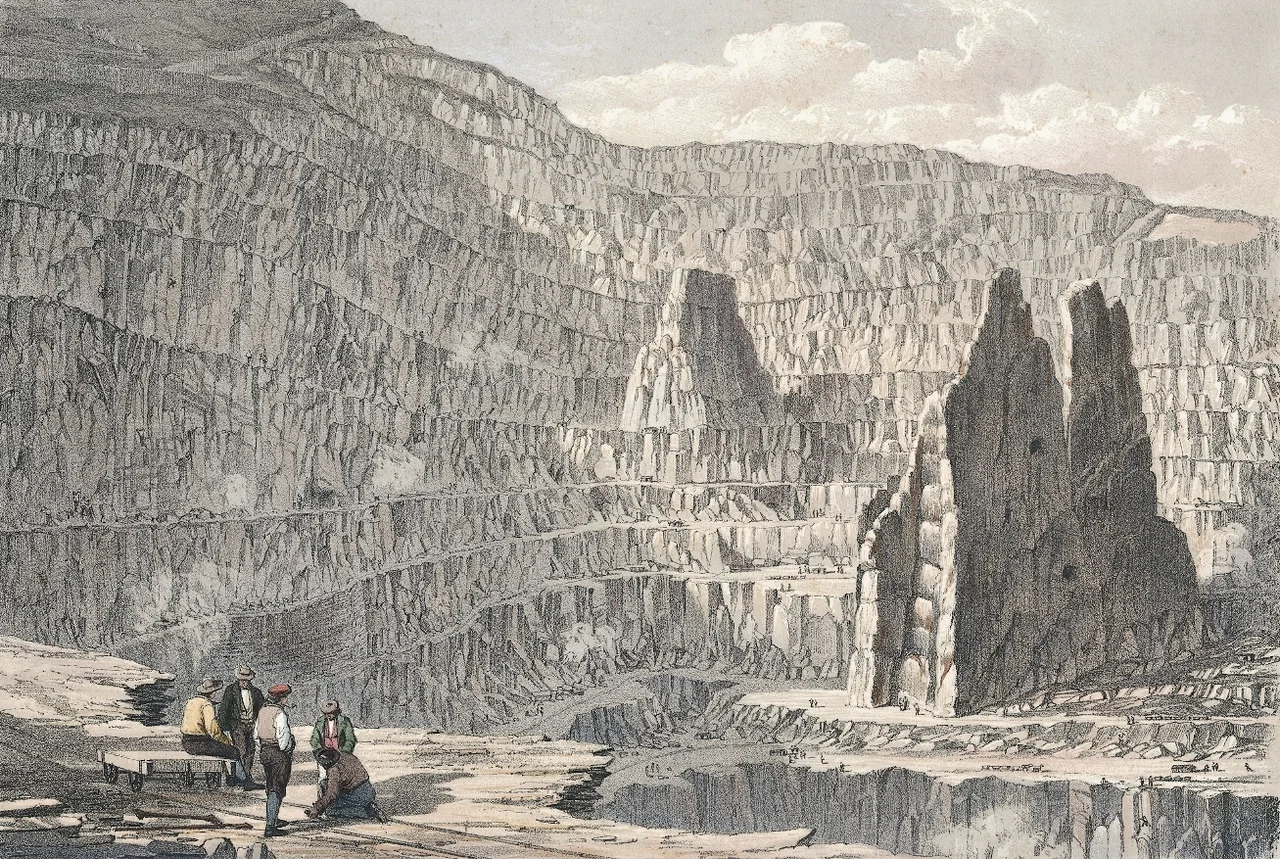

Penrhyn Quarry
From the air it looks like a wound. A great stepped pit nearly a mile long and twelve hundred feet deep, hacked into the western flank of the Ogwen valley, with grey terraces stacked like the rings of an inverted ziggurat. The Penrhyn quarry was the largest slate quarry in the world at the end of the nineteenth century, and almost three thousand men worked it. The slate that roofed Victorian Britain, that travelled to Germany and America and Argentina, came out of this hole. So did the wealth that built Penrhyn Castle. So did three years of bitter silence between neighbours that has not entirely faded after a hundred and twenty years.
Sugar, Slate, and a Title
Slate had been worked at Penrhyn since at least 1570, when a Welsh poem mentioned the quarry, but it was Richard Pennant who industrialised it from the 1770s onwards. Pennant did not make his fortune in Wales. His family fortune came from Jamaica, where his ancestors had built up four or five sugar plantations worked by enslaved Africans. By 1805 Richard Pennant owned nearly a thousand enslaved people across his Jamaican estates. He never visited the island. In his letters to his managers he referred to those people as chattels, grouping them in the same word with cattle. He chaired the West India Committee in Parliament and led the organised opposition to abolition. The peerage that made him Baron Penrhyn in 1783 was paid for by sugar that was paid for by forced labour. He brought that money home to Wales and sank it into slate. The quarrymen of Bethesda knew where the capital came from. The strikers of 1900 would say so out loud.
A Vote, a Sacking, a Warning
The relationship between the quarry's owners and its workers was unequal from the start, and the owners did not hide it. In 1868, eighty quarrymen were sacked for failing to vote for George Douglas-Pennant, the owner's son, in the general election. The secret ballot was not yet law. The Pennants kept lists. The lesson was clear enough. So was the lesson eleven months long that the men taught back in 1896, when the first strike forced limited concessions. Both sides knew the next dispute would be larger.
The Great Strike
On 22 November 1900, the second strike began. It lasted three years. It is still the longest industrial dispute in British history. The conflict was not only about wages and safety, though it was about those things. It was a clash between a wealthy Anglican English-speaking landlord and a workforce of Nonconformist Welsh-speaking quarrymen, many of whom spoke no English at all. Lord Penrhyn could close the quarry. He could call the workforce ungrateful. He could not close the chapels or the language. The strikers and their families wrote four words on cards and placed them in their front windows. Nid oes bradwr yn y tŷ hwn. There is no traitor in this house. The houses that did not show the card were the houses of the men who had crossed the line, the bradwyr. Streets divided. Chapels divided. Welsh choirs toured England raising relief funds. William John Parry of the North Wales Quarrymen's Union organised a co-operative to take over Pantdreiniog, Moel Faban, and Tanybwlch quarries and employ the locked-out men. After three years the men returned beaten, the union broken. The damage to the Welsh slate industry never healed. The damage in Bethesda took longer.
Memory and Markers
In 2003, on the centenary of the strike's start, the Transport and General Workers' Union unveiled a plaque to the strikers. Modern historians have moved beyond the union ledgers and the management accounts to recover the women's lives, the families who chose hunger over capitulation, the children who grew up knowing which doors had carried the card and which had not. The strike lives in song and in chapel hymnody and in the way Welsh historians talk about Lord Penrhyn. The National Trust now manages Penrhyn Castle and confronts visitors with the slavery and the strike side by side, telling the story the family for two centuries preferred to tell differently.
The Quarry Now
Alfred McAlpine bought the operation in 1963 and ran it until 2007. The Irish businessman Kevin Lagan then bought it and renamed it Welsh Slate Ltd, before the Lagan Group was itself absorbed into the Breedon Group in 2018. The workforce is around two hundred. In 2019 the International Union of Geological Sciences designated Welsh slate a Global Heritage Stone Resource. In 2021 UNESCO inscribed the slate landscape of northwest Wales, with Penrhyn at its heart, as a World Heritage Site. The flooded lower workings, no longer needed for extraction, became Zip World. The Velocity 2 zip line crosses the abandoned pit at over a hundred miles an hour. Tourists fly along on a wire above the place where their great-grandfathers split slate by hand. It is one of the strangest second acts in industrial heritage. It is also, perhaps, the only second act available.
From the Air
Penrhyn quarry sits at 53.17 north, 4.07 west, on the western flank of the Ogwen valley above Bethesda. The pit is unmistakable from the air, a long stepped excavation roughly a mile in length running northwest to southeast. Recommended viewing altitude 3,000 to 5,000 feet for the full scale of the working. The terraced cliffs and the flooded lower levels are visible in clear weather. Mountain weather can come in fast off the Glyderau and Carneddau. Nearest airports EGCK Caernarfon to the south, EGOV Valley on Anglesey to the northwest, and EGNR Hawarden further east.
Nearby Stories
- Tudweiliog 3.6 km away
- Denbigh Castle and Town Walls 6.4 km away
- Rhoscolyn Lifeboat Station 7.6 km away
- Butlin's Pwllheli 20 km away
- East–West Interconnector 20 km away
- New Brighton Lifeboat Station 31 km away
- Battle of Oswestry 31 km away
- Celtic Array 44 km away