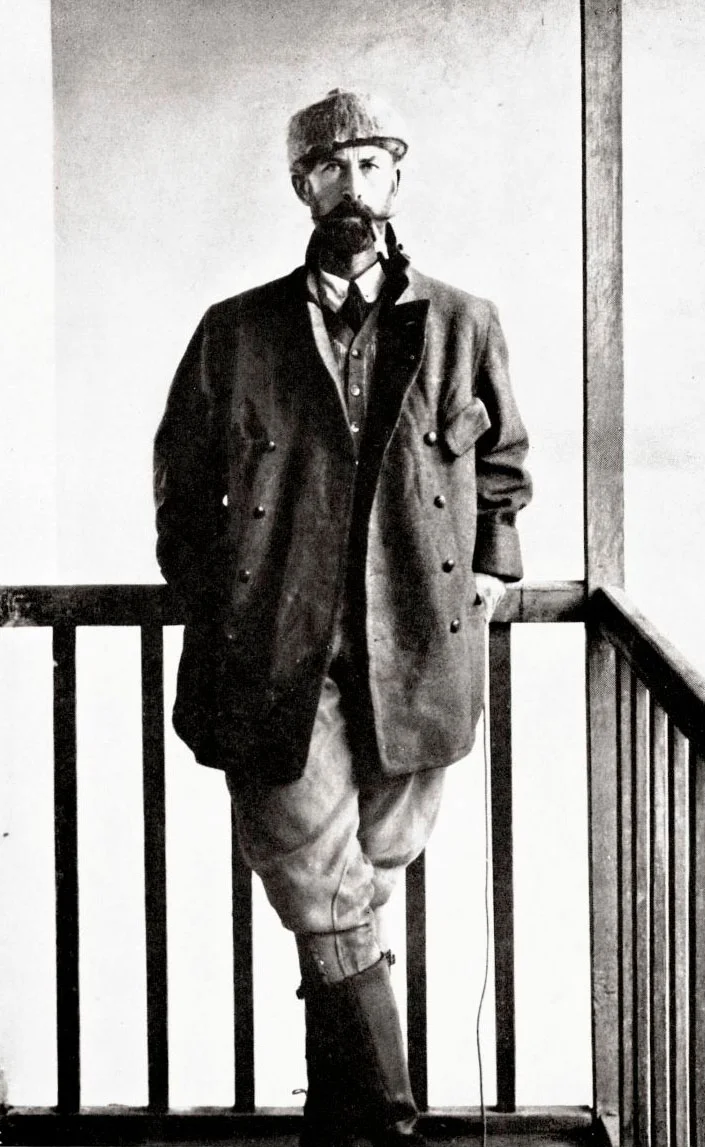

Percy Fawcett
The final letter went out on 29 May 1925, carried by a native runner to be forwarded to Percy Fawcett's wife in England. He wrote from a place he called Dead Horse Camp, somewhere in the Upper Xingu region of Mato Grosso. He wrote that he and his eldest son Jack and Jack's friend Raleigh Rimmel were about to push into unexplored territory. He wrote that his wife should not worry - "You need have no fear of any failure." Then the three men walked east from Dead Horse Camp, into the territory of peoples they had been warned not to enter, carrying no gifts and barely any supplies. No European ever saw them again. The mystery of what happened to Colonel Percy Fawcett has produced a century of expeditions, claims, counterclaims, bones that were not his bones, a signet ring found in a pawn shop, and at least one person who died trying to solve it.
The Officer Explorer
Fawcett was born on 18 August 1867 in Torquay, Devon, into old Yorkshire gentry who had made money as shipping magnates in the East Indies. His father was a Fellow of the Royal Geographical Society. His elder brother Edward Douglas Fawcett wrote adventure novels and practiced Eastern occultism. Percy attended the Royal Military Academy at Woolwich and was commissioned as a lieutenant of the Royal Artillery in 1886. He served in Hong Kong, Malta, and Ceylon. At Newton Abbot Proprietary College he had been schooled alongside Bertram Fletcher Robinson, a future mutual friend of Arthur Conan Doyle. Fawcett joined the RGS in 1901 to study surveying and mapmaking, later working for British Secret Service in North Africa. He became friends with Conan Doyle and Rider Haggard - the former would use Fawcett's Amazonian field reports as the template for The Lost World.
Seven Expeditions
In 1906 the Royal Geographical Society sent Fawcett to Brazil to map a stretch of jungle bordering Bolivia. The RGS had been hired as a neutral party, unencumbered by national interests. Fawcett arrived in La Paz in June 1906. He would return to South America seven times between 1906 and 1924, tracing river sources, charting unexplored jungle, and reporting back to the Society. He claimed to have shot a 62-foot anaconda in 1907, and was ridiculed by zoologists. He reported double-nosed Andean hunting dogs that scientists later confirmed actually exist. He reported giant spiders he called Apazauca and giant peanuts that were almost certainly Arachis nambyquarae. He treated the indigenous peoples he encountered mostly with courtesy, sharing gifts and moving patiently. He came back to Britain in 1914 to serve as an artillery commander in Flanders, was mentioned three times in Haig's dispatches, and was awarded the Distinguished Service Order in 1917. He returned to the jungle after the war.
The Lost City Of Z
By 1914 Fawcett had developed his theory about a lost civilization hidden in the Mato Grosso. He called it Z - just the letter, spoken Zed. His evidence was partly documentary: a manuscript housed in the National Library in Rio de Janeiro, known as Manuscript 512, apparently written in 1753 by a Portuguese bandeirante who claimed to have found the ruins of an ancient city with arches and hieroglyphics somewhere in the Bahia sertão. The manuscript gave no specific location. Fawcett believed it. He also believed, more idiosyncratically, that a complex civilization had existed in the Amazon, that isolated ruins might still survive, and that he was personally destined to find them. He carried a jade statue with inscriptions on its chest and feet. He told a Brazilian general, Ramiro Noronha, that the statue gave him irresistible supernatural power over the indigenous peoples of the Amazon - a claim that says more about Fawcett than it does about the statue. This was not pure science. It was obsession bound up with Edwardian occultism and the dream of Atlantis.
Dead Horse Camp And After
On the 1925 expedition Fawcett brought his eldest son Jack, who was in his early twenties, and Jack's friend Raleigh Rimmel. Two Brazilian laborers, eight mules, two horses, and two dogs went with them initially. Fawcett sent the laborers back. From Dead Horse Camp the three men walked east, into the territory of the Kalapalo, the Arumás, the Suyás, and the Xavantes. The Kalapalos were the last people to see them alive. They had been Fawcett's hosts at a nearby village, had warned him that the tribes to the east would kill him, and had watched Fawcett's campfire smoke each evening for five days after the three men walked away - before the smoke stopped appearing. The explorer John Hemming, who knows the region better than almost anyone, believes the party was simply too small to survive and had offended their hosts by arriving empty-handed, having lost their gifts in a river mishap. The most commonly repeated account - conveyed through Orlando Villas-Bôas, the Brazilian activist for indigenous peoples - is that a Kalapalo chief named Izarari killed all three men with a club after an argument. The Kalapalos today deny this. The truth is probably simpler and sadder: three outsiders pushed into country they did not understand, and the country did what country does.
A Century Of Searching
The RGS formally declared Fawcett lost in January 1927. The searches began immediately. In 1927 George Miller Dyott claimed to have found evidence of Fawcett's death at the hands of the Aloique - a claim most scholars found unconvincing. Aloha Wanderwell tried to land her seaplane on the Paraguay River in 1930-31 and crashed, living with the Bororo people for six weeks before flying back empty-handed. In 1951 Villas-Bôas produced what he said were Fawcett's bones; later scientific analysis showed they were not. In 1979 Fawcett's signet ring turned up in a pawnshop, suggesting the possibility of murder by bandits rather than indigenous combatants. In 1998 the English explorer Benedict Allen interviewed the Kalapalo elder Vajuvi, who denied any tribal involvement. In 2005 David Grann of The New Yorker visited the Kalapalo and heard their oral history - that Fawcett and his party had left heading east despite warnings, and the "fierce Indians" in that direction had killed them. Grann's 2009 book The Lost City of Z made the story famous to a new generation. A feature film followed. What has not come, and likely never will, is certainty.
From the Air
Coordinates: 11.72 S, 54.58 W (approximate location of Dead Horse Camp, Mato Grosso). Remote region of the Upper Xingu with very limited aviation infrastructure. The region is within the modern Xingu Indigenous Park, established in 1961. Dense rainforest with winding river systems - the landscape Fawcett disappeared into remains largely as it was in 1925. Closest airport: regional fields in Mato Grosso state; Cuiabá (SBCY) is the major aviation hub approximately 300 nautical miles southwest.
Nearby Stories
- Sinop, Mato Grosso 39 km away
- Mato Grosso Tropical Dry Forests 67 km away
- Xingu Indigenous Park 106 km away
- Kuhikugu 131 km away
- Serra do Cachimbo 140 km away
- Cristalino II State Park 206 km away
- Querência 256 km away
- Chapada dos Guimarães 395 km away