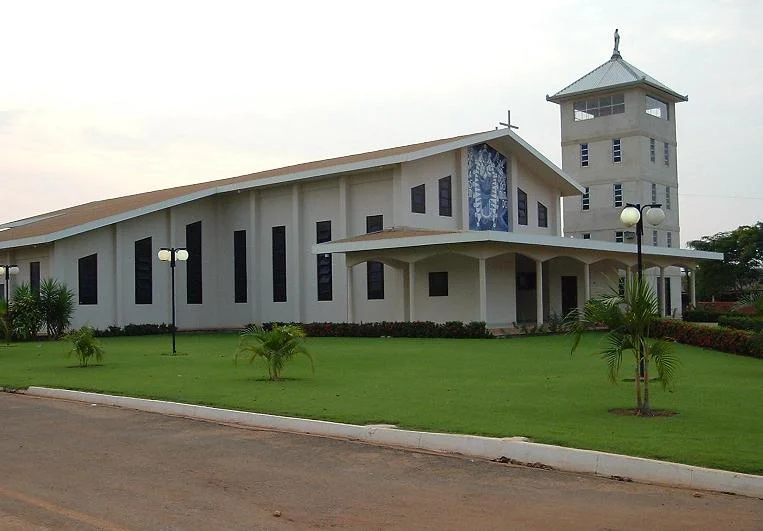

Querência
The word querência is difficult to translate. It is a gaucho word, carried by the cattle herders of the Pampas, and it means something like "the place where you long to be" - the home you return to, the patch of land your horse instinctively heads for at the end of a long ride. The people who founded this municipality in the 1980s were Lutheran Germans and their descendants, gauchos from Rio Grande do Sul, and they had just moved 2,500 kilometers north into the Amazon basin. They were not in their querência. They named the place for what they had left behind.
Pastor Schwantes's Cooperative
The origins of Querência begin with a pastor. Norberto Schwantes was a Lutheran minister from Rio Grande do Sul who, in the 1970s, helped found the Cooperativa Mista de Canarana - a settler cooperative designed to move southern Brazilian families north into Mato Grosso. The project acquired 180,000 hectares of the Fazenda Betis from the Peres Maldonado family, in a sparsely populated region between Barra do Garças and São Félix do Araguaia. The goal was not just resettlement but transformation: take gauchos from the crowded, subdivided lands of Rio Grande do Sul and give them frontier farms in the Amazon transition zone. Querência was founded on 8 December 1985 as an outpost of the cooperative. The first gaucho families arrived the following year, to improvisation and shortage and a climate nothing like the Pampas they had left. The Amazon does not welcome newcomers gently. It was 1991 before Querência received official municipality status, splitting its territory from Canarana and São Félix do Araguaia by state law No. 5,895.
A Landscape of Three Biomes
Querência's territory covers 17,850 square kilometers - larger than some small countries - and sprawls across three distinct ecosystems. To the south, the cerrado of Mato Grosso, with its grasslands and twisted trees. To the north, true Amazon rainforest. In between, one of the largest and ecologically significant transition zones in the country, where species from both biomes mingle and compete. Part of the Xingu Indigenous Reserve lies within the municipal limits, protecting territories of the Xingu peoples whose ancestors have lived here for far longer than any settler cooperative. The elevation is 350 meters. The climate is tropical, with a wet summer from October to March and a dry winter from May to September. Average annual rainfall is 1,696 millimeters, nearly all of it arriving in a six-month rush. The average temperature stays near 25 degrees Celsius year-round, but the dry season brings dust that coats everything, and the wet season brings roads that disappear.
Soybeans on a Colossal Scale
The transformation of Querência into one of Brazil's most productive agricultural zones happened with astonishing speed. By 2006 the municipality was responsible for the 14th largest soybean production in Brazil - 461,100 tons on roughly 200,000 hectares. By 2008 soybean output had grown to 534,240 tons. By 2017 Querência was the third-largest exporter in the entire state of Mato Grosso, shipping $792 million in agricultural products, most of it soy. That same year it became the first municipality in the Vale do Araguaia to cross R$1 billion in GDP - R$1.24 billion - with the highest per-capita GDP in eastern Mato Grosso. Major international agribusinesses set up operations locally: Cargill, Bunge, Caramuru, Amaggi, ADM, Agrex, Fertilizantes Tocantins. A town that started in 1985 with wooden shacks and 4,226 inhabitants in 1996 had, within three decades, become a linchpin of the global soybean trade. The population grew with it - 7,274 in 2000, 15,121 by 2014, an estimated 17,479 by 2019.
Parties, Rodeos, and the German Inheritance
The cultural calendar of Querência tells you where its people came from. The Baile do Chopp, at the end of May, is a beer festival of distinctly German flavor, featuring bands from Rio Grande do Sul. The Festa do Colono e Motorista - the Farmer and Driver Festival - at the end of July is the most traditional annual event, opening with a parade of trucks, tractors, and combine harvesters through the city center. EXPOQUER, launched in 2006, is the biggest event of the Querencian year: country music shows, agricultural machinery exhibitions, and a bull-riding rodeo that is part of the Mato Grosso rodeo circuit. Tied to all of this is the Querência State School December 19 - named for the founding date - and the State School March 20, and a school named Alegria do Saber, "joy of knowing." The frontier town has a library, a day care, and a Technological Milk Center. The town's ENEM scores in 2007 put it among the state's top performers. The settlers built fast, and what they built was thorough.
A Frontier That Matured
Querência now has paved highways connecting it to Ribeirão Cascalheira and the broader Mato Grosso road network - the BR-242 finally linked to the BR-158 in November 2010, realizing a dream Querencianos had held since the town was founded. The Betis Stream that runs near town is being converted into a leisure center with an artificial beach, summer houses, and bars. The noisy old thermoelectric plant has been retired; the city is now connected to the state electricity grid. Five rural settlements dot the municipality - Pingo D'Água is the largest, with 549 lots. The original gauchos who arrived with wooden shacks and no infrastructure are, many of them, still alive, though their grandchildren now run R$1-billion agribusinesses. Querência means the place you long to be. The settlers who chose that name did so as an act of memory. Their descendants, born here, have made the word literal.
From the Air
Coordinates 12.48°S, 52.38°W, elevation 350 m. Located in northeastern Mato Grosso, in the Amazon-cerrado transition zone. The municipality borders the Xingu Indigenous Reserve. Distance to Cuiabá (state capital) roughly 900 km southwest; São Félix do Araguaia lies to the north. Nearest airports: small regional airstrip at Querência; major airports at Sinop (SBSI) and Barra do Garças. Recommended viewing altitude 5,000-10,000 feet AGL to appreciate the mosaic of cerrado, transition forest, and rainforest, and the vast rectangular soybean fields that now dominate much of the landscape.
Nearby Stories
- Kuhikugu 45 km away
- Mato Grosso Tropical Dry Forests 95 km away
- Xingu Indigenous Park 146 km away
- São Miguel do Araguaia 178 km away
- Mundo Novo, Goiás 216 km away
- Araguaia National Park 245 km away