
Pereiaslav
Pereiaslav has more than twenty museums for a town its size, which is why Ukrainians call it a living museum. Set where the Alta and Trubizh rivers meet, some ninety-five kilometers southeast of Kyiv, this is one of the truly ancient places of the country, a city already important a thousand years ago when it guarded the southern approaches to the Rus lands. Today it gathers under open skies the collected memory of Middle Dnieper Ukraine, from Trypillian pottery to Cossack glory to the humble craft of the rushnyk, the embroidered towel. Few small cities carry so much of a nation's past in one place.
A Capital of Old Rus
Pereiaslav's story reaches back to the dawn of the Rus state. It appears in the written record as early as a 911 treaty between the Rus and the Byzantine Empire, and it grew into one of the key regional centers of the medieval age, the capital of its own principality. So old is the name that when Yuri Dolgoruky founded a namesake town in the northeast in 1152, this original was sometimes called Pereiaslav-Ruskyi to tell them apart. It stood on a dangerous frontier facing the steppe, and its fortunes rose and fell with the raids and rivalries of the era, including the nearby defeat on the Alta River in 1068. Excavated ruins of buildings from the tenth and eleventh centuries still surface here, the bones of a Rus city beneath a modern one.
The Living Museum
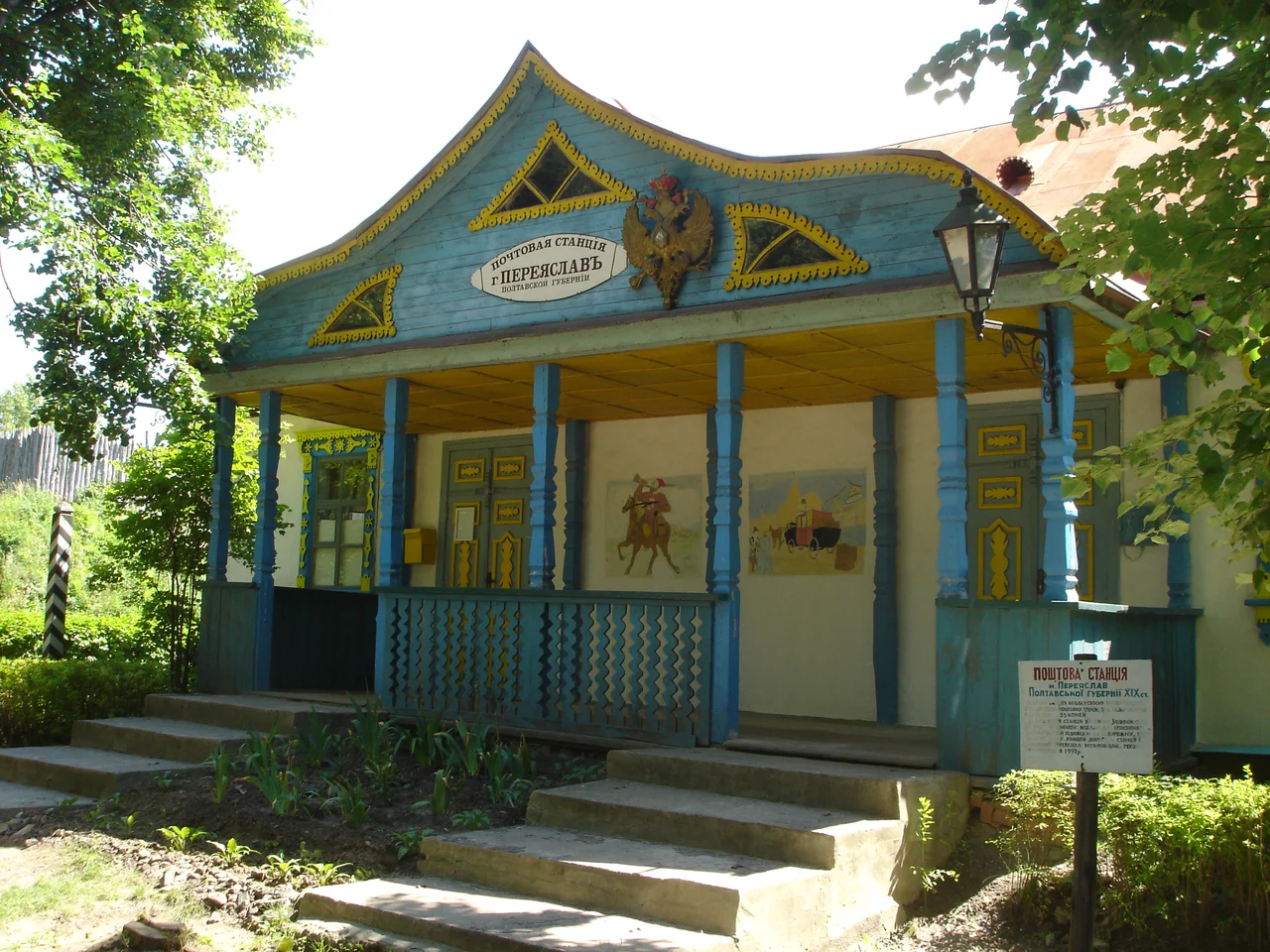
What sets Pereiaslav apart is how completely it has turned itself into a keeper of heritage. Its centerpiece is the Museum of Folk Architecture and Household Traditions of Middle Dnieper Ukraine, an open-air complex that gathers old buildings and folkways under one sprawling site, with specialized collections branching off it: museums of bread, of beekeeping, of land transport, of postal service, of Cossack glory, even of space exploration, alongside a replica of an eleventh-century Rus dwelling. Older landmarks anchor the town too, from St. Michael's Church, built in the mid-seventeenth century, to the Ascension Monastery, whose cathedral rose between 1695 and 1700. To wander Pereiaslav is to walk through centuries laid out room by room and building by building.
The Town of Sholem Aleichem
Pereiaslav gave the world one of literature's warmest voices. In 1859 the writer Sholem Aleichem, the great chronicler of Jewish life in the Pale of Settlement and the creator of Tevye the Dairyman, was born here. He returned to the town after his family fell into poverty, studied at its gymnasium, and later poured its streets and characters into his autobiographical prose. The town keeps a museum to him within its ethnographic reserve. He was not the only notable child of Pereiaslav: the American sculptor Louise Nevelson was born here in 1899 before her family emigrated, and the Hetman Pavlo Teteria and the statesman and artist Petro Kholodnyi belong to its roll as well.
A Community's Long Memory
For centuries Pereiaslav was home to a substantial Jewish community, and its history here runs through both flourishing and grief. Jews are recorded in the town from 1620, and by the late nineteenth century they made up a large share of its people, with synagogues, schools, and houses of study filling its streets. That community also endured terrible days. Jewish residents of Pereiaslav were among the first killed in the Khmelnytsky Uprising of 1648, a slaughter that seventeenth-century chroniclers recorded in anguished detail, and later generations suffered the pogroms that swept the region. The chroniclers also remembered acts of mercy amid the horror, when local neighbors sheltered survivors and brought them home. It is a memory the town carries with the rest of its long history. Long known as Pereiaslav-Khmelnytskyi, the city reclaimed its ancient name of Pereiaslav in 2019.
From the Air
Pereiaslav sits at about 50.07 degrees north, 31.45 degrees east, near the confluence of the Alta and Trubizh rivers in Kyiv Oblast, central Ukraine, southeast of the capital. From altitude, look for the low river country near the Dnieper's left-bank tributaries and the green expanse of the town's open-air museum reserve. Kyiv lies roughly 95 kilometers to the northwest; Ukrainian airspace is closed to civil aviation.
Nearby Stories
- Taras Hill 3.9 km away
- Vydubychi Monastery 31 km away
- Cherkasy 34 km away
- Boryspil 38 km away
- Khotiv Hillfort 48 km away
- Kachanivka Palace 78 km away
- Motronynskyi Monastery 97 km away
- Maidanetske 106 km away