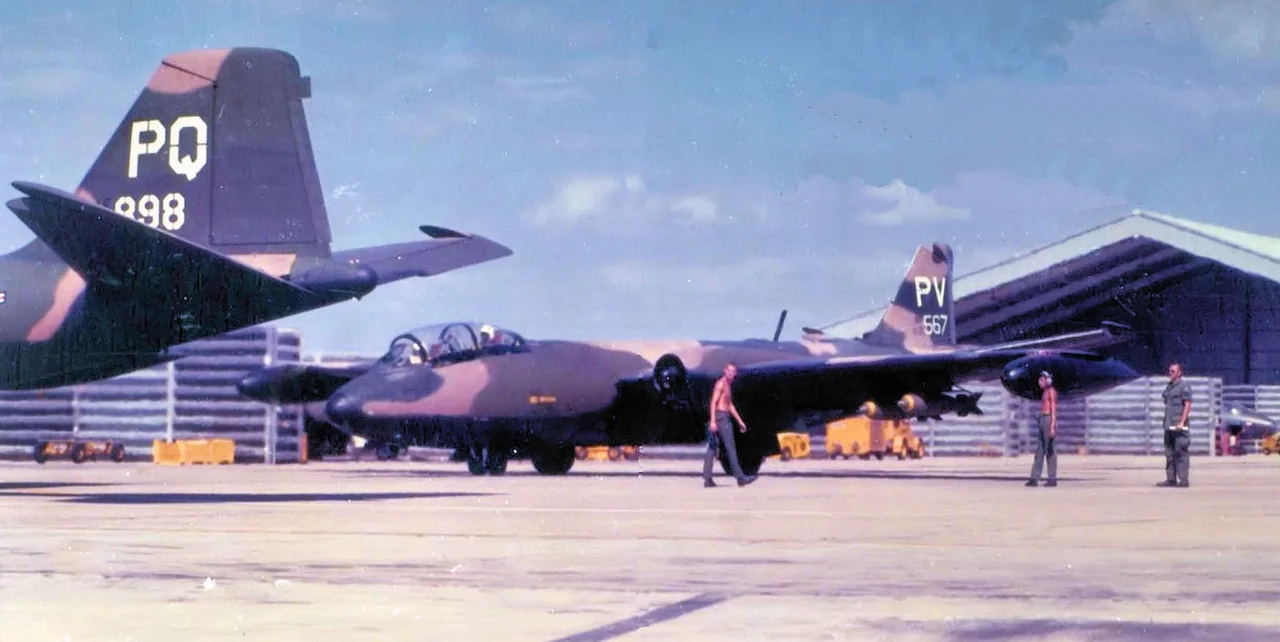

Phan Rang Air Base
Three different air forces have owned Phan Rang. The Japanese built it around 1942. The French used it and walked away in 1954. The Americans rebuilt it from almost nothing in 1965, turning a modest 3,500-foot runway into a sprawling complex that hosted fighter wings, special operations squadrons, and AC-47 Spooky gunships. Then, in the final days of April 1975, North Vietnamese armor rolled through its perimeter gates and the base became something else entirely. That compressed sequence — three foreign air forces, one local one, and the violent handover at the end — makes Phan Rang one of the most layered military sites in Vietnam.
Building the Base, Twice
The original runway at Phan Rang dated to the Imperial Japanese Army occupation around 1942. After Japan's defeat, the French Air Force used the same 3,500-foot strip during the First Indochina War before abandoning the facility when French control over Indochina ended in 1954. The strip sat dormant for a decade. In April 1965, CINCPAC ordered a survey for a new American airfield at the site. Construction was plagued from the start: bad weather, shortages of concrete, piping, and aluminum matting pushed the completion date from October 1965 to December, then to April 1966. On March 20, 1966, the 366th Tactical Fighter Wing became the first permanent USAF unit stationed there. By then the base had grown well beyond the old French runway, with ramps, revetments, and facilities capable of supporting multiple squadrons of F-4 Phantoms.
A Hub for Special Operations
Phan Rang was not just a fighter base. In November 1967, it became a forward operating location for four AC-47 Spooky gunships of the newly activated 14th Air Commando Squadron — slow-moving, heavily armed aircraft that could orbit targets and deliver sustained fire. In June 1967, the 315th Air Commando Wing moved in from Tan Son Nhut, operating C-123 Provider aircraft on missions that included troop movements, cargo drops, flare missions over night battlefields, aeromedical evacuations, and supply air-drops to isolated positions. The base survived Tet: on January 31, 1968, naval gunfire deterred a Viet Cong attack. It survived sapper attacks in 1970. Through the early 1970s, as American units drew down and the Republic of Vietnam Air Force (RVNAF) took on more responsibility, Phan Rang remained operational, its A-37 Dragonfly aircraft becoming the workhorses of the 2nd Air Division.
The Last Stand: April 1975
The final days of Phan Rang unfolded over two weeks in April 1975, as the PAVN advance swept south following the fall of the Central Highlands. On April 1, crowds of soldiers and civilians from Nha Trang and Cam Ranh flooded the base seeking evacuation. Two Australian RAAF C-130s that landed to pull out civilians were mobbed. Order was intermittently restored and then lost again. The Phan Rang A-37s flew aggressive sorties throughout early April, attacking PAVN columns moving along Route 1 and Route 450 — destroying vehicles, taking losses to anti-aircraft fire, servicing aircraft in flak jackets because rocket and mortar fire made the flight line dangerous. On April 16, the PAVN committed 20 tanks and armored personnel carriers in an armored spearhead. By 09:30 that morning, they had captured the base. As it fell, a single A-37 pilot braved the PAVN fire, landed under fire, and evacuated the wing commander. Of 72 A-37s, 24 escaped. The rest were shot down or abandoned.
After the Fall
With the base captured, the Vietnam People's Air Force (VPAF) took possession of what the Americans and South Vietnamese had built. Some facilities were torn down — the complex was simply too large for the VPAF's needs. The 04R/22L runway was decommissioned and has since been largely erased. Several hangars remain standing; others were demolished. The captured aircraft — the A-37s and UH-1H Hueys the RVNAF had left behind — flew VPAF missions in the subsequent Cambodian-Vietnamese War, the Dragonflies proving better suited to ground support than the VPAF's MiG-17s and MiG-21s. Today the base operates as Thành Sơn Air Base, home to the VADAF 937th Fighter Regiment flying Sukhoi Su-22 fighter-bombers on a single maintained runway. Concrete shelters and steel revetments from the American era still mark the ramp, unused but standing.
From the Air
Phan Rang Air Base (Thành Sơn Air Base) lies at 11.6336°N, 108.9519°E, approximately 5.2 miles north-northwest of Phan Rang–Tháp Chàm city. ICAO: VVPR. The base is clearly visible from altitude as a military airfield with a single active runway oriented 04/22, adjacent ramp areas, and concrete shelters. Recommended viewing altitude: 5,000–8,000 ft AGL. Phan Rang Bay is visible to the east; the terrain rises steeply to the west toward the Central Highlands. Cam Ranh International Airport (CXR/VVCR) lies approximately 55 km northeast.
Nearby Stories
- Ca Na 13 km away
- Phước Bình National Park 15 km away
- Operation Byrd 21 km away
- Lak Lake 53 km away
- Vũng Rô Bay 102 km away
- Cat Tien National Park 124 km away
- Vũng Rô Bay Incident 131 km away
- South-East Asian Theatre of World War II 174 km away