
Phillip Island
Every evening, just as the light goes out of the sky, the smallest penguins in the world come home. They surface in the shallows off the Summerland beach in rafts, wait until the safety of near-darkness, and then waddle up the sand in their hundreds, crossing the dunes to burrows they have used for years. People come from all over the planet to sit in silence and watch them. This is the Penguin Parade, and the colony behind it — around 40,000 little penguins — is the largest in the world. It is the strange, soft heart of an island that also happens to host one of the fastest motorcycle races on Earth.
The Parade at Dusk
Little penguins stand barely 33 centimetres tall, and they spend their days at sea, hunting fish kilometres offshore. They come ashore only under cover of darkness, when fewer predators can see them. The nightly procession at Summerland has been a managed attraction since the 1920s, and the care taken now is considerable. Boardwalks and seating keep visitors back; a visitor centre opened in 2019 to replace the old facilities; and photography is banned entirely during the parade, because a camera flash can disorient and harm the birds. The colony has been hard-won. After a 2019 heatwave killed many penguins, conservators planted native bower spinach around the nest boxes to insulate them, and an ongoing project replaces flammable introduced plants with fire-resistant native species — because the penguins, alarmingly, do not flee from grass fires.
A Coast Full of Wildlife
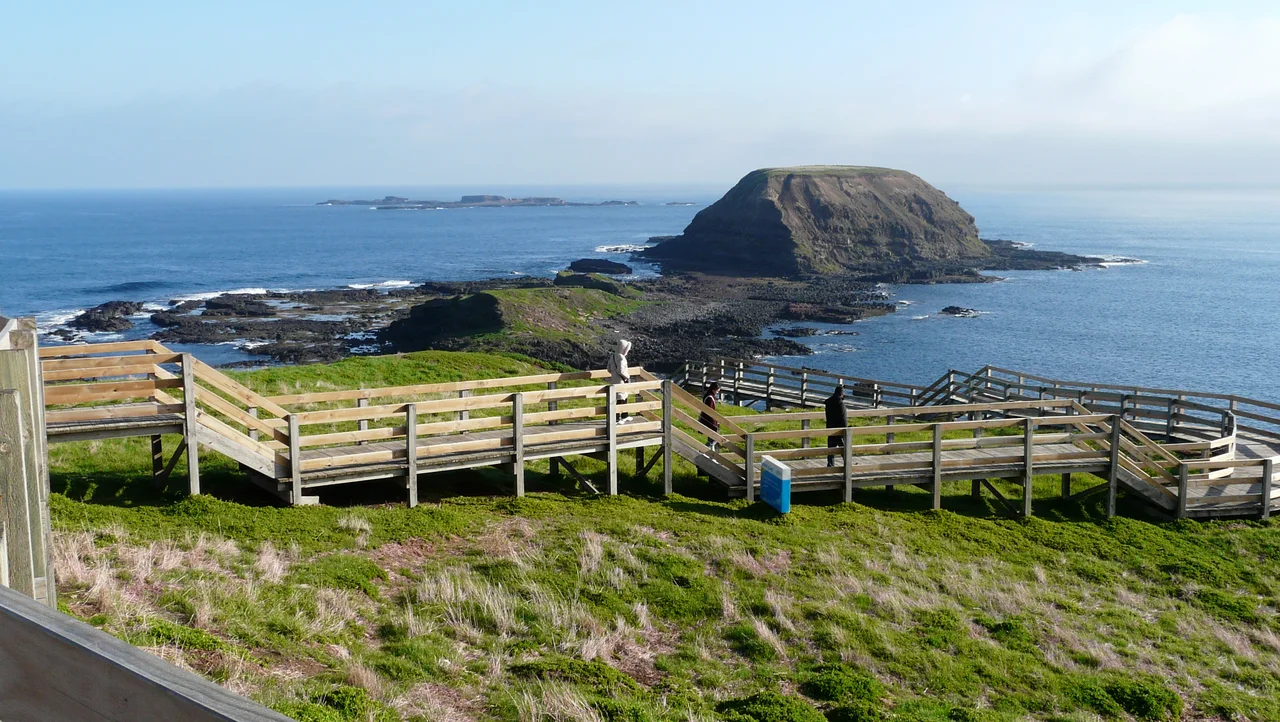
The penguins are only the beginning. At the island's western tip, Seal Rocks holds one of Australia's largest colonies of Australian fur seals — many thousands of them hauled out on the bare rock, visible from the boardwalks at the Nobbies. From May to September, humpback and southern right whales pass along the coast on their migration, slowly recovering in number decades after illegal Soviet whaling decimated them in the 1970s. The island is recognised by UNESCO as part of the Mornington Peninsula and Western Port Biosphere Reserve, and BirdLife International ranks its shores as an Important Bird Area for the penguins, the short-tailed shearwaters, and the Pacific gulls that breed here. Roughly sixty percent of the island is still farmland, sheep and cattle on green paddocks, but its real wealth is the life along its 97 kilometres of coast.
The Island That Roars
Then there is the other Phillip Island. Australian motor racing was practically born here: the very first Australian Grand Prix ran in 1928 on a temporary circuit laid out along the island's public roads. A permanent track, the Phillip Island Grand Prix Circuit, opened in 1956, and after a redevelopment in 1988 it became the home of the Australian Motorcycle Grand Prix. The 4.448-kilometre circuit rolls over the island's coastal hills with the ocean as a backdrop, fast and flowing and beloved by riders, and it holds one of the highest-grade licences in the world for MotoGP. There is a quirk of history here too: the original Armstrong 500 endurance race began on this track, but when the bridge to the mainland could not bear the weight of resurfacing equipment, the race moved away in 1963 to a hill called Mount Panorama — and grew into the legendary Bathurst 1000.
Bridges, Beaches and Hollywood
A 640-metre bridge links the mainland town of San Remo to Newhaven on the island; the first crossing opened in 1940 with a full public holiday declared to celebrate. Beside it, Churchill Island holds the site of Victoria's first European garden, planted in 1801, now a working heritage farm. The surf is serious — in 2013 the island gained Victoria's first National Surfing Reserve, covering four breaks under the motto 'care, share, and preserve.' And the cliffs are genuinely dangerous: visitors have fallen from the Cape Woolamai lookout while chasing photographs, and the warnings are not decoration. Hollywood found the island too. In 1959 the apocalyptic film On the Beach brought Fred Astaire, Gregory Peck and Ava Gardner to shoot scenes at the Grand Prix circuit — the famous and the feathered, sharing the same small island at the bottom of the world.
From the Air
Phillip Island sits at roughly 38.49 degrees S, 145.24 degrees E, about 125 km south-south-east of Melbourne, forming a natural breakwater across the mouth of Western Port. From the air it reads as a distinct 26-km-long landmass joined to the mainland by the San Remo bridge, with the surf-battered Nobbies and Seal Rocks marking its western tip and the Grand Prix circuit visible inland near Ventnor. Recommended viewing altitude is 2,000 to 4,000 feet; the seal colony and the racetrack are both easy to pick out. Nearest fields are Moorabbin (YMMB) and Melbourne (YMML) to the north-west; Latrobe Valley (YLTV) lies to the east. Expect mild but persistent south-westerly winds off Bass Strait and frequent cloud — the island averages only about 32 clear days a year — so plan visual passes for calm, bright mornings.
Nearby Stories
- Puffing Billy Railway 26 km away
- Geelong 51 km away
- Yarra River 53 km away
- Walhalla, Victoria 71 km away
- The Valentich Disappearance: 'It Is Not an Aircraft' 77 km away
- Great Ocean Road 101 km away
- Eureka Rebellion 106 km away
- Bass Strait 148 km away