
Walhalla, Victoria
A visitor in 1874 looked up at Walhalla and decided the houses resembled "a number of birds' nests situated in the branches of trees." He was not exaggerating. The town runs along a single road threading the floor of Stringers Creek gorge, with ranges climbing nearly vertical on either side, and homes were pegged onto those slopes wherever a foothold could be cut. Someone gave the place a grand name, Walhalla, after Valhalla, the hall where Norse warriors feast among the gods. The reality was harder and stranger: a community of 4,000 souls, packed into a Gippsland ravine, living and dying on the gold buried in the mountain beneath them. Today around 20 permanent residents remain, and the gorge that once roared with stamp mills is quiet again.
A Rush Up the Creek
It started, as these things did, with one man and a glint in the water. Ned Stringer found alluvial gold in this remote creek in late 1862 and registered his claim in January 1863 at the distant settlement of Bald Hills. He barely had time to grasp what he'd found; Stringer died that September, never capitalising on the discovery, though his party was later granted a hundred-pound reward and the creek still carries his name. The real prize came in February 1863, when prospectors John Hinchcliffe and William Myers struck a colossal quartz outcrop in the hill above the water. They called it Cohen's Reef, after a storekeeper, and it would prove to be the largest single gold reef in all of Victoria. A town that started as "Stringer's Creek" was rechristened Walhalla, after its richest mine.
Tunnelling Into the Mountain
Walhalla's gold did not lie politely in the ground. The surface deposits were exhausted fast, and the reef plunged into steep valley walls, so miners did something unusual: they tunnelled sideways, boring straight into the mountainside as well as digging down. The Long Tunnel mine, working Cohen's Reef, became the richest of them all, pulling more than 30 tonnes of gold from the rock between 1865 and 1914 and paying its shareholders over 1.28 million pounds in dividends. By 1900 the reef as a whole had yielded roughly 55 tonnes. But the crushing batteries that freed gold from quartz devoured wood, and the hills around town were stripped bare for fuel, the timber hauled in by tramway from ever further away. That hunger for firewood, as much as anything, would eventually starve the town.
Two Electric Lights and a Chess Club
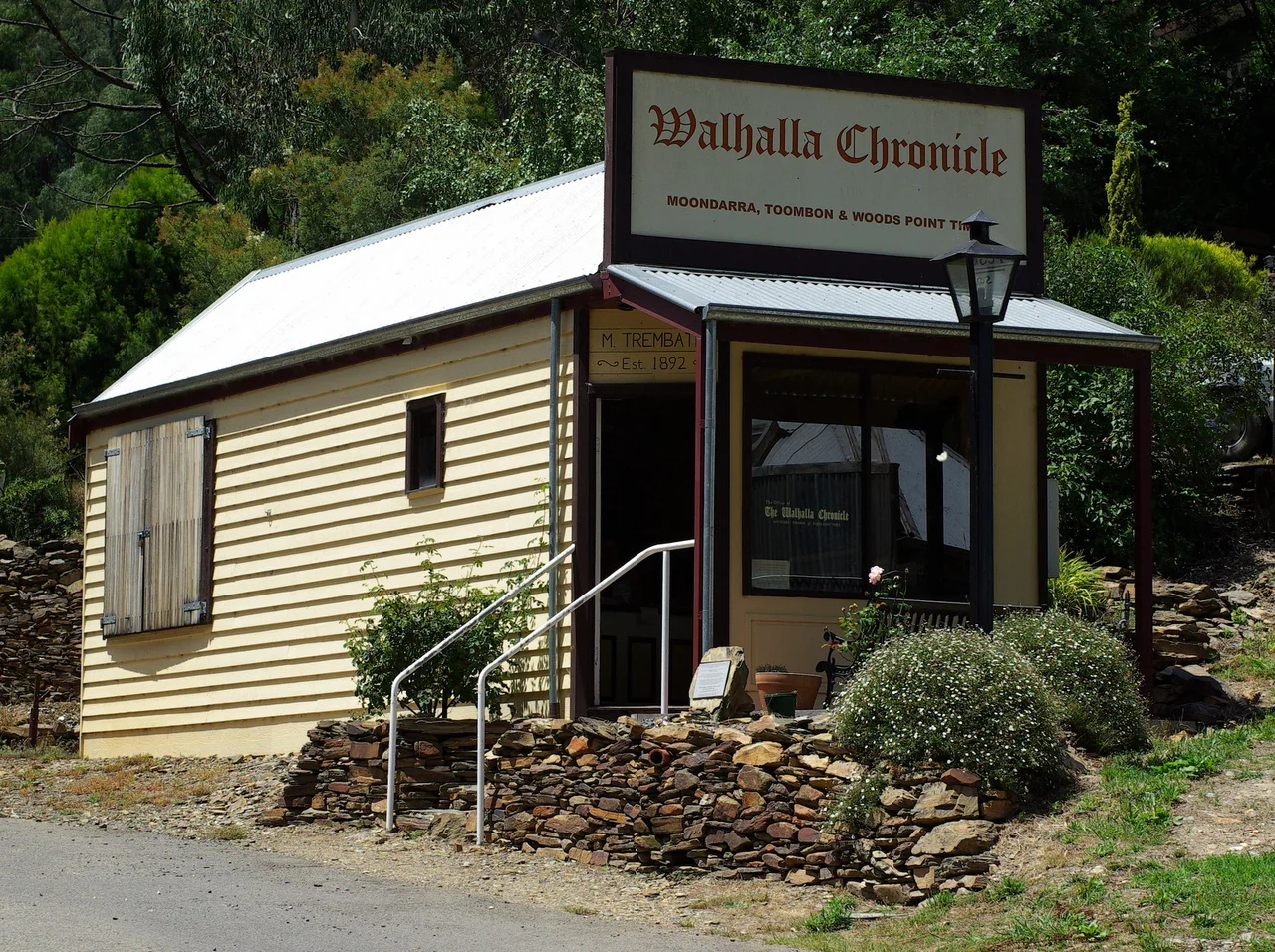
At its height, Walhalla was a full and surprising society crammed into a crevice. More than a dozen hotels operated, alongside breweries, banks, a newspaper called the Walhalla Chronicle, fraternal lodges, a choral union, a debating society, and briefly even a chess club. There was no flat ground for sport, so the locals levelled the top of a hill to make a cricket ground, reachable today by a 45-minute climb. An Italian community settled from 1873, working as miners, woodcutters, farmers, and publicans. In 1884 the Long Tunnel company gave the town two electric street lights, briefly making this mountain hamlet one of the first places on Earth so lit. The irony is bitter: those two lamps were never extended, and Walhalla would wait more than a century for proper power.
The Railway That Came Too Late
For decades the town begged for a railway, and the gorge fought every metre of it. When the narrow-gauge line finally snaked up Stringers Creek in 1910, it was an engineering marvel, ledges blasted from sheer rock, dry-stone walls rising from the creek bed, six timber trestle bridges in the final approach, and it was almost immediately useless. The major mines closed by 1914; the gold had run out and the wood had run out with it. The railway's busiest task became hauling the town's own buildings away. Walhalla emptied. The shire was dissolved into a neighbour in 1918. Yet it never quite became a ghost town. A stubborn handful stayed on, keeping a post office, a hotel, a church, and a store alive through decades of fire, flood, and slow decay.
The Lights Come On at Last
Around 1977 something turned. Heritage enthusiasts began restoring the survivors, the Star Hotel, the Mechanics' Institute, and rebuilding the railway as a tourist line that now carries visitors up the restored gorge once more. The Long Tunnel Extended mine, fifth-largest goldfield of colonial Victoria, opens daily for tours 300 metres into a machinery chamber carved from solid rock. And in December 1998, Walhalla finally claimed a strange distinction: it became the last town on the Australian mainland to be connected to mains electricity, the cable run underground for kilometres so as not to spoil the heritage streetscape. The town that briefly led the world with two electric lamps in 1884 had to wait 114 years for the third. It was worth the wait. Walhalla endures, beautiful and improbable, in its narrow green gorge.
From the Air
Walhalla lies at 37.94°S, 146.45°E in the steep Stringers Creek valley of Victoria's Great Dividing Range, in West Gippsland about 180 km east of Melbourne and adjoining Baw Baw National Park. The town sits roughly 4 km upstream of the Thomson River junction; from the air the tight, forested gorge and the single road winding its floor are the key landmarks, with the Baw Baw plateau rising to the northwest. The nearest significant airport is Latrobe Regional Airport (ICAO YLTV) near Traralgon/Morwell, about 40 km south; Melbourne's Essendon (YMEN) and Moorabbin (YMMB) fields lie within reach to the west. Terrain is the dominant hazard: steep, heavily timbered ridges, narrow valleys, and rapidly forming mountain weather. Maintain generous terrain clearance, watch for afternoon cloud build-up over the ranges, and be alert to bushfire smoke in summer, when the region has burned repeatedly.
Nearby Stories
- Puffing Billy Railway 48 km away
- Phillip Island 69 km away
- Glenrowan, Victoria 130 km away
- Waterloo Plains massacre 138 km away
- Snowy River 139 km away
- The Disappearance of Harold Holt: The Prime Minister Who Vanished Into the Sea 141 km away
- Murray River 143 km away
- Wybalenna Aboriginal Establishment 226 km away