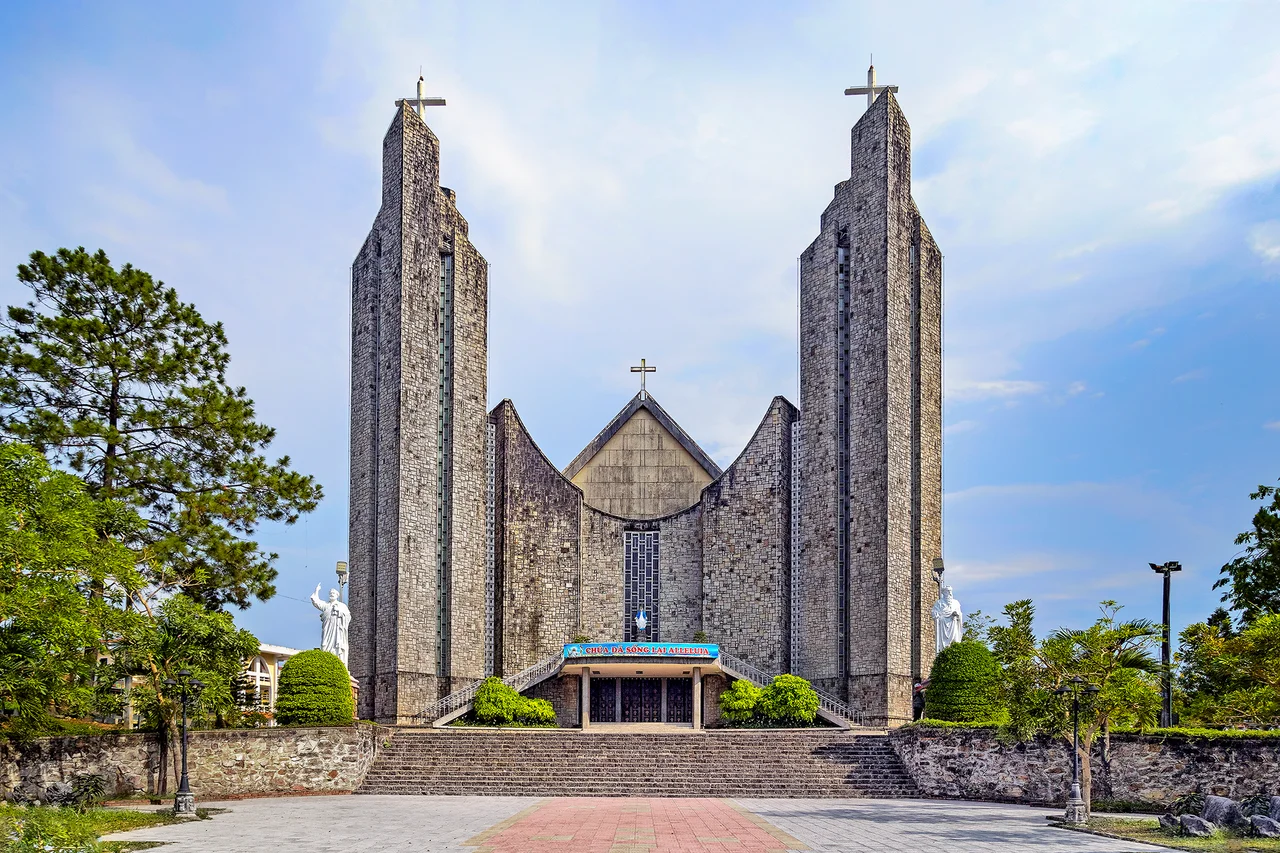

Phủ Cam Cathedral
Ground was broken on the current cathedral in 1963. Five years later, the unfinished building took bomb damage during the Tet Offensive. Construction halted, then stalled again after 1975, leaving the nave standing incomplete for decades — visible from the surrounding hillside but unconsecrated, a skeleton of the building it was meant to be. It was finally completed in May 2000, thirty-seven years after the first stone was laid. That gap — between intention and completion, between the Vietnam in which it was designed and the Vietnam in which it was finished — is written into the building's very walls.
Four Centuries on a Huế Hillside
Before the current cathedral, before even its predecessor, the site on Huế's south bank was an orange plantation. Catholic missionaries arrived in central Vietnam in the seventeenth century, and a church has occupied this hill since that era — making Phủ Cam one of the oldest continuous Catholic presences in the country. The Archdiocese of Huế, of which Phủ Cam is the seat, traces its roots to those early missionary years.
The Papal Delegation to Vietnam — the Holy See's office that oversaw Catholic affairs across Vietnam, Thailand, Cambodia, and Laos together — established its residence next to the cathedral on 20 May 1925. That physical proximity made Phủ Cam not just a parish church but a node in a much larger ecclesiastical network, one that stretched across Southeast Asia from this small hill in Huế.
A Design Built for Endurance
The architect chosen for the current cathedral was Ngô Viết Thụ, the first Vietnamese architect to win the Grand Prix de Rome and a figure whose work shaped modern Vietnamese civic design. His design for Phủ Cam is distinctively modern in its structure: concrete supporting pillars placed close to the walls and bent gradually inward, with three such pillars at each corner. The result is a building that creates a wide interior space without the forest of columns that an older Gothic structure would have required.
Inside, the cathedral follows classical Catholic tradition: two rows of colored glass windows running along the upper walls, a marble altar on an elevated circular platform, and a cross made of steel and concrete on a round pillar. The building has two wings. In the left wing is the tomb of Archbishop Philippe Nguyễn Kim Điền, who served as Archbishop of Huế from 1968 until his death in 1988. The right wing holds a shrine to Saint Paul Tống Viết Bường, one of the 117 Vietnamese Martyrs canonized by Pope John Paul II in 1988 — people who died for their faith during centuries of persecution.
The Long Interruption
Construction began in 1963, but Huế in 1968 was among the most fiercely contested cities of the Tet Offensive. North Vietnamese forces occupied the city for twenty-six days in some of the war's bloodiest urban fighting, and the unfinished cathedral suffered significant bomb damage during the battle. When the fighting ended, the building stood damaged and incomplete.
Work did not fully resume after 1975, as the country's reunification under Communist governance left the Catholic Church in Vietnam in a complicated position — not forbidden, but operating under tight restrictions. Through the 1980s and into the 1990s, the cathedral's nave inched toward completion, visible proof that the congregation had not given up. Under the direction of Archbishop Nguyễn Như Thể, the final push to completion succeeded, and the cathedral was consecrated on June 28 and 29, 2000, during the Feast of Saints Peter and Paul — the parish's patron saints.
Still Being Built
Even after consecration, Phủ Cam continued to grow. Archbishop Francis Xavier Lê Văn Hồng inaugurated a new rectory on October 8, 2014, funded through a combination of local contributions and donations from Vietnamese Catholics abroad — a diaspora connection that has become a significant source of support for churches across Vietnam.
From the hillside, the cathedral's profile is striking against the Huế skyline: two tall flanking sections with a lower curved central section between them, an arrangement that visitors often describe as resembling an open book seen in perspective. The hill gives it an unusual presence in a city otherwise dominated by low rooflines and the distant walls of the citadel. After nearly four centuries of Catholic presence on this site, through orange groves and missionary chapels and a cathedral interrupted by war, Phủ Cam stands as one of the most architecturally distinctive buildings in central Vietnam.
From the Air
Phủ Cam Cathedral sits at 16.4525°N, 107.5878°E on a small hill on the south side of the Perfume River in Huế. At 2,000–3,000 feet, the cathedral's elevated position on its hill makes it one of the easier landmarks to pick out in the city's southern residential neighborhoods. The Perfume River curves through the frame about 1 km to the north. Phú Bài International Airport (VVPB) lies roughly 12 km to the south-southeast. The citadel is visible to the northwest, and the long span of Trường Tiền Bridge appears clearly between the cathedral's hill and the citadel grounds.
Nearby Stories
- Battle of Fire Support Base Ripcord 4 km away
- Sơn Trà Mountain 5.8 km away
- Quảng Trị Citadel 7.3 km away
- Battle of Nam Dong 10 km away
- Hội An wreck 56 km away
- Battle of Cua Viet 65 km away
- Saravan 100 km away
- Hainan Island Incident 342 km away