
Picts
The Romans called them Picti, the Painted Ones, because they were rumoured to tattoo themselves. The Irish called them Cruithni. The Welsh called them Prydyn. They never, as far as we can tell, called themselves anything in their own language that has survived. The Picts ruled the northern half of what is now Scotland for roughly seven centuries. Then, in the ninth century, they were absorbed into a new Gaelic-speaking kingdom called Alba and effectively erased from history. Their language is extinct. Their kings are known mostly from the lists of dead men. Most of what remains is carved into stone: serpents, crescents, mirrors, double discs, all in a symbolic vocabulary that no one has yet translated.
Who They Were and Were Not
The Picts were not a single tribe. They were a federation, or perhaps a series of related federations, of peoples living in what is now Scotland north of the Firth of Forth, in the Early Middle Ages. The name Picti first appears in a Roman panegyric of AD 297, used by outsiders to describe unromanised northern Britons. Whether the Picts ever embraced the name themselves remained unclear for centuries. The historian James Fraser has argued that Picti only became an endonym, a self-description, in the late seventh century, after the Battle of Dun Nechtain in 685, when the kingdom of Fortriu united most of the north under what is now called the Verturian hegemony. Before that, Pict was mostly a Roman insult about painted barbarians.
Stones That Will Not Speak
What survives most visibly of Pictish culture are the carved stones, scattered across northern Scotland. Class I stones are unworked boulders incised with abstract symbols. Class II stones are dressed slabs combining symbols with Christian crosses. The symbol vocabulary repeats again and again: a Z-rod over a double disc, a V-rod over a crescent, a mirror and comb, a creature now called the Pictish Beast. No one knows what these symbols meant. They may have been names, territorial markers, family identifiers, or something else entirely. Some stones also carry inscriptions in ogham, a linear alphabet borrowed from Ireland, but most ogham texts on Pictish stones have resisted convincing translation. The carving was clearly meant to be read. The reading has been lost.
Fortriu and the Battle That Mattered
Medieval texts speak of seven Pictish kingdoms with names like Cat, Ce, Circin, Fib, Fidach, Fotla and Fortriu, each said to descend from a son of a legendary founder called Cruithne. The number may be schematic. What is certain is that Fortriu, recently shown by scholars to have been centred on the Moray Firth rather than Perthshire, dominated the others for most of recorded Pictish history. The Pictish kingdoms were tributary to the Anglian kingdom of Northumbria for much of the 7th century. That changed at Dun Nechtain in 685, when Bridei mac Beli destroyed a Northumbrian army and stopped Anglian expansion north. After Dun Nechtain, the Picts as a recognisable people enter the historical record.
Farmers, Not Painted Savages
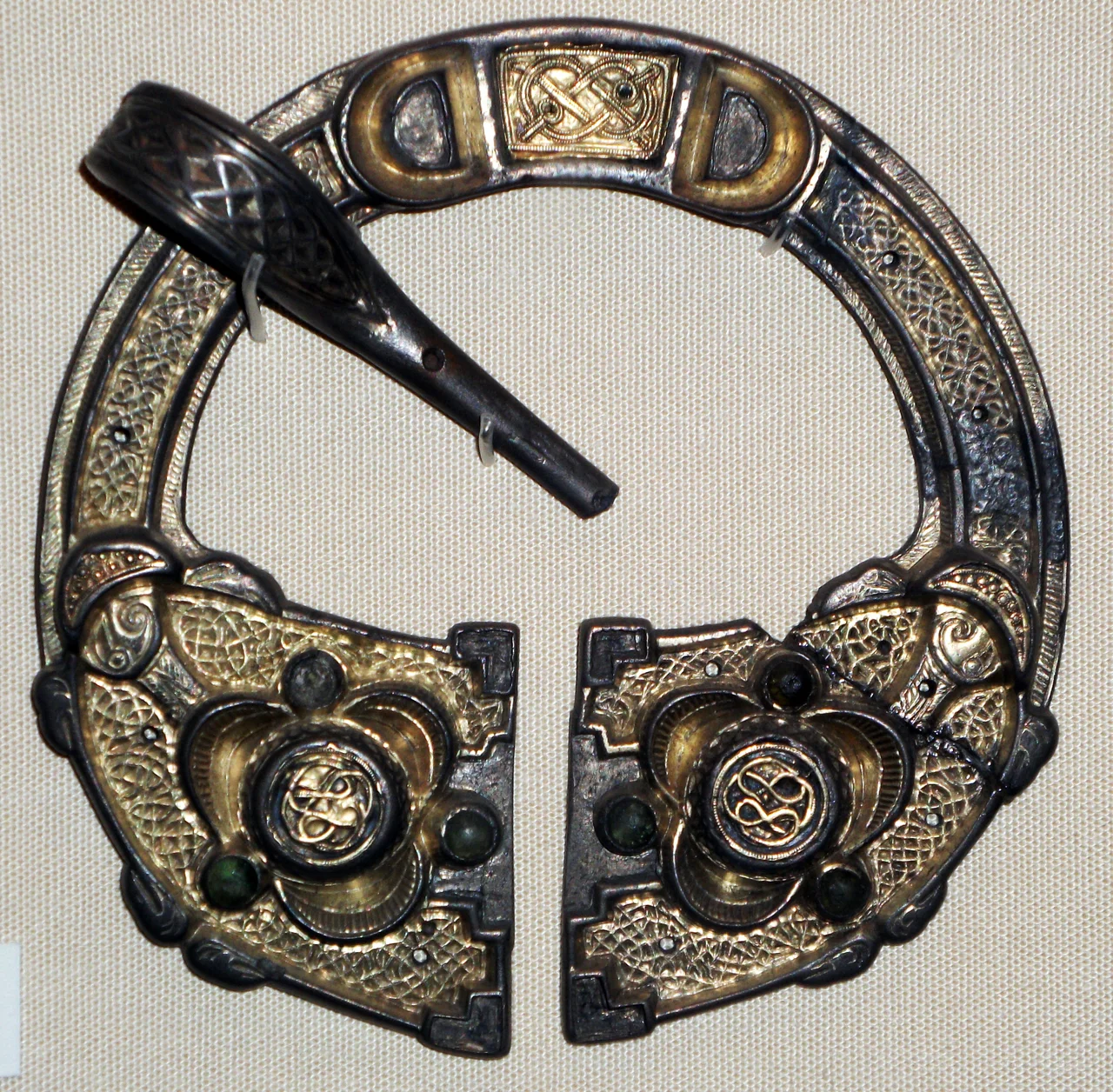
Roman writers stressed the foreign strangeness of the Picts. The archaeological record suggests something different. Pictish people were settled farmers, living in small communities, raising cattle and horses and sheep, growing wheat, barley, oats and rye, eating peas and beans and turnips, gathering wild garlic and watercress, fishing the rivers and coasts. They lived in roundhouses and timber halls. They built churches, first in wood and later in stone. They wore wool and linen. They produced exquisite silver chains, often more than half a metre long, and elaborate penannular brooches. The St Ninian's Isle Treasure, hidden away on Shetland around AD 800, is one of the finest collections of Pictish metalwork to survive.
Disappearance
In the middle of the ninth century, Viking attacks devastated Pictland. In 839 the Vikings killed Eogan mac Oengusa, king of Fortriu, and Aed mac Boanta, king of Dal Riata, in a single battle. In the wreckage that followed, Kenneth MacAlpin emerged in the 840s as king of the Picts, and within a generation the territory was being referred to from outside as the Kingdom of Alba rather than the Kingdom of the Picts. The Pictish language did not vanish overnight. But Gaelicisation, perhaps already underway, accelerated; by the 11th century Pictish was apparently extinct, and the inhabitants of northern Alba had become Gaelic-speaking Scots. The 12th-century historian Henry of Huntingdon was among the first to remark that the Picts as a people seemed to have simply disappeared. Their stones, though, are still standing across the north, holding silent messages that no living person can read.
From the Air
The Pictish heartland centred on Moray and the Great Glen at roughly 57.0 N, 4.9 W, with major sites scattered across northeastern Scotland from Aberdeenshire to Caithness and Orkney. Inverness (EGPE), near the Brude mac Maelchon era stronghold and the suggested location of Fortriu, is the nearest commercial airport. Pictish stones survive in concentration in Aberdeenshire, Angus and Easter Ross; museums in Edinburgh and St Andrews hold many of the finest. From altitude, Pictish symbol stones are invisible, but the broader landscape they inhabited, the fertile coastal plains of the Moray Firth and Strathmore, reads clearly. Weather changes rapidly over the eastern Highlands.
Nearby Stories
- Cannich wildfire 1 km away
- Corrour railway station 3.9 km away
- Highland Folk Museum 7.7 km away
- Lochalsh 11 km away
- Tomatin distillery 14 km away
- Battle of Glen Shiel 15 km away
- Falls of Bruar 17 km away
- Strontian 20 km away