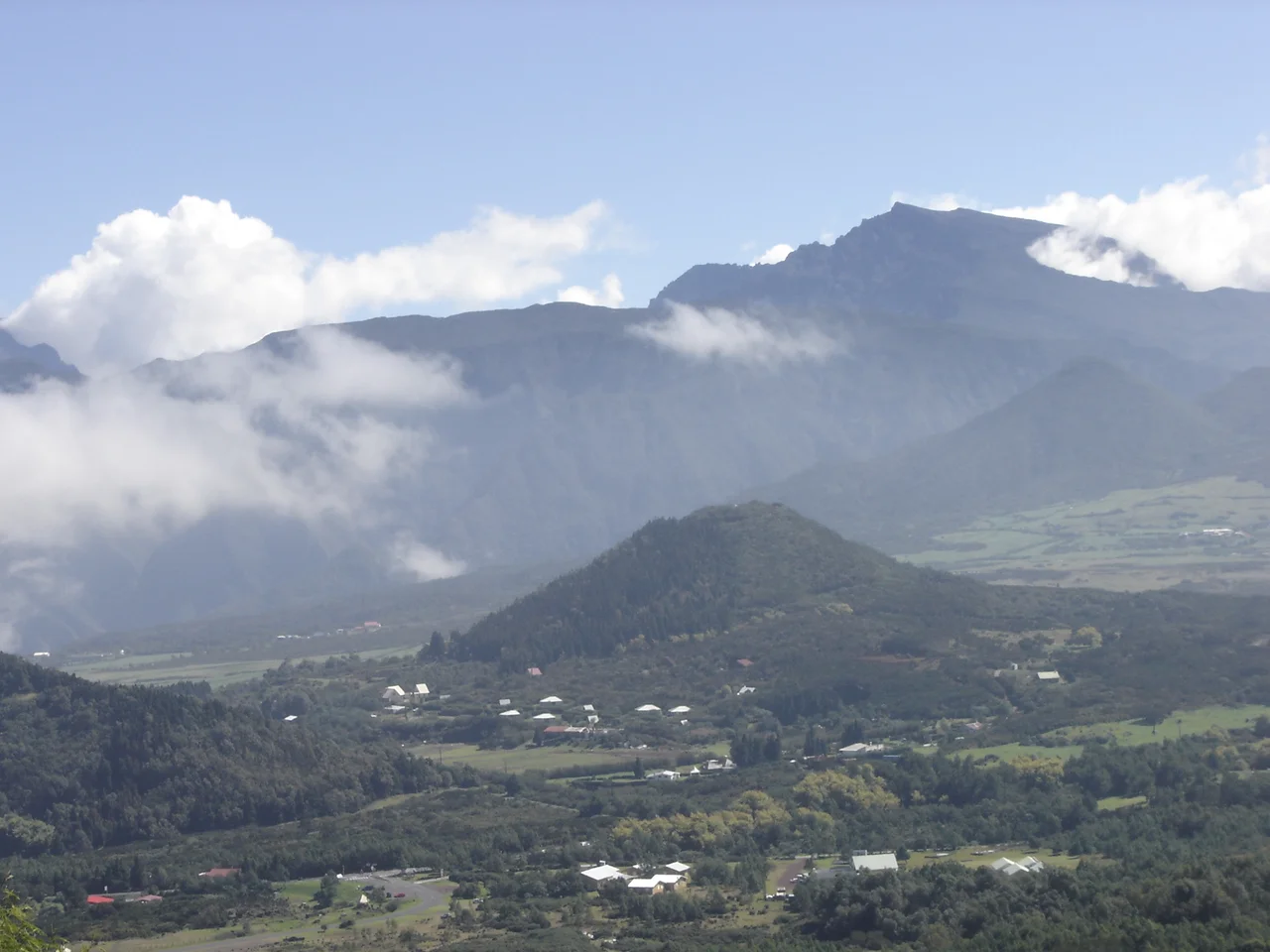

Piton des Neiges
Its name means Snow Peak, which sounds like a joke at this latitude. Réunion sits in the tropics, closer to the equator than to any temperate shore, and yet a few times each winter a dusting of white settles on this summit - just enough to justify the name early French settlers gave it. At 3,069 meters, Piton des Neiges is not only the roof of Réunion. It is the highest point anywhere in the Indian Ocean, a dead volcano standing watch over a living one.
An Island Built From the Deep
Piton des Neiges did not rise from a continental crack. It was built by a hotspot, a fixed plume of magma deep in the mantle that the Earth's crust drifts slowly over, leaving a trail of volcanoes in its wake. Around two million years ago, eruptions from that hotspot finally broke the ocean surface here, and the peak kept growing until it formed the northwestern two-thirds of the island. The same plume is thought to have helped create the Deccan Traps in India long before. Réunion, then, is the visible tip of a process that has been shaping the planet for tens of millions of years - and Piton des Neiges is its grandest local monument.
The Mountain That Fell In
The volcano went quiet long ago; its last eruptions are estimated at roughly twelve thousand years past, and it is considered extinct. But its most dramatic feature was carved after the fire died. Rain and erosion, working on a structure already weakened by collapse, gouged three enormous amphitheater valleys into the old volcano's flanks. These are the cirques - Cilaos, Mafate, and Salazie - and together they form one of the most extraordinary landscapes on Earth, a triptych of green-walled chasms radiating out from the central peak like the marks of a giant's hand. The summit you climb today is what remains of a mountain that partly devoured itself.
A Refuge for the Rare
Isolation makes islands strange, and Réunion's altitude amplifies the effect. The slopes climb through climate zones in a few thousand vertical meters, and the plant life adapted in isolation: the island hosts well over two hundred flowering plants found nowhere else, which prompted the creation of a biological reserve on the lower flanks of the peak. Higher up, the forest thins to tamarind groves and then to bare volcanic rock, where the only sounds are wind and the crunch of cinder underfoot.
The Walk to the Roof
Reaching the summit is a pilgrimage Réunionnais make by the thousands. Trails climb from the cirques of Salazie and Cilaos and from the Plaine des Cafres, converging near the Gîte de la Caverne Dufour, a refuge at around 2,479 meters where hikers sleep before the final push. The classic ascent begins long before dawn. Walkers leave the hut in the dark, head torches strung up the last stretch of trail, timing it to reach the top as the sun lifts out of the Indian Ocean. From up there the whole island unfolds beneath your boots - all three cirques at once, the distant glint of the sea, and the shadow of the peak thrown for miles across the clouds.
From the Air
Piton des Neiges stands at approximately 21.10°S, 55.48°E, summit elevation 3,069 m - the highest terrain in the Indian Ocean and the dominant obstacle on Réunion. Give it generous clearance; orographic cloud and turbulence build over the central massif, often capping the summit from late morning onward, so clear sightlines are a dawn phenomenon. The three radiating cirques (Cilaos, Mafate, Salazie) make the peak unmistakable from the air. Nearest airports are Roland Garros / Saint-Denis (ICAO FMEE) on the north coast and Pierrefonds / Saint-Pierre (ICAO FMEP) to the south.
Nearby Stories
- Nouvelle Route du Littoral 3.8 km away
- Tromelin Island: The Forgotten Enslaved People of the Isle of Sand 560 km away
- Battle of Tamatave 653 km away
- Canal des Pangalanes 738 km away
- Ambalavao 872 km away
- Siege of Galle (1640) 4003 km away
- Galle Fort 4024 km away
- French Western Australia 5777 km away