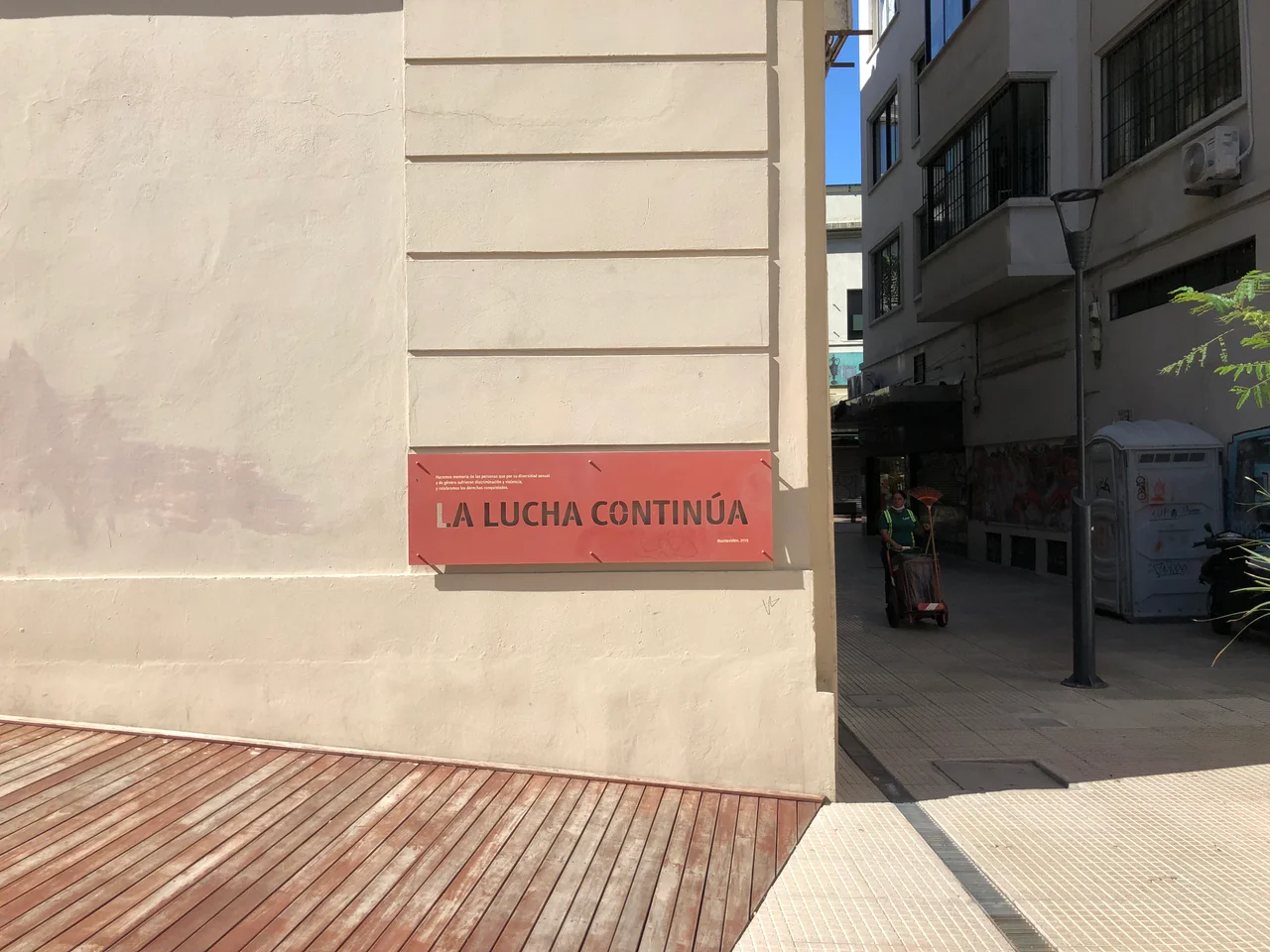

Plaza de la Diversidad Sexual
A triangle of granite rises from a small square in Montevideo's Old City, and its shape carries a hard memory. The pink triangle was once a badge of shame, a marker the Nazis forced gay and lesbian prisoners to wear in the camps. Here, in the Plaza de la Diversidad Sexual, that symbol has been reclaimed, lifted from the language of persecution into the language of pride. When Montevideo dedicated this plaza on February 2, 2005, it became the first public square in Latin America given over to honoring sexual diversity, and only the fourth such place anywhere in the world.
A City That Said Yes
The plaza did not arrive by decree from above. Eight activist and human rights groups came together to propose it, among them Amnesty International's Uruguayan chapter and a coalition of LGBT organizations, and they carried their proposal to the city's legislature. The vote was unanimous. That detail matters: in a region where laws and attitudes around sexuality have often lagged or hardened, Montevideo's representatives chose, without dissent, to set aside public ground for this purpose. The opening ceremony drew activists, intellectuals, and artists, including the writer Eduardo Galeano, whose presence lent the moment the weight of Uruguay's literary conscience. The mayor, Mariano Arana, presided.
The Monolith and Its Words
At the heart of the plaza stands the granite monolith, its triangular form deliberate and unmistakable. Across it runs an inscription that reads, in Spanish, "Honoring diversity is honoring life: Montevideo for the respect of every gender, identity, and sexual orientation." The words are not a celebration in the festive sense but a civic promise, carved in stone so that it cannot easily be walked back. The choice of the pink triangle as the central image insists on remembering the cost. People died wearing that mark. To place it here, enlarged and dignified in a public square, is to refuse to let that history be forgotten or repeated.
Lives Remembered
The square has become a place where stories are told as well as commemorated. In 2023, the researchers Diego Sempol and Aldo Garay mounted an open-air exhibition in the plaza titled, in translation, The Life of Gloria Meneses: Historical Memory and Silences. It gathered photographs from the life of Gloria Meneses, a travesti and LGBT rights activist, and set them out in the public space where passersby could not avoid them. The exhibition's subtitle, with its acknowledgment of silences, speaks to the work the plaza tries to do: not only to honor those who were visible, but to name the many whose lives went unrecorded and whose dignity history failed to register at the time.
A Symbol Turned Inside Out
To understand why the triangle matters, you have to know where it came from. In the Nazi concentration camps, prisoners were sorted by colored badges, and a downward-pointing pink triangle marked men imprisoned for homosexuality. Thousands suffered and died bearing it. In the decades after the war, activists across the world reclaimed the pink triangle, turning a brand of persecution into an emblem of identity and resistance. Montevideo's monolith belongs to that long act of reclamation, and its placement here was a deliberate piece of public memory. Uruguay has a deep secular tradition, having separated church and state early in the twentieth century, and that civic culture helped make room for a square like this. The city now marks September as a month of diversity, with this plaza among its anchor points.
A Quiet Landmark in the Old City
Set among the colonial streets of the Ciudad Vieja, the plaza is modest in size, the kind of square a visitor might come upon by chance while exploring Montevideo's oldest quarter. That ordinariness is part of its meaning. It does not stand apart in some special precinct; it belongs to the everyday fabric of the city, a small open space where children pass and neighbors cross. Uruguay would go on to legalize same-sex marriage in 2013, becoming one of the first nations in Latin America to do so, but this plaza came years earlier, a marker laid down when such a gesture was still rare and brave.
From the Air
The Plaza de la Diversidad Sexual sits in Montevideo's Ciudad Vieja at approximately 34.906 degrees south, 56.202 degrees west, within the dense colonial grid of the Old City near the Rio de la Plata waterfront. From the air, the plaza itself is too small to pick out, but the Old City's distinctive street pattern on its narrow peninsula, ringed by the wide estuary to the south and west, marks the neighborhood clearly. The nearest major field is Carrasco International Airport (ICAO: SUMU), about 11 nautical miles east-southeast along the coast; Angel S. Adami Airport (ICAO: SUAA) lies to the northwest. Clear coastal conditions give the best view of the peninsula and harbor below.
Nearby Stories
- Piriápolis 24 km away
- Minas 40 km away
- Tronador (rocket) 67 km away
- Nueva Helvecia 69 km away
- La Plata Museum 122 km away
- Battle of Sarandí 126 km away
- Mundo Marino 145 km away
- South Georgia Island 2584 km away