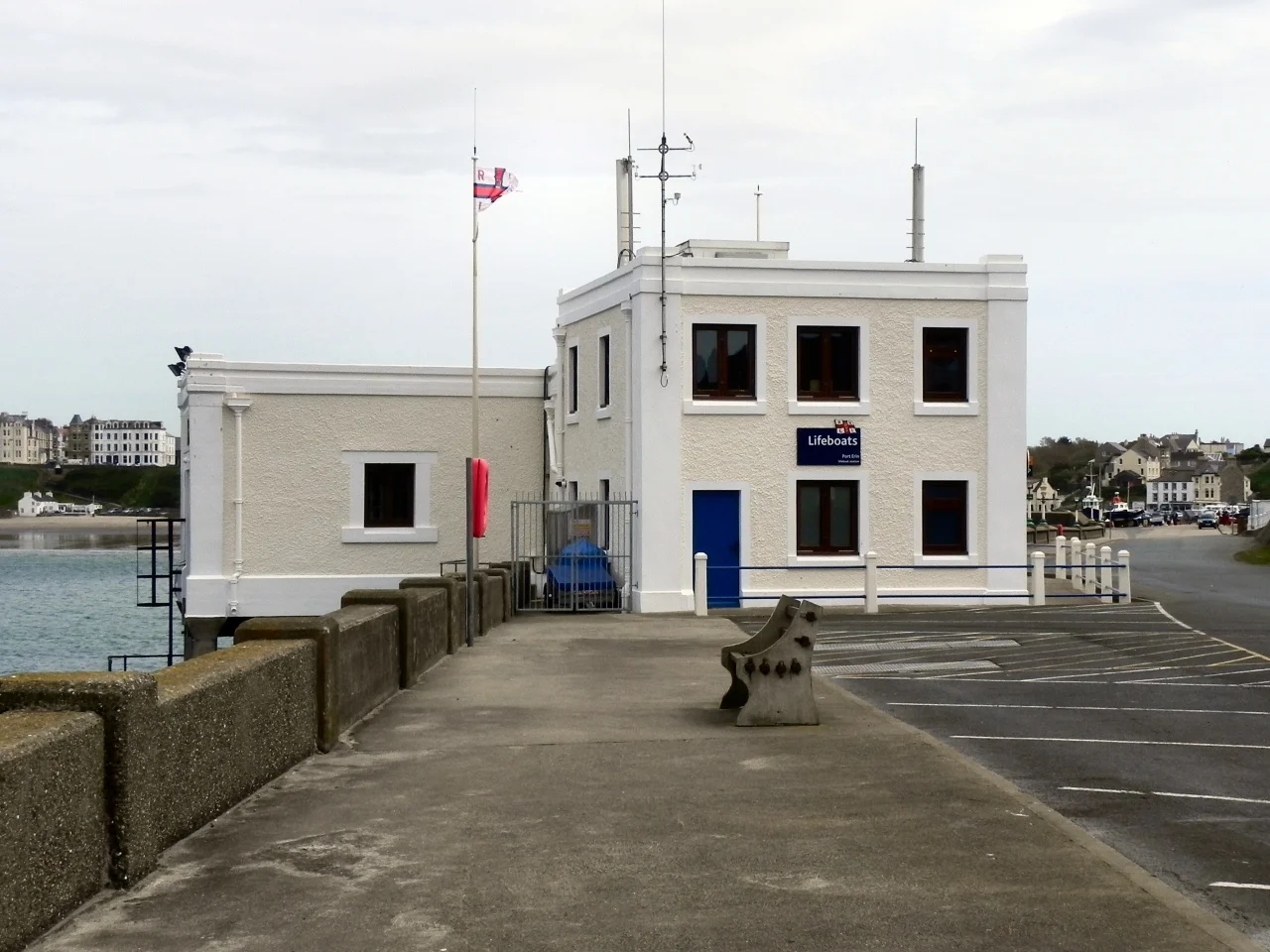

Port Erin Lifeboat Station
On 28 August 1883, a brass band met a horse-drawn cart at the shore of Port Erin Bay. The cart had come overland from Douglas, twenty-five kilometres away, pulled by eight horses. On it was a thirty-two-foot pulling-and-sailing lifeboat called Ann and Mary of Manchester, paid for from the bequest of one Richard Roberts of Blackley, Manchester, who had decided in his will that fishermen on a small island he probably never visited deserved a chance. The Lieutenant Governor of the Isle of Man, Henry Loch, gave a speech. The Manchester gentleman's name was read out. The boat was launched into Port Erin Bay for a demonstration, and the village had its first lifeboat. Every lifeboat since then has come the same way: someone, somewhere, decides that an island they may never see deserves better than to lose its fishermen.
The First Boat, and the Slipway That Followed
The Ann and Mary of Manchester needed somewhere to live. A boathouse went up on Breakwater Road in 1884, opposite the Raglan Pier, at a cost of 250 pounds. The coxswain and his crew rowed her out on alarms for nine years, but ten oars in an Atlantic swell were never going to be enough, and in January 1892 the station took delivery of a larger thirty-seven-foot, twelve-oared boat. This one was named William Sugden, funded from the bequest of Miss L. C. Sargenson of New Bond Street, London, again the gift of a stranger to the island. She served Port Erin for twenty years and is credited with saving twelve lives. Launching a heavy pulling lifeboat from a shingle beach is brutal work, and in 1900 the station gained a proper slipway at the cost of another thousand pounds. By then Port Erin had begun the slow process of becoming what it is now: a small Manx village with a boat that goes out when nobody else will.
The Names on the Boats
Every RNLI station carries its donors' names in the registry of its lifeboats. At Port Erin the roll runs from Ann and Mary of Manchester, through William Sugden, to the Osman Gabriel, a thirty-seven-foot motor lifeboat named in 1973 for Major Osman Gabriel, who paid for her. She launched seventy times between 1973 and 1992, and is credited with fifty-five lives saved. The 1990 RNLI coastal review reshuffled the south of the island: Port Erin moved from an all-weather lifeboat to an Atlantic 21 inshore boat, the kind designed for fast response close in, and the all-weather work passed to Douglas. On 24 June 2025 a new Atlantic 85 arrived, named Neil Crowe, the gift of the Gough Ritchie Trust, one of five lifeboats the trust has funded for the Isle of Man. She was formally named on 12 July 2025. She is the fastest boat that has ever been kept at Port Erin.
Why the South-West Needs a Lifeboat
The water between Bradda Head and the Calf of Man is the kind of water that punishes inattention. Tidal races run between Kitterland and the mainland. The prevailing south-westerlies blow straight into Port Erin Bay, turning the harbour entrance into a wall of white on a bad day. A sailor who misjudges the Sound between Spanish Head and the Calf can be on the rocks within minutes. Long before the breakwater was attempted in the 1860s, this stretch of coast had a reputation. The lifeboat service replaced an older tradition of voluntary rescue by the village's fishermen, who simply rowed out in their own boats when they saw something in trouble. The RNLI gave them better boats and, eventually, training. The voluntary crew, however, remained what it has always been: people who live on Bradda Road or Shore Road, who keep a pager next to the bed, and who run for the slipway when the pager goes off.
A Crew in a Small Village
Port Erin had a population of 3,730 at the 2021 census, and the lifeboat crew is drawn from those streets. The cox and the helms are people you might pass at the Co-op by the railway station, or walking a dog up the path to Bradda Head. The station does open days in summer; in winter it does training runs in conditions that would empty most beaches. The new boat sits in its house on Breakwater Road, ready, and the slipway runs straight down into the bay. From the air the station is barely visible as a building; what you can see is the slipway, a pale tongue of concrete running down into the surf, and the place where, on any given morning of any given year, somebody might be about to launch.
From the Air
Port Erin Lifeboat Station sits at 54.085 degrees north, 4.77 degrees west, on the south side of Port Erin Bay on the south-west coast of the Isle of Man. Best viewed at 1,500 to 2,000 feet on a coastal pass from the south, with Bradda Head (382 feet, capped by Milner's Tower) on the north side of the bay and the white-sand beach between. Nearest airport is Ronaldsway (ICAO: EGNS), about six miles to the east. Strong south-westerly winds and Irish Sea swell are common; the bay funnels the prevailing wind toward the village.
Nearby Stories
- RAF Jurby Head 14 km away
- German submarine U-246 16 km away
- German submarine U-1051 17 km away
- Kilclief Castle 18 km away
- Ardglass 31 km away
- St Bees Lighthouse 44 km away
- Trwyn Du Lighthouse 54 km away
- Seascale Lifeboat Station 61 km away