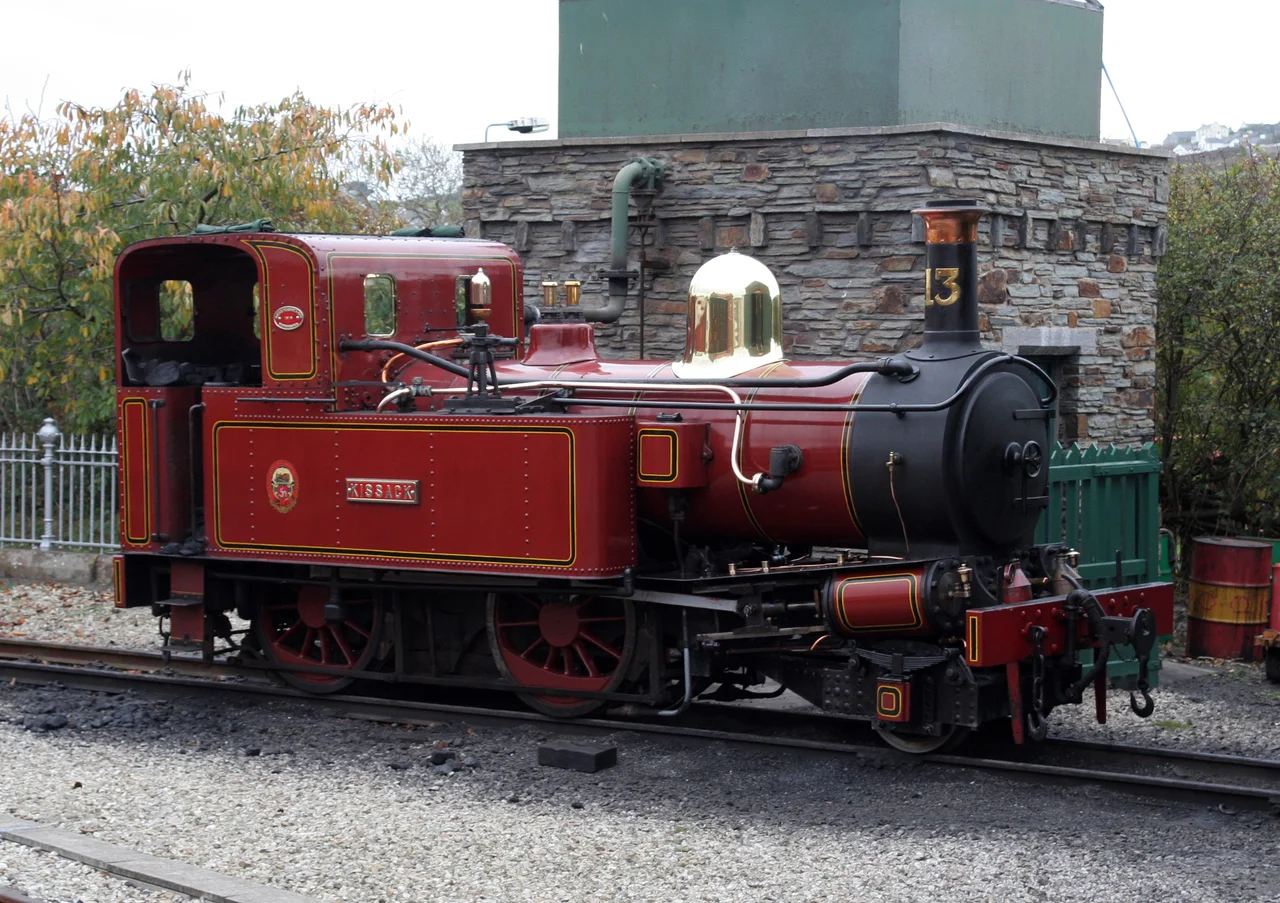

Port Erin railway station
There is a small hand-painted sign on the side of the locomotive shed at Port Erin that reads Purt Çhiarn / Port Erin. For most of the twentieth century it was the only bilingual railway sign on the Isle of Man, an oddity preserved by a station-master who liked Manx Gaelic better than corporate policy. Today the sign still hangs, and the trains that pull in beneath it run from Douglas, twenty-five kilometres east, through the green hills of the south of the island, through Castletown and Ballasalla and Port St Mary, and stop here. There is no more railway. The buffers are about a hundred metres from the door of the Bay Hotel.
Where the Network Ended Up
The Isle of Man Railway opened its first line to Peel in 1873, and a year later the southern line reached Port Erin on 1 August 1874. At the network's peak there were three main lines running west to Peel, south to Port Erin, and north to Ramsey, with branches to Foxdale. They had 46 miles of three-foot narrow gauge track. By 1968 only the southern line was left. Today the steam railway has Port Erin as its only outer terminus, and the trains still come, four a day in the summer season, taking 70 minutes from Douglas. They are pulled by locomotives that were built in the 1870s and 1880s, and they look exactly like the postcards of 1910 because, in a sense, they are the postcards of 1910 with new boiler tubes.
Two Stations on the Same Spot
The first station here was a small slate-rubble building, almost identical to the one that survives at Castletown. It was built in 1874 when the railway company was running short of money. It served until the Edwardian boom in seaside tourism overwhelmed it. Between 1902 and 1909 the entire station was rebuilt in Ruabon brick, that distinctive red engineering brick from north Wales, and the result is the building you see today: a long booking hall and waiting rooms, a cafe in what was once the porters' office, intricate carved wooden fascia boards along the canopy. The whole thing fitted into an awkward diagonal site between the platforms and Station Road, which is why the station has its particular oddity, a public right of way crossing the platform partway down. In the old days, when a long train pulled in, the locomotive crew had to uncouple the train so that the footpath to Athol Park stayed open. The arrangement is so unusual that Ripley's Believe It or Not! once featured it under the headline 'Right of Way Through a Train.'
The Museum Around the Corner
Across the yard from the platform is the Isle of Man Railway Museum, opened in 1975 in what used to be a bus garage built by Isle of Man Road Services, the railway company's road subsidiary. Inside are locomotives that the network can no longer use on the line. The largest, No. 16 Mannin, was supplied in 1926 and is too heavy for the surviving track. Next to her stands No. 6 Peveril, built in 1875, sister to the engines that opened the line. There are carriages, tickets, lamps, station signs from the long-closed lines to Peel and Ramsey. Most movingly there are framed timetables from the 1960s, the last decade in which it was possible to travel by train almost anywhere on the Isle of Man. In 2017 the museum hosted the fiftieth anniversary of the railway's reopening, and in 2023 No. 5 Mona was rolled into the main hall for the line's 150th.
What Coming Off the Train Feels Like
Trains operate from mid-March to the end of October. The platform is short and the train stops just shy of the buffers, so when you step off, the locomotive is still hissing into the boiler-room sky and the smell of hot oil and coal smoke fills the booking hall. Outside on Station Road the buses are waiting (Route 1, 2, or 11 to Douglas via everywhere) and the village proper is two blocks away across a level crossing on Droghadfayle Road that was automated only in 2011. Until then, the gatekeeper opened the gates by hand, and the locomotive crew opened them again to run round their train for the journey back. Some of the wooden picket fencing was lost to metal security panels in 1999 around the bus yard, which the railway preservation people still grumble about, but the new South-West Regeneration scheme of 2016 to 2018 brought back the miasma tower above the roof and laid a stone paving area outside. The station, in other words, is being looked after.
From a Few Hundred Feet Up
Look down on Port Erin from above and the railway is obvious from the shape: a long red building set diagonally into the village, the green-and-cream paintwork visible on the platform canopy, the locomotive shed off to the south, the new carriage shed of 1998 behind. Beyond it the village runs down to the bay, the white sand of Port Erin Beach curving north toward Bradda Head and Milner's Tower on top of it. From this height the steam trains, when running, are a thin white plume drifting south from Castletown. The whole line is less than fifteen miles long. It is the last working stretch of the Manx narrow gauge. It is older than the airport, older than nearly every road on the island, and on a fine June morning with the train standing at the platform and the kettle on in the cafe, it is one of the more comforting places to be in the British Isles.
From the Air
Port Erin Railway Station sits at 54.085 degrees north, 4.76 degrees west, in the centre of Port Erin village. Best viewed at 1,500 to 2,500 feet on an approach from the east, with the red Ruabon brick of the station building, the curving track running south-west toward the buffers, and the white sand of Port Erin Bay opening to the west. Nearest airport is Ronaldsway (ICAO: EGNS), about six miles to the east. The Isle of Man Steam Railway operates from mid-March to the end of October; on operating days the locomotive's steam plume is often visible from altitude.
Nearby Stories
- RAF Jurby Head 14 km away
- German submarine U-246 16 km away
- German submarine U-1051 17 km away
- Kilclief Castle 18 km away
- Ardglass 31 km away
- St Bees Lighthouse 44 km away
- Trwyn Du Lighthouse 54 km away
- Seascale Lifeboat Station 61 km away