_Apr_2024.jpg)
Porthdinllaen Lifeboat Station
The crew at Porthdinllaen launches in Welsh. The call comes in -- shipping in trouble in Caernarfon Bay, a yacht dismasted off Bardsey, an angler swept off rocks at Trefor -- and the coxswain runs through the ready check in the language his grandfather spoke. Every other Royal National Lifeboat Institution station in Britain operates in English. Porthdinllaen is the exception. The station has stood at the end of this Llyn Peninsula spit since 1864, and the bay it guards is one of the busiest stretches of small-craft water on the Welsh coast.
Why the Station Is Here
In the nineteenth century, North Wales had no good roads. Goods moved by sea, and the sea around the Llyn Peninsula was unforgiving -- exposed to the full sweep of the Irish Sea, with few harbours of refuge. Porthdinllaen's natural harbour, sheltered by a headland that breaks every wind except a north-easterly, became the safest anchorage on the entire peninsula. In 1861 alone over 700 ships passed through the port. With that volume of traffic came wrecks, and with wrecks came the need for a lifeboat. The RNLI established the station in 1864. The first Bronze Medal awarded to a Porthdinllaen crewman, Robert Rees, predates the station itself -- given in 1863 for a rescue carried out without a dedicated lifeboat. The station has been continuously crewed for over 160 years, through age of sail and age of steam, through wartime convoys and modern weekend yachting.
Bequest and Boathouse
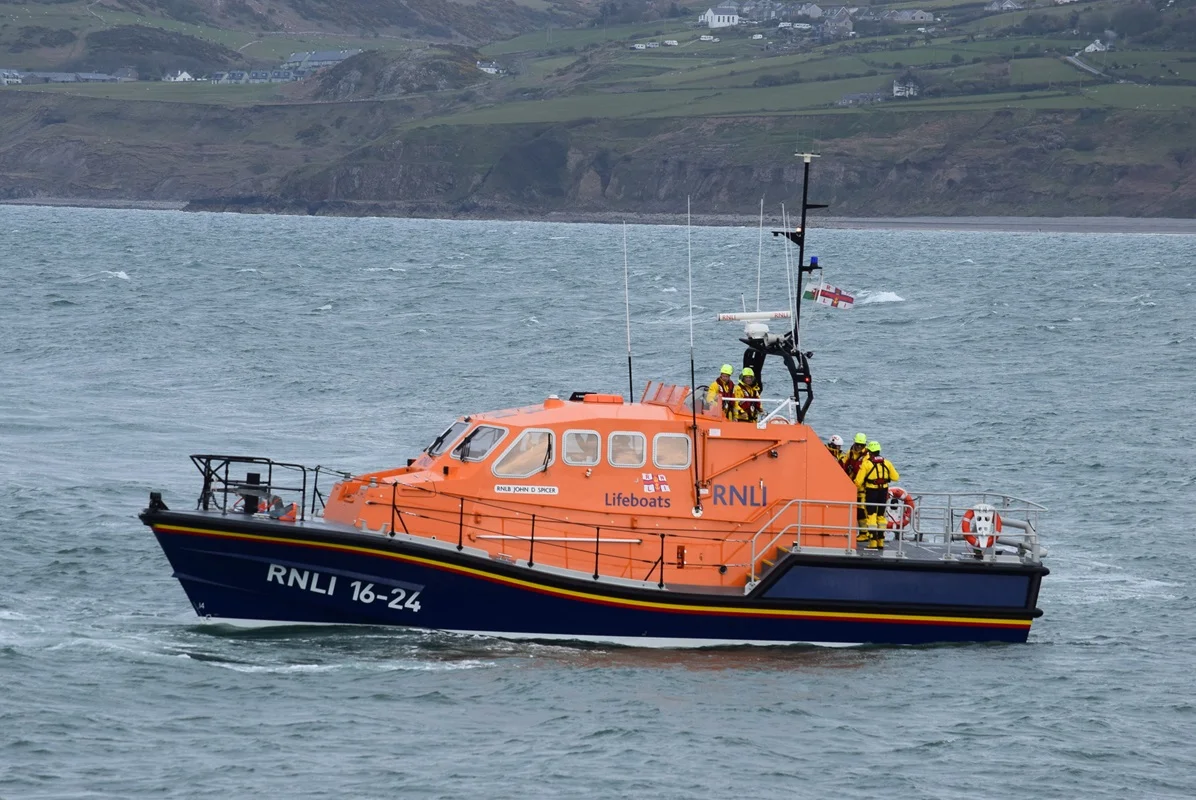
In October 2010 a man called John Dominic Spicer died in Oxfordshire. His will left a substantial bequest to the RNLI, and the executors agreed it should fund a new all-weather lifeboat for Porthdinllaen. The Tamar-class boat that arrived in 2012 was named 16-24 John D. Spicer in his memory. She replaced the Hetty Rampton, which had served the station since 1987. But the new boat was bigger than the old boathouse could accommodate, and a new boathouse had to be built -- at a cost of eight million pounds. The construction problem was logistical rather than financial. There is no proper road to Porthdinllaen. The only land access runs along a cliff-top track and across the Nefyn and District Golf Club's fairways. Local residents objected to widening either, and the cost of realignment was prohibitive. The RNLI's solution: deliver every brick, beam, ton of concrete and length of steel by sea. The same approach had worked at Tenby a few years earlier. The boathouse opened in April 2014.
Medals on the Wall
The honours board at Porthdinllaen records bravery across generations. One Silver Medal, awarded in 1951 to Second Coxswain William Dop. Three Bronze Medals: Griffith John Jones, Coxswain in 1975; Glyn Roberts, crew member in 1977; Michael Massarelli, Acting Coxswain in 1981. The Thanks of the Institution inscribed on Vellum, awarded twice. A British Empire Medal to Kenneth Fitzpatrick, the station's Lifeboat Operations Manager, in the 2024 New Year's Honours. Mike Davies, a former Coxswain, received the Merchant Navy Medal for Meritorious Service in 2019. Each award marks a specific shout in specific weather -- a fishing vessel taking on water in a force eight, a yacht aground on Bardsey Sound, swimmers cut off by rising tide. The last Bronze, in 1981, was for a particularly difficult rescue off Trwyn Cilan in heavy seas. In 2013 the Welsh-language broadcaster S4C ran a six-part documentary, Bad Achub Porthdinllaen, following the crew through a year on station.
Visitors Welcome
The RNLI classifies Porthdinllaen as an Explore station -- one of those designed to give the public a close look at the lifeboat and the work of the crew. There is a gift shop. There are free summer tours and pre-booked winter ones. Getting here is part of the visit: the walk along the headland past the Iron Age hillfort, or across the beach from Morfa Nefyn at low tide. The boathouse and its slipway sit at the seaward end of the National Trust hamlet, beyond the Ty Coch Inn. When the maroon goes up and the doors open and the John D. Spicer launches down the slipway into Caernarfon Bay, the people sitting outside the Ty Coch put down their pints to watch. It happens often enough that they have stopped being surprised, but they have never stopped watching.
From the Air
Located at 52.95N, 4.56W at the seaward end of the Porthdinllaen spit on the north-west coast of the Llyn Peninsula. Caernarfon Airport (EGCK) lies 16nm east. Best viewed at 1,000-2,000ft AGL. The new boathouse and slipway sit at the tip of the small headland, surrounded by water on three sides. The Nefyn golf course occupies the higher ground behind. On a clear day the view extends north to Anglesey and east to Yr Eifl's three peaks.
Nearby Stories
- GeoMôn 1.9 km away
- Battle of the Conwy 3.2 km away
- Irish Sea Bridge 5.2 km away
- Ysbyty Ifan 10 km away
- Machynlleth 16 km away
- Barmouth Lifeboat Station 23 km away
- Irish Sea 27 km away
- HMS Tyler 32 km away