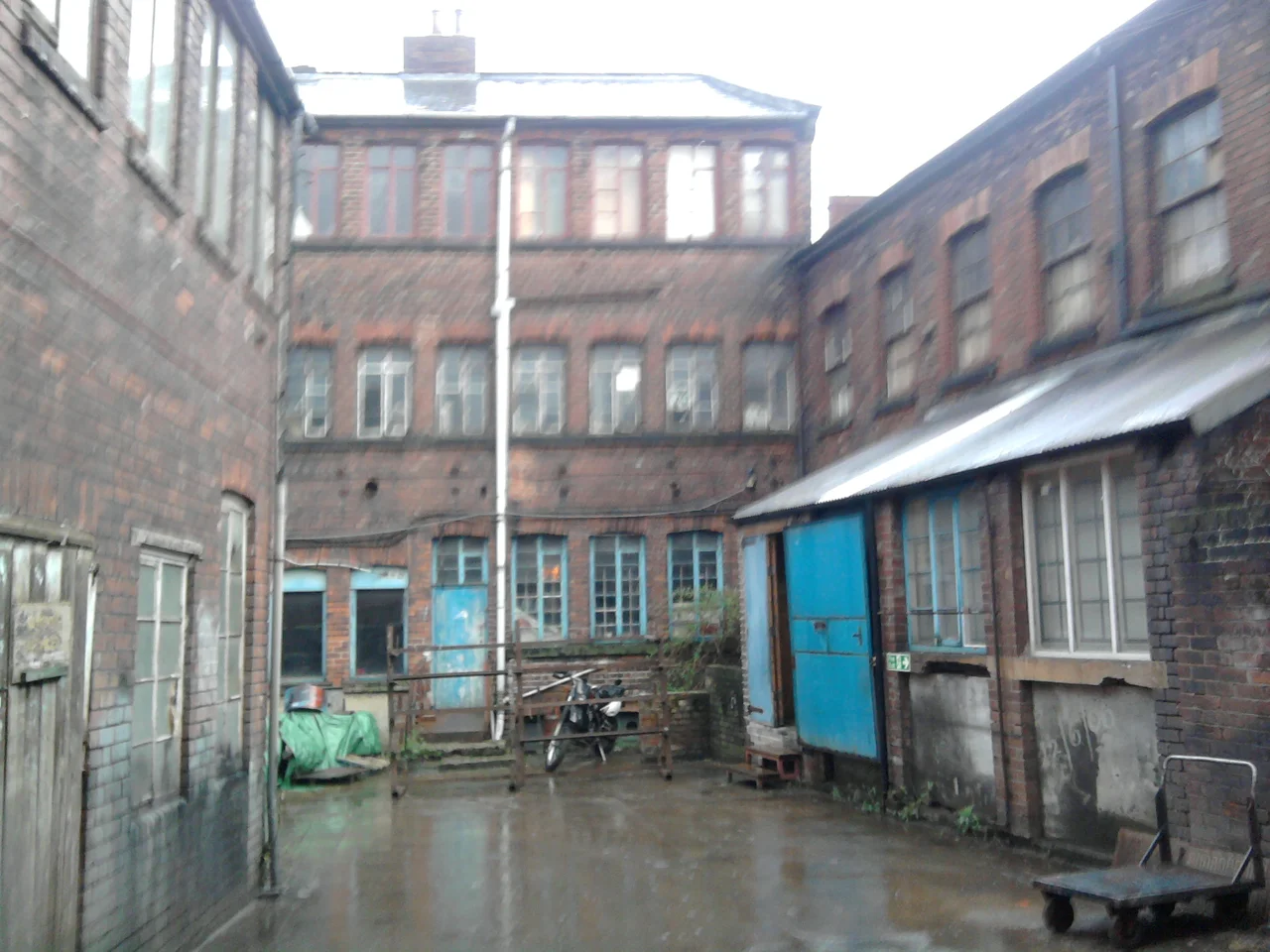

Portland Works
Stand in the courtyard of Portland Works on Randall Street and you can hear the building working. There is hammering from a forge to your left. The soft buzz of a guitar luthier's belt sander upstairs. From a far doorway, the unmistakable sound of someone steeping juniper berries for a small-batch gin. Around 30 small businesses share these 2,600 square metres of brick workshops and offices, gathered around the octagonal chimney that has stood since J.H. Jenkinson designed this place in 1877. Cutlery is still made here. So is jewellery, furniture, photography, theatre, art. In 2013, when developers wanted to convert it into flats, the workers and their neighbours pooled their savings and bought the building themselves.
Brearley's Knife
In 1913, a metallurgist named Harry Brearley working at Brown Firth Research Laboratories was looking for a steel that would resist erosion in gun barrels. While experimenting with chromium additions he noticed that one of his rejected billets, left in a yard, refused to rust. He understood what he had: a steel that did not stain. To turn the discovery into an actual product he needed a cutler. He found Ernest Stuart at R.F. Mosley & Co., who occupied Portland Works at the time. In 1914, Brearley, Stuart and Mosley made the first knife blades from what Stuart would dub 'stainless steel' - the table knives that, more than any single Sheffield innovation, changed how the world ate. Portland Works was where the first stainless cutlery in the world was forged, ground and finished. It is still where some of the city's last hand-finished knives are made.
Workshops Around a Courtyard
The building's design was a Sheffield archetype. Three two- and three-storey ranges of red-brick workshops, offices and showrooms enclose a courtyard with an octagonal chimney at its centre. Each range was further subdivided into small workshops rented out to individual masters and journeymen - the 'little mesters' whose self-employed craftsmanship defined the Sheffield trade. The works was partially mechanised from the start. When English Heritage surveyed it in 1995, hand forges and a steam-grinding room were still in place; the central section of the rear range had been reduced from three storeys to two after a fire, a small architectural scar that no one ever quite repaired. R.F. Mosley & Co. held the works for many years before it was split into the small-business warren it remains today.
The Save Portland Works Campaign
By 2009, with Sheffield's industrial buildings vanishing fast, an outside developer applied for planning permission to convert Portland Works into residential flats. The existing tenants - cutlers, engravers, artists, knife-makers - faced eviction. They organised. The 'Save Portland Works' campaign formed in 2009, became a registered Community Benefit Society in 2011, and launched one of the largest community share issues in British history. Nearly five hundred individual people put up their own money - some hundreds of pounds, some thousands - to buy the building outright. By early 2013 they had raised almost £500,000, with critical help from the Architectural Heritage Fund, and the works passed into community ownership. There are now over 500 shareholders. None of them can earn dividends. The point was never profit.
What a Living Factory Sounds Like
Since 2013, volunteers have been slowly restoring the works, retaining as much original fabric as possible - pitch-pine window frames, hand-forged window catches, lime-mortar pointing on the brick - while adding modern essentials like roof insulation and fire alarms. A Heritage Lottery Fund grant funded extensive roof restoration in 2018. Tenants include knife makers, engravers and engineers; cabinetmakers and joiners; jewellers and silver platers; artists, guitar makers, photographers and a Yorkshire gin distillery. Def Leppard rehearsed here in their early years. Local artist Joe Scarborough painted a 'Life in the Big Village' cutaway of the works in 2019. A small museum celebrates the Mosley family and the workers who passed through these rooms. The next time someone tells you that British industry is dead, send them to Portland Works on a Tuesday morning - and tell them to listen.
From the Air
Coordinates 53.37°N, 1.4741°W. Best viewed from 1,500-2,500 feet AGL. Located in the Highfield area of Sheffield, just south of the city centre, on the corner of Randall Street and Hill Street. Nearby airports: Sheffield/Doncaster (EGCN) 19 nm east, Manchester (EGCC) 35 nm west. Look for the rectangular brick building with an octagonal chimney at its centre, sandwiched between residential streets. Bramall Lane football stadium - home of Sheffield United, nicknamed The Blades - sits within walking distance to the southwest.
Nearby Stories
- Rochdale Pioneers Museum 3.4 km away
- Adlington Hall 4 km away
- National Coal Mining Museum for England 4.2 km away
- Sneyd Colliery Disaster 6.6 km away
- Southwell Minster 6.8 km away
- Belper North Mill 9 km away
- Selby Rail Crash 13 km away
- RAF Finningley 15 km away