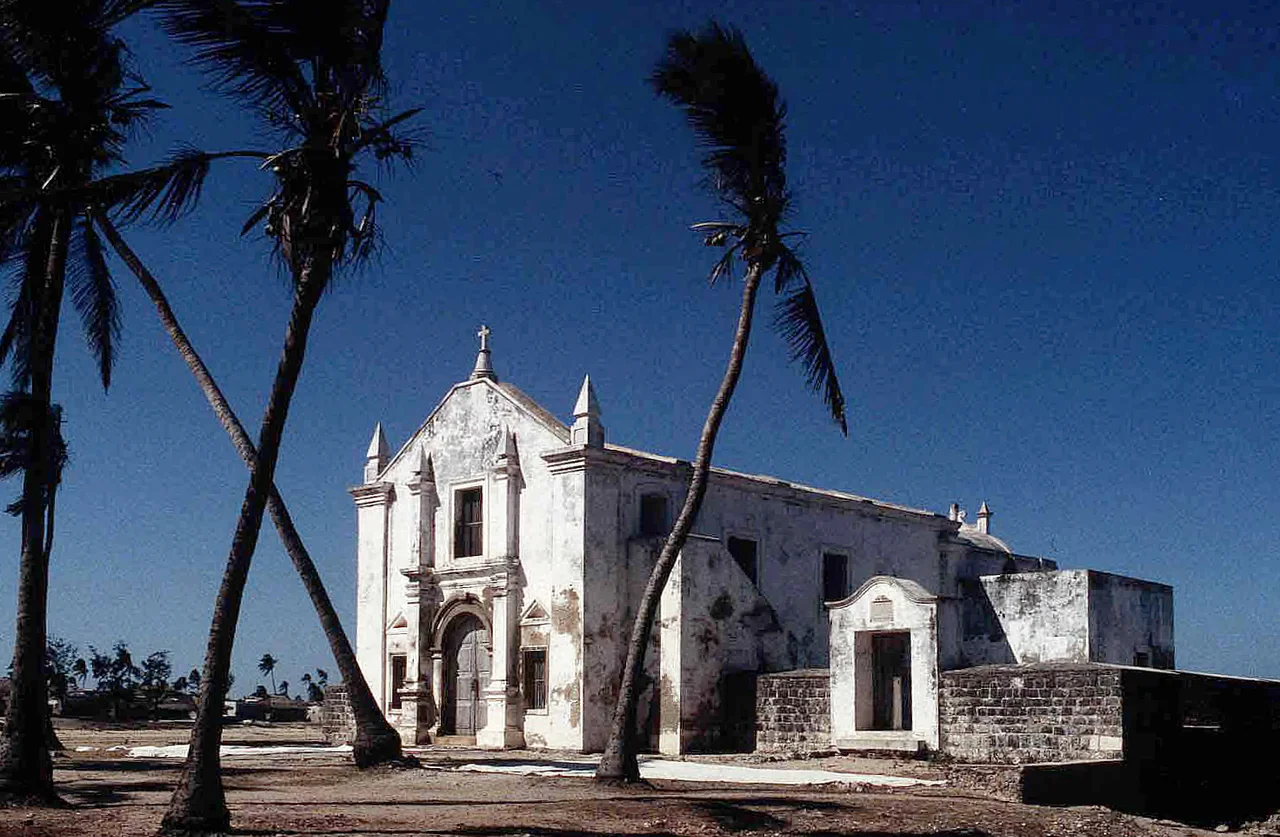

Portuguese Mozambique
Vasco da Gama's ships reached this coast in 1498, and Portugal did not let go for 477 years. What began as a string of trading forts strung along the Indian Ocean - way stations on the sea route to India - hardened over the centuries into a colony, then a self-styled overseas province, then a system that bound millions of Africans to labor they had not chosen. The story of Portuguese Mozambique is the story of how a maritime trading empire became a settler state, and of the long, costly war that finally ended it.
Forts on the Edge of an Empire
For four centuries Portugal's grip was thinner than the maps suggested. Coastal posts were built, abandoned, and rebuilt; governors came to make their fortunes and leave. The settlers who stayed were traders who married local women and kept careful relations with African chiefs, while the Mwenemutapa and other inland kingdoms went on largely undisturbed. Portugal cared more about the spice trade with India and the colonization of Brazil. To control the interior, the crown handed out prazos - vast land grants that, through intermarriage, became African-Portuguese estates defended by armies of enslaved soldiers called Chikunda. Slavery was woven through the whole arrangement. People were bought and sold by African chiefs, Arab traders, and the Portuguese alike, and many of the enslaved were captives sold by chiefs who raided rival communities.
The Machinery of Forced Labor
When the Scramble for Africa forced Europe to draw hard borders, Portugal had to actually occupy what it claimed. It waged war against African polities into the early twentieth century, and it built a state designed to extract labor. Even after slavery was formally abolished, the chartered companies that ran much of the territory enacted forced-labor policies, supplying cheap and often coerced African workers to mines and plantations across southern Africa. The 1929 Statute of Indigenous Populations made the inequality law: it split society into citizens, who held Portuguese rights, and indígenas, the African majority, who were subject to customary authority, pass laws, and unpaid forced labor. A small middle group, the assimilados, could escape forced labor only by proving they had become, in the colonizer's eyes, sufficiently European. Behind the talk of a civilizing mission was a system built to keep most people poor and working.
A Settler Economy
By the mid-twentieth century the contradictions had a price tag. The economy boomed in the 1950s and 1960s, drawing tens of thousands of Portuguese settlers and foreign capital - British sugar concessions, Belgian-financed coal at Moatize, the great Cahora Bassa dam begun in 1969. By independence, Mozambique had one of the more developed industrial bases in sub-Saharan Africa. But the wealth was deeply unequal. In 1970, after generations of segregated schooling, only about 7.7 percent of the population could read. The statistics were blunt: roughly a quarter-million Europeans, around 3 percent of the people, held the skilled jobs, the good schools, and the capital, while millions of Africans were locked out of the prosperity their labor produced. From this gap the independence movement grew.
The War and the Carnation
In September 1964, the Front for the Liberation of Mozambique - FRELIMO, led by Eduardo Mondlane and headquartered in Tanzania - opened a guerrilla campaign against Portuguese rule. It became one front of the Portuguese Colonial War, fought simultaneously in Angola and Guinea, and it dragged on for a decade. The war consumed a punishing share of Portugal's budget and patience, and it was the soldiers themselves who ended it: on 25 April 1974, officers in Lisbon overthrew the Estado Novo regime in the nearly bloodless Carnation Revolution. The new government offered independence to the colonies. Mozambique became free on 25 June 1975. Within a year almost the entire Portuguese population had gone, leaving as refugees the homeland called retornados - some expelled, many simply afraid - and a new nation inherited both a rare industrial base and the deep scars of what had built it.
From the Air
Portuguese East Africa stretched some 2,470 km along the coast, from the Rovuma River in the north to Maputo Bay in the south, its administrative heart anchored at the old colonial capital of Lourenço Marques (now Maputo) at roughly 25.92°S, 32.58°E. From altitude the legacy is still legible: the deepwater ports of Maputo, Beira, and Nacala; the rail lines driving inland toward Zimbabwe, Malawi, and South Africa; and the vast Cahora Bassa reservoir on the Zambezi in the northwest. Maputo International Airport (ICAO: FQMA) and Beira Airport (ICAO: FQBR) anchor the southern and central coast. Best viewed in the dry season (May-September) when haze over the Indian Ocean lowlands clears; recommended altitude 5,000-10,000 ft over the port cities.
Nearby Stories
- 1986 Mozambican Tu-134 Crash 3.9 km away
- Eswatini 65 km away
- Ponta d'Ouro 82 km away
- Sabi Sand Game Reserve 96 km away
- Sudwala Caves 186 km away
- Zavora 252 km away
- MS Africa Shell 267 km away
- Ngilgi Cave 7739 km away