.jpg)
Preston Mill
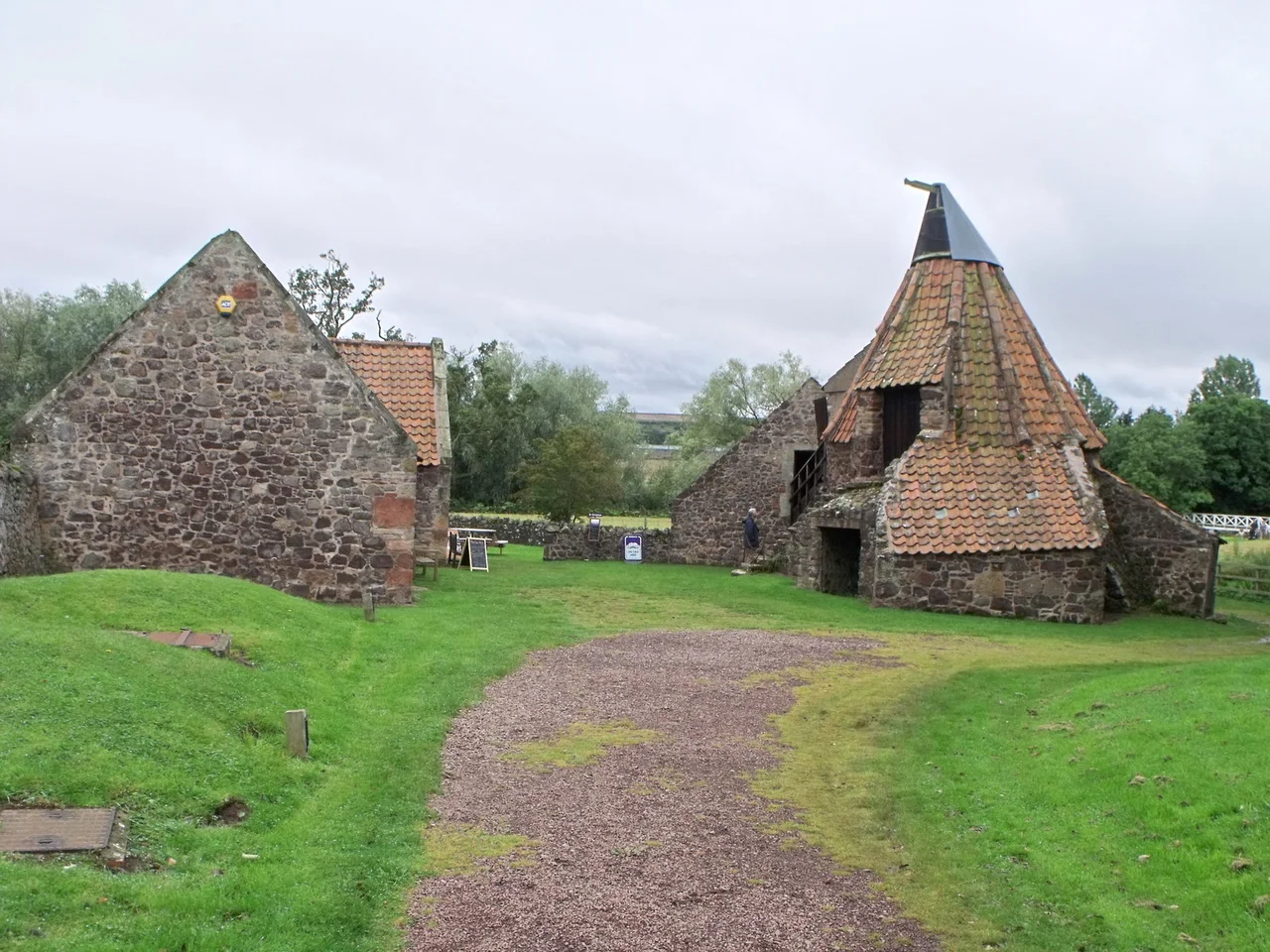
The kiln roof is what stops the cars on the B1407. It is a perfect cone of red pantile, rising over a rough stone tower, looking less like a piece of Scottish industrial heritage and more like something from a fairy tale or a Studio Ghibli film. Painters have set up easels here for two centuries. Photographers stop for the reflections in the millpond. Outlander filmed scenes here. The mill itself ground oatmeal commercially until 1959, which means there are still people alive in East Linton who remember the dust on their fathers' boots coming home. The River Tyne still turns the wheel for visitors, and inside the building the wooden machinery still clatters and shakes the way it has since the eighteenth century.
A Mill on the Tyne Since the 1500s
There has been a mill on this exact spot, on the east bank of the River Tyne where it loops past the hamlet of Preston, since at least the sixteenth century. The present building dates from the eighteenth century, though the water wheel that visitors see today was installed in 1909. Andrew Meikle, the engineer and millwright who later invented the threshing machine that transformed nineteenth-century agriculture, maintained the mill in the late 1700s. Meikle's grave is at nearby Prestonkirk. He was buried in 1811, full of the years and the ideas that mechanized Scottish farming, and the mill he kept running outlived him by 148 commercial years before silence finally settled in 1959.
Oats, Floods, and the National Trust
Preston Mill produced oatmeal, the staple food of lowland Scotland for centuries. The kiln, with its conical red roof, is where the oats were dried before grinding, fired by anthracite or peat from below to give the meal its faintly smoky flavour. The mill survived the closure of every other watermill in the parish, but it could not survive the economics of the twentieth century. In 1948 a flood from the River Tyne submerged the buildings entirely. In 1950 the local landowner handed the mill to the National Trust for Scotland. The milling firm Rank Hovis McDougall, recognizing what they had once been, supplied expertise and money for the renovation that brought the wheel back to turning. Commercial milling ended in 1959. Visitor demonstrations began shortly afterward and have not stopped.
What Stands on the Site Today
Preston Mill is technically three structures: the mill itself, the kiln with its photogenic roof, and the miller's house where the family lived. All three are Category A listed, the highest grade in Scotland's heritage classification. The interior tour takes visitors through the gear room where the water wheel's torque is converted by a system of wooden gears into the rotation of the millstones above. The stones themselves are dressed with grooves cut by hand to do their cutting work as the grain passes between them. There is a milling exhibition in the kiln. The mill pond outside still floods regularly when the Tyne rises, a recurring feature of life on this floodplain that the National Trust now manages as part of the visitor experience rather than as the disaster it once was.
Phantassie and the Wider Estate
A short walk from the mill, across a field path, stands the Phantassie Doocot, a beehive-shaped dovecote that once held over 500 nesting boxes for pigeons. Doocots like this were a feudal privilege; only landowners could maintain them, and the pigeons that fed on neighbouring farmers' grain were a tax in feathers and meat. The Smeaton Hepburn estate and Smeaton Lake lie just to the north. Prestonkirk Parish Church, where Andrew Meikle is buried, sits a few hundred yards south. The whole bend of the Tyne here is a compact archive of Scottish rural life: the laird's house, the parish church, the working mill, the dovecote, the mill cottages, all preserved in roughly the relationship they held to one another in 1800. Few places in Scotland keep this much of the agricultural past visible at once.
From the Air
Preston Mill sits beside the River Tyne at 55.99N, 2.65W just east of the village of East Linton in East Lothian. From the air the distinctive conical red kiln roof is the visual marker, beside the dark loops of the River Tyne. Edinburgh Airport (EGPH) is 22nm west; Dundee Airport (EGPN) lies 22nm north across the Firth of Forth. The A1 trunk road passes just north of the mill, with the East Coast Main Line railway slightly further north. Bass Rock and North Berwick Law are visible 4nm north of the site. Best viewed at 1,500-3,000ft with good visibility.
Nearby Stories
- Leith 0.8 km away
- Crail 1.4 km away
- Falkland Palace 2.8 km away
- Peebles 8 km away
- Mellerstain House 9.9 km away
- Eyemouth Disaster 11 km away
- Battle of Homildon Hill 19 km away
- River Dee Ferryboat Disaster 99 km away