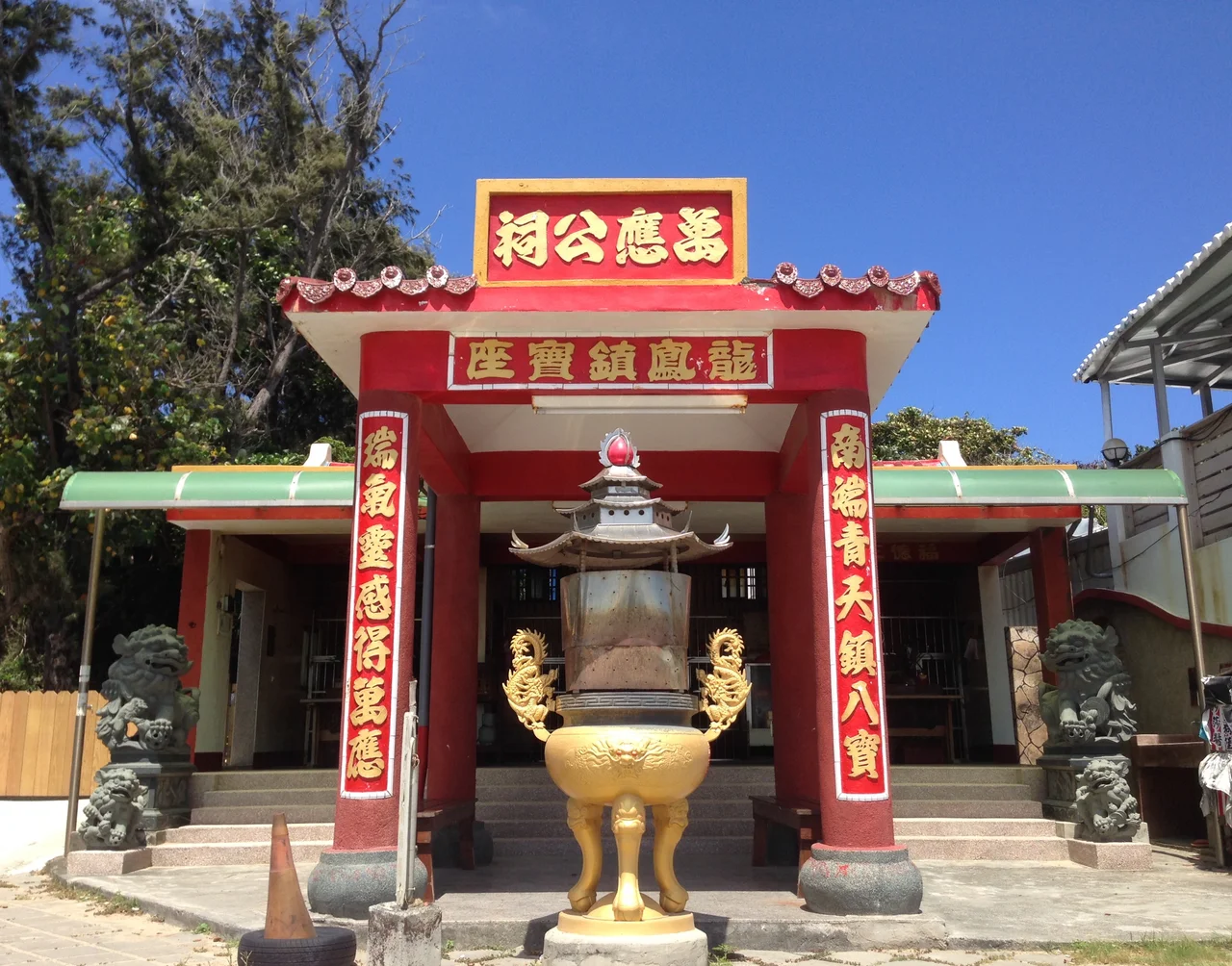

Princess Babao Temple
The worshippers bring coffee and red wine. This is not typical temple protocol in Taiwan, but the Princess Babao Temple is not a typical temple. Tucked beside a beach in Kenting National Park, it enshrines a woman named Margaret — a foreigner, by all accounts Dutch, who died on this coast centuries ago after a shipwreck. No one knows precisely when she lived or whether the legend is literally true. But the eight belongings taken from her body — a pair of wooden clogs, a silk scarf, a pearl necklace, a gemstone ring, a leather suitcase, earrings, a feather pen, and paper — gave the shrine its name: babao, meaning "eight treasures." And so she became Princess Babao, honored with offerings suited to her origins rather than the traditions of the land that claimed her.
A Ship, a Shore, and Eight Things
The legend at the center of the temple begins with a Dutch vessel wrecked off the coast of Hengchun. The survivors who came ashore encountered indigenous people of the Guizijiao community — the group now known as the Paiwan people of the Sheding area. According to the tradition, the indigenous people of the area did not customarily kill women among shipwreck survivors. The men were killed; the women were spared. But a woman named Margaret was killed nonetheless, either deliberately or because her gender was mistaken. A lone tribesman took eight items from her body, and those eight objects — specific, particular, human things that someone had packed for a voyage — became the symbolic core of her veneration. The name babao attached to her memory. The temple that grew up around that memory made her a princess.
History Hovering Near the Legend
Historians have noted a significant parallel. In 1867, the American merchant ship USS Rover shipwrecked off Taiwan's southern coast, and the survivors — including Mercy G. Hunt, wife of the captain, Joseph Hunt — were killed by indigenous people. The Rover incident became an international diplomatic episode, pressing both American and Chinese authorities to address the status of the island's indigenous territories. Whether the Princess Babao legend is a garbled memory of Mercy Hunt's story, an independent event from an earlier era, or a composite of multiple maritime tragedies that touched this coast over the centuries, scholars cannot say with certainty. The similarities are striking enough to invite the question but not clear enough to settle it. What is certain is that this stretch of coastline was, for centuries, a place where the sea brought strangers who did not survive to tell their own stories.
Three Halls, One Portrait
The Princess Babao Temple is a small structure, its scale intimate rather than grand, divided into three halls. The central hall holds an altar to Wanyinggong — unnamed, unknown souls, the spiritual residue of all who died without proper burial or remembrance. On one side, Princess Babao has her own altar. On the other, Tudigong, the earth god who appears in countless Taiwanese temples, holds his place. Above Princess Babao's altar hangs a portrait of a White woman, the artist's attempt to give a face to a legend. The offerings left for her are deliberately foreign: coffee and red wine, the kinds of things a Dutch woman might have wanted. In Taiwanese religious practice, the logic of veneration is often practical — give the spirit what she would have wanted in life. In March 2016, a fire broke out in the temple, likely from incense lodged in the cracks of a wooden artifact. The charred wood was kept in place. Some things you leave as they are.
What the Temple Tells You About This Coast
The Hengchun Peninsula has always been a place of crossings. It is the southernmost reach of Taiwan, surrounded by open ocean, positioned where the Taiwan Strait meets the Pacific. Ships have moved through these waters for as long as ships have sailed the South China Sea. Wrecks were not rare. Encounters between sailors from distant ports and indigenous communities who had lived here for millennia were not rare either. The Princess Babao Temple is one result of those encounters — a place where loss and uncertainty solidified into ritual, where a stranger who died without ceremony was eventually given a permanent home and a name. The temple sits next to a beach inside Kenting National Park, drawing both devout visitors and curious tourists. The beach is beautiful, the water clear. It is easy to forget, standing there, that the coast has a long memory.
From the Air
Princess Babao Temple is located at approximately 21.943°N, 120.799°E, near the southern coast of the Hengchun Peninsula within Kenting National Park. The site is close to the shoreline on the peninsula's southeastern side. Approaching from RCKH (Kaohsiung International), roughly 65 kilometers north-northwest, the Cape Eluanbi lighthouse at Taiwan's southern tip provides the primary visual landmark; the temple sits a few kilometers north along the eastern coast from the cape. Recommended altitude for coastal context is 2,000 to 3,500 feet, where the beach adjacency and the proximity to both the forest reserve and the cape become visible together. Winds off the Pacific typically come from the east or southeast in this area.
Nearby Stories
- Mudan Incident 2 km away
- Lanyu Flying Fish Cultural Museum 30 km away
- Zhaori Hot Spring 59 km away
- Ten Drum Rende Creative Park 88 km away
- Mavulis Island 89 km away
- Barclay Memorial Park 121 km away
- 1991 Eruption of Mount Pinatubo 722 km away
- Scarborough Shoal 762 km away