
Prudhoe
Five thousand miles of frozen tundra separate Prudhoe in Northumberland from Prudhoe Bay in Alaska, and yet they share a name. The Arctic oil field, the largest in the United States, was christened in the 19th century by the explorer Sir John Franklin, who named the bay after his good friend Algernon Percy, Baron Prudhoe, of Prudhoe in Northumberland. The English town on the steep north-facing hill above the Tyne has no oil, but it has a Norman castle that the Scots could never take, a giant stone badger by the bypass, and the actor who played the angel in It's a Wonderful Life.
The Proud Spur
The name is Anglo-Saxon. Prud, from prūd meaning 'proud,' and hoe or haugh, a spur of land. A castle has stood on that spur since the 11th century, and from the start it was meant to keep Scotland out. Robert d'Umfraville, the Norman knight who built the first stone defences, held the barony from Henry I. By the 12th century Prudhoe Castle was strong enough to repel William the Lion of Scotland twice in successive years (1173 and 1174). Local tradition holds that the Scots once burned an orchard at the foot of the castle, in an area still called Castlefields, hoping to smoke out the garrison; the garrison held. Prudhoe is, by tradition, the only medieval defensive fortification in Northumberland never captured by the Scots.
Coal, Chalk and Cold War
Prudhoe was a coal town. The West Wylam Colliery worked the seams beneath the modern road into Castlefields, and a miner's cart found in nearby brambles by a former employee still marks the spot. The colliery is buried, but the industrial site by the river has cycled through many owners: ICI built a fertiliser plant there, leaving behind the artificial chalk hills called the Spetchells (now turfed over, now a country park, with chalk-loving flora that should not really be in Northumberland at all). Cleveland Engineering followed ICI, making car parts; Kimberly-Clark followed Cleveland, making tissue paper. The plant is now run by the Swedish firm Essity. During the Cold War, the Royal Observer Corps maintained an underground nuclear monitoring post opposite Highfield Park, one of about 1,563 such posts manned by civilian volunteers across Britain. It opened in 1962 and closed in 1991, three months after the Soviet Union fell.
Cottier Glass and the Church that Moved
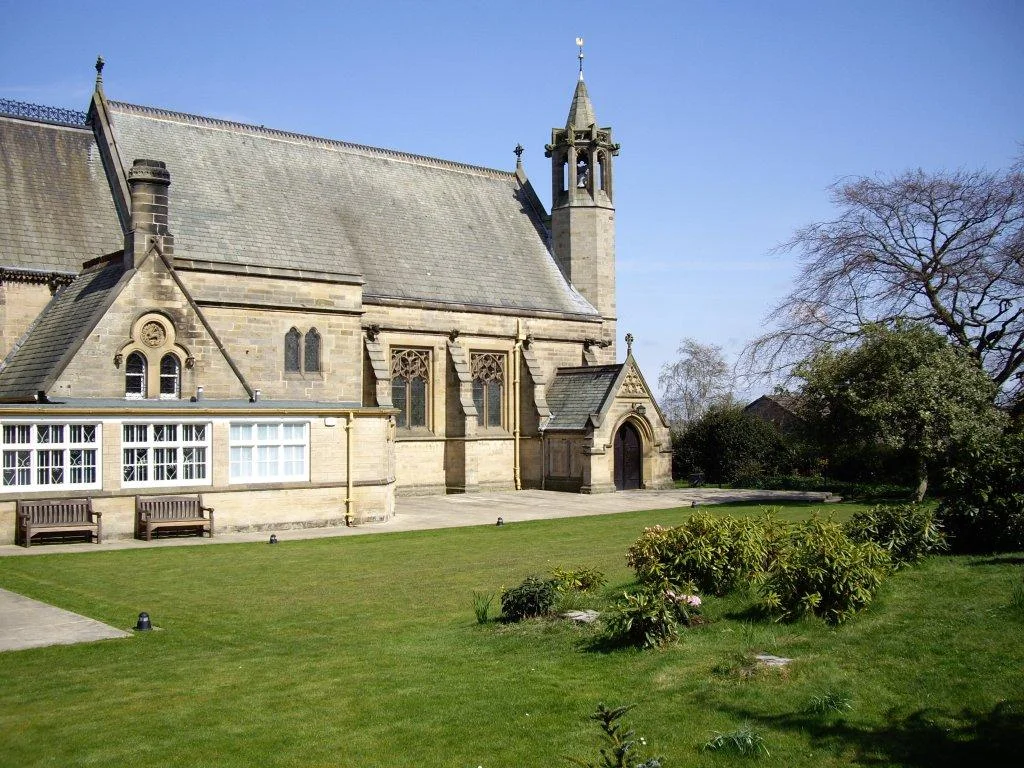
In 1868 Matthew Liddell built Prudhoe Hall, and his architect Archibald Dunn commissioned a young Scottish stained-glass designer named Daniel Cottier to make the windows. Cottier had just won a prize at the 1867 Paris International Exhibition, and his glass at Prudhoe is among his earliest surviving work. Some panels show idyllic naturalistic scenes of sun rising over a river, with swaying reeds, made around 1870. The visual language predates by a decade the famous American collaboration between Cottier and Louis Comfort Tiffany. When the Liddells moved away in 1904 to 1905 and could no longer support the small Catholic mission they had founded, the Cottier glass moved with the chapel: first into the larger 1891 church, then a mile down the hill into the town of Prudhoe. Father Paul Zielinski wrote a book about it called The Church that Moved. The same windows visible in 19th-century photographs of the original chapel are visible today in the Catholic Church of Our Lady and St Cuthbert on Front Street.
Famous Sons and a Stone Badger
Henry Travers, the Oscar-nominated character actor best known as Clarence Odbody, the second-class angel from It's a Wonderful Life, was born in Prudhoe in 1874. Bob Stokoe (1930 to 2004), the manager who led Sunderland to the 1973 FA Cup, came from the nearby village of Mickley. When Northumberland County Council needed a landmark sculpture for the new A695 bypass, they used percent-for-art money to commission the Prudhoe Badger, a 30-metre-long dry-stone-and-marble sculpture beside the Low Prudhoe roundabout. Prudhoe is also twinned with Mitry-Mory near Paris, runs the only ferret rescue in north-east England, and is, in the BBC radio serial The Archers, the home town of Ruth Archer and her mother Heather Pritchard.
Flying Over Prudhoe
Coordinates 54.961 N, 1.849 W, geohash gcy8t. Cruise 1,500 to 2,500 ft AGL. The town climbs a steep north-facing hill from the river, with elevations exceeding 200 metres at the southern moors above. From the air, the unmistakable landmark is Prudhoe Castle on its ridge above the Tyne, just north of the town. The A695 bypass curves north of the urban area through Low Prudhoe industrial estate. The Essity tissue mill is the largest building in the valley floor. The Spetchells chalk hills lie east of the mill, now grassed over. The Tyne Valley railway runs along the south bank of the river. Newcastle International Airport (EGNT) is 7 miles north-northeast. Newcastle city sits 11 miles east. Hexham, the larger Tyne Valley town, is 11 miles upstream to the west.
From the Air
Coordinates 54.961 N, 1.849 W. Cruise 1,500-2,500 ft AGL. Town climbs steep north-facing hill above the Tyne. Prudhoe Castle on a ridge north of town is the key landmark. Newcastle International (EGNT) 7 miles north-northeast.
Nearby Stories
- Seaburn Dene 1.2 km away
- SM UB-115 3.5 km away
- Kielder Forest 4.5 km away
- Appleby Horse Fair 9 km away
- Simonside Hills 9.7 km away
- Streatlam Castle 12 km away
- Stockton-on-Tees 12 km away
- RAF Spadeadam 14 km away