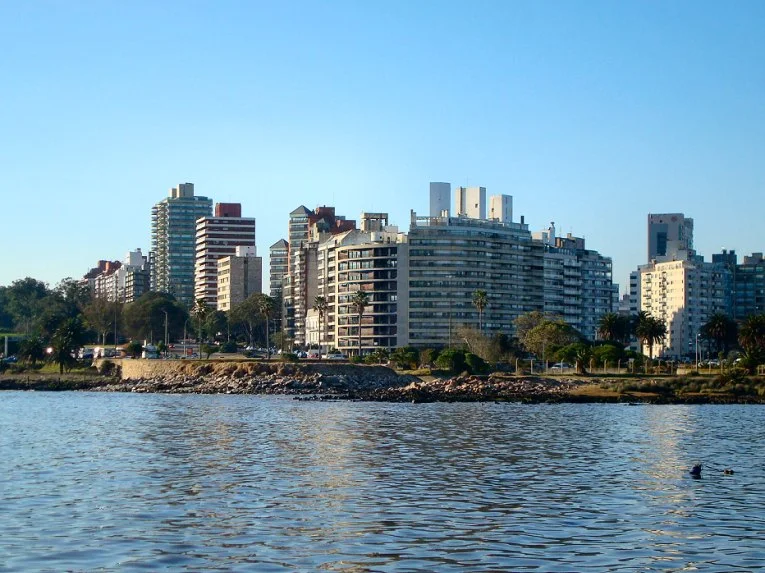

Punta Carretas
Shoppers ride the escalators past brand-name storefronts, never quite registering that the walls around them once held Uruguay's most famous prisoners. The Punta Carretas Shopping opened in 1994 inside a penitentiary that had stood since 1915 - the same building from which more than a hundred guerrilla fighters tunneled to freedom in 1971. Today the southernmost neighborhood of Montevideo is all embassies and haute cuisine, a place where the past has been polished into retail. But the bones of the old detention center are still there, and so are the stories.
The Cart-Shaped Rock
Before the apartment towers and the golf club, there was only the headland and the danger beneath it. Sailors called this point Punta Brava - the rough point - because a submerged rock reached out into the Río de la Plata and tore the hulls out of ships. Later they renamed it Punta Carretas, after the shape of that same rock, which to their eyes resembled a cart. In the 1870s, builders raised a 21-meter lighthouse on the southernmost tip to warn vessels off the rocks; locals knew it simply as La Farola. It still stands, its beam sweeping the same gray water that once claimed the unwary.
The Tunnel Tradition
For half a century, Punta Carretas was defined by its prison, and the prison was defined by escapes. In 1931, anarchists led by Miguel Arcángel Roscigna dug from a firewood-and-charcoal shop straight into the prison bathrooms, spiriting their comrades - jailed for robbing a currency exchange in the city center - out underground. Four decades later came the masterpiece. In September 1971, members of the Tupamaros guerrilla movement burrowed a tunnel into a neighboring house and slipped away in a single night. More than a hundred prisoners escaped, the largest breakout of political detainees ever recorded, and the operation unfolded in near silence, without a single shot. A civil engineer among the inmates, Jorge Manera Lluberas, helped plan the route. Among those who crawled to freedom was a wiry farmer named José Mujica, recaptured the following year and held for more than a decade - much of it in brutal solitary confinement - before going on to serve as Uruguay's president from 2010 to 2015. The operation's code name was darkly fitting: El Abuso.
From Cells to Storefronts
Because of that grim detention center, Punta Carretas stayed thinly settled through the first half of the twentieth century. People simply did not want to live beside a prison. Then, in the 1950s, the city crept south, and the headland transformed. International hotels arrived, then clothing brands, then the high-rise apartments that now crowd the Rambla. Real estate values climbed, and the barrio became one of Montevideo's most exclusive. The final irony came in 1994, when the prison itself reopened as a glittering shopping mall - the cells erased, the watchtowers repurposed, the place of confinement turned into a temple of consumption.
An Alchemist's Castle and a Backyard Republic
Punta Carretas keeps its eccentrics close. Along the streets stands the Castillo Pittamiglio, a fantastical house that architect Humberto Pittamiglio began around 1910 and tinkered with until his death in 1966. Its facade and chambers are studded with alchemical, Masonic, and Templar symbols - a riddle in stone left by a man who believed buildings could hold secrets. Nearby, a neoclassical palace houses Parva Domus, a private cultural club founded in 1878 that cheerfully declares itself a micronation, complete with its own self-styled republic. Add the Gandhi statue on the Rambla, the 1994 Holocaust memorial, and the leafy Villa Biarritz park with its weekend flea market, and the neighborhood reveals itself as a collector of curiosities.
Where the City Meets the River
Stand at the southern edge today and the contradictions resolve into something simply beautiful. The Punta Brava lighthouse anchors the point. Joggers and cyclists stream along the waterfront, mate gourds in hand, while the wide brown sheet of the Río de la Plata stretches to a horizon with no far shore in sight. The golf club, founded in 1922 on the grounds of a vanished nineteenth-century racetrack, rolls green toward the water. It is hard, watching the light fade over the estuary, to imagine the shipwrecks and the prison breaks. But that is Punta Carretas - a place that has buried its hardest chapters under something gentler, without ever quite forgetting them.
From the Air
Punta Carretas sits at 34.92°S, 56.16°W, the southernmost headland of Montevideo, jutting into the Río de la Plata. From the air, look for the Punta Brava lighthouse at the point and the dense cluster of high-rise apartment towers fronting the Rambla. The green expanse of the Club de Golf del Uruguay and the leafy square of Villa Biarritz park mark the neighborhood's interior, with the boxy Punta Carretas Shopping nearby. The nearest airport is Carrasco International (ICAO: SUMU), roughly 18 km east along the coast; the smaller Ángel Adami Airport (SUAA) lies to the north. Best viewed at low altitude in clear weather, when the contrast between the gray-brown estuary and the city skyline is sharpest.
Nearby Stories
- Piriápolis 24 km away
- Minas 40 km away
- Tronador (rocket) 67 km away
- Nueva Helvecia 69 km away
- La Plata Museum 122 km away
- Battle of Sarandí 126 km away
- Mundo Marino 145 km away
- South Georgia Island 2584 km away