
The Rice Goddess and the Dutchmen with Strings
Carved into the spirit barrier of Pura Beji Sangsit, the structure meant to deflect evil from the temple's inner sanctum, are two Dutchmen playing stringed instruments. They flank a figure of Naga, the serpent deity, as if their music were part of the cosmic defense. No one knows exactly when this carving was added or by whose hand, but it speaks to something essential about this temple: Pura Beji absorbs what arrives. Built in the 15th century by Brahmins from Java's Majapahit Kingdom, dedicated to the rice goddess Dewi Sri by farmers who depend on irrigation for their livelihood, and decorated in a style so densely botanical that the stone seems to grow, this temple in northern Bali has been quietly accumulating layers of meaning for over five hundred years.
Where Water Becomes Sacred
The word 'Beji' shares its meaning with the Balinese temple pond, linking Pura Beji to purification through holy water. This is not merely etymological. Archaeologists discovered a former pond on the temple's east side, fed by an ancient well, confirming the site's long association with a water source. For the farmers of Sangsit, the connection between temple and water runs deeper than symbolism. They revere Pura Beji as a 'pura subak,' a temple of the traditional Balinese paddy irrigation system. The subak system was introduced in 1074 during the reign of Marakata, and it transformed Balinese agriculture by organizing water distribution across rice terraces through cooperative management. At Pura Beji, agriculture and devotion are the same practice. The farmers honor Dewi Sri here because their harvests depend on water, and water in Bali has always been the province of the gods.
Stone That Blooms
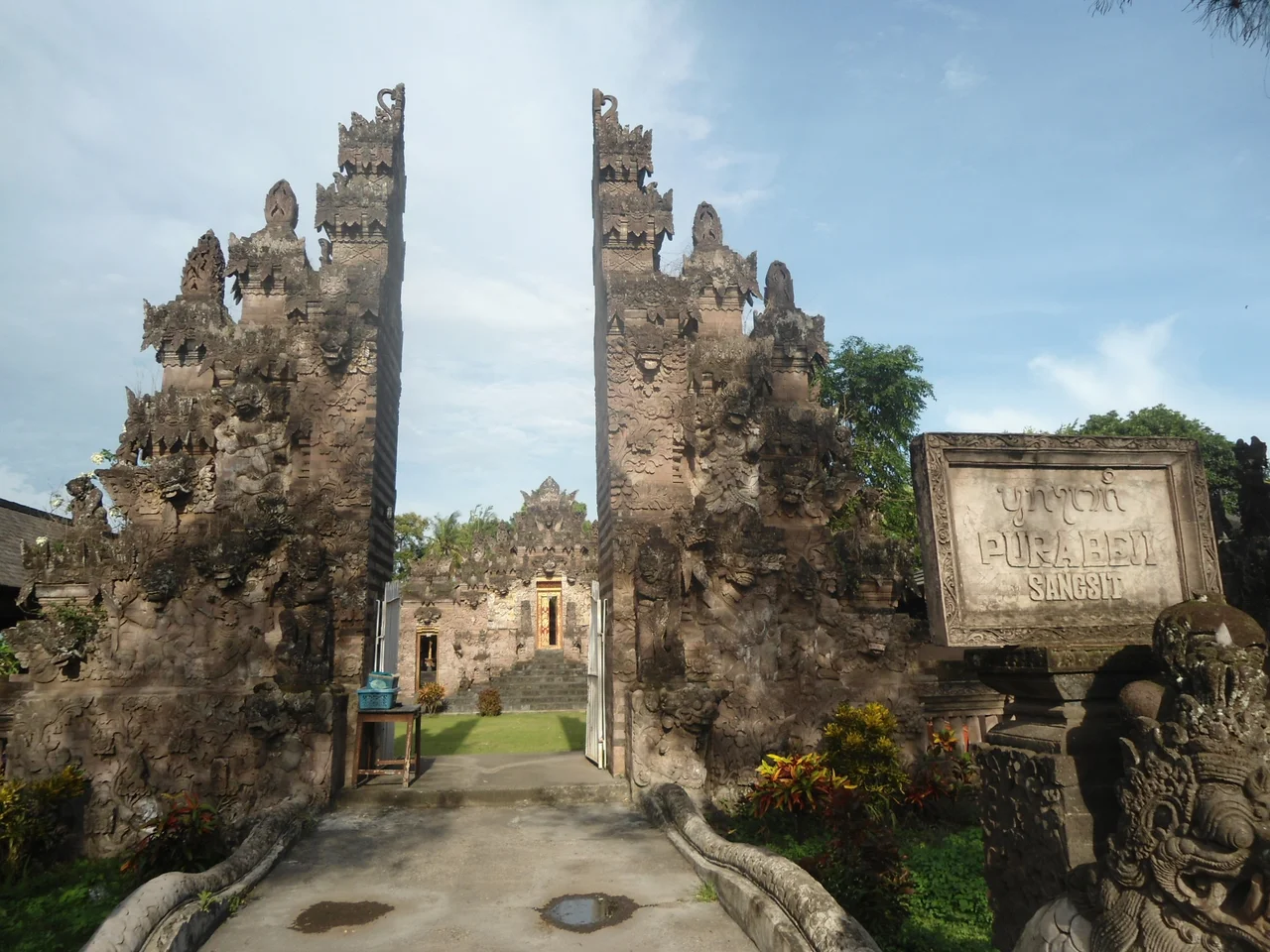
Northern Balinese temple architecture distinguishes itself from the south through sheer density of ornamentation, and Pura Beji is one of its finest expressions. White sandstone walls disappear beneath carvings of vine motifs, flowers, and foliage so intricate that the temple appears to be consumed by a stone garden. Traces of pigment discovered in the carvings reveal that these surfaces were once painted, adding color to the already overwhelming detail. Guardian nagas coil along staircases, their scales individually rendered. Demons inspired by Hindu epics stand watch from walls and balustrades. The effect is not merely decorative. In Balinese cosmology, the boundary between the natural and spiritual worlds is permeable, and these carvings make that permeability visible. Every tendril of carved vine, every blossom frozen in sandstone, suggests a temple that participates in the living world rather than standing apart from it.
Three Sanctums, Three Thresholds
Pura Beji follows the traditional Balinese temple layout of three concentric zones, each more sacred than the last. The outer sanctum contains the bale kulkul, the pavilion housing a slit-log drum used to call the faithful to prayer. This structure is notably plain compared to the rest of the temple, its relatively bare surfaces suggesting it was built later, perhaps by a sculptor unfamiliar with the northern Balinese style. A candi bentar, the distinctive split gate of Balinese architecture, provides passage to the middle sanctum. This gate is carved with the heavy botanical decoration characteristic of the north, with multiple carved heads along its crown to ward off malevolent spirits. The middle sanctum houses several pavilions. Another threshold, a large portal crowned with Bhoma heads, protectors of sacred space, opens into the inner sanctum. Here stands the main shrine, dedicated to Sang Hyang Widhi, the supreme god of Balinese Hinduism. The deities Dewa Braban, Dewa Ayu Manik Galih, and Dewi Sri are also honored within.
Survival Through Careful Hands
A photograph from the early 20th century shows the candi bentar of Pura Beji in a state of significant damage. The temple has been restored several times over its long history, and each restoration has been carried out with deliberate attention to maintaining the original style. This is no small feat. Northern Balinese carving is labor-intensive, requiring sculptors who can replicate vine motifs and figurative detail that were first cut five centuries ago. The commitment to stylistic continuity means that Pura Beji today looks much as its original architect, Truna Pesaren, and its patron, Pasek Sakti Batu Lepang, would have intended. The village of Sangsit, once known simply as Beji, sits about eight kilometers east of Singaraja, the historic capital of northern Bali. It is a quiet agricultural community, and the temple at its center reflects that quietness. Pura Beji does not compete with Bali's larger, more famous temples for attention. It earns something rarer: the sustained devotion of the people who grow rice in its shadow.
From the Air
Pura Beji Sangsit sits at 8.08S, 115.13E, in the village of Sangsit along Bali's northern coast, approximately 8 km east of Singaraja. From altitude, the temple compound is set among the dense agricultural landscape of Buleleng Regency, with rice paddies extending south toward the volcanic highlands. The narrow coastal plain of northern Bali is clearly visible, compressed between the Bali Sea to the north and the steep slopes of the central mountains. Ngurah Rai International Airport (WADD) lies roughly 80 km to the south. The northern coast's distinct character, drier and less touristed than the south, is apparent from the air in the sparser development and agricultural patterns.
Nearby Stories
- The Sleeping Caldera of a Thousand Temples 2.4 km away
- Menjangan: The Island the Deer Swim To 15 km away
- When the Ground Moved at Dawn: Bali's 1979 Earthquake 27 km away
- The Ship of Four Names 36 km away
- When Sapudi Shook at Dawn 38 km away
- Alas Purwo: Where Java Begins and the Surf Never Stops 49 km away
- The Invisible Frontier: Where Asia Ends and Australia Begins 59 km away
- Forty-Five Men and Thirty-Six Depth Charges 70 km away