.jpg)
Purbeck Mineral and Mining Museum
In 1806, before the great age of steam, a Staffordshire potter needed clay. Josiah Wedgwood and his partners required a steady supply of ball clay, the fine pale clay of the Isle of Purbeck that fired into the white-bodied earthenware their customers wanted. The clay was buried in pits inland from the heaths, miles from the nearest navigable water. The roads were tracks. The answer was a railway: not the steam-and-iron behemoth that would arrive a generation later, but a horse-drawn line of cast iron rails laid on stone sleepers, running across Hartland Moor to a quay on Middlebere Creek where ships could carry the clay north. It was one of the first industrial railways in England, and it ran for 101 years.
Benjamin Fayle and the Iron Rail Way
The man behind it was Benjamin Fayle, a close friend of Thomas Byerley of Wedgwood. When the original owner of the Purbeck clay pits, Barker Chofney, went bankrupt, Fayle took the pits over to keep Wedgwood and the other Staffordshire potteries supplied. The line he built was called the Iron Rail Way, designed by John Hodgkinson using the same techniques as the Surrey Iron Railway, one of England's pioneering industrial railways. The rails were cast iron, L-shaped, three feet long and weighing forty pounds each. The wagons had flangeless wheels, since the L-shape of the rail kept them in place. The sleepers were not wooden but stone, sixty pounds each, and the line required well over ten thousand of them. The rails were spiked to the stone with metal pins and oak dowels. Horses pulled the clay wagons across the moor, in fair weather and foul, for a hundred years.
Tunnels and Tracks Across the Heath
In 1807 the line was extended south under the Wareham-to-Corfe road through a tunnel that is now a listed building, though it has been blocked for safety. A second tunnel was added in 1825, further east, and it too is blocked. In 1881 the London and South Western Railway built its standard-gauge Swanage branch nearby, and Fayle's Tramway, as the line had become known, was extended east to meet it. Eldons Sidings were laid so that clay could be transferred from the narrow gauge to the standard gauge for despatch to the Potteries. The line was finally abandoned in 1907 after 101 years of service. The quay at Middlebere Creek has fallen into ruins. Stone sleepers still rest in the heath, holes drilled through them where the rails once bolted down. Others have been reused as garden paving. A few are mortared into the walls at Middlebere Farm. The route across Hartland Moor can still be traced in places, if you know where to look.
Tiny, the Locomotive Named for Its Size
In May 1854, a second tramway opened, this one from the clay pits at Newton to a pier on Goathorn in Poole Harbour. The Admiralty had given permission for the pier in 1852. The line ran horse-drawn at first, then was re-gauged to take a steam locomotive built by Stephen Lewin at Poole Foundry around 1870. The engine was officially named Corfe, but the workers called it Tiny because of its diminutive size, and Tiny it became. An engine shed was built at Newton, alongside the cottages where the clay workers and their families lived. Water came from a hand-pumped well to the south of the shed. Coal arrived by ship at Goathorn Pier. In 1907, the Newton Tramway was joined to Norden and part of it became Fayle's Tramway, completing a network that had been growing piecemeal for a century.
The Museum at Norden
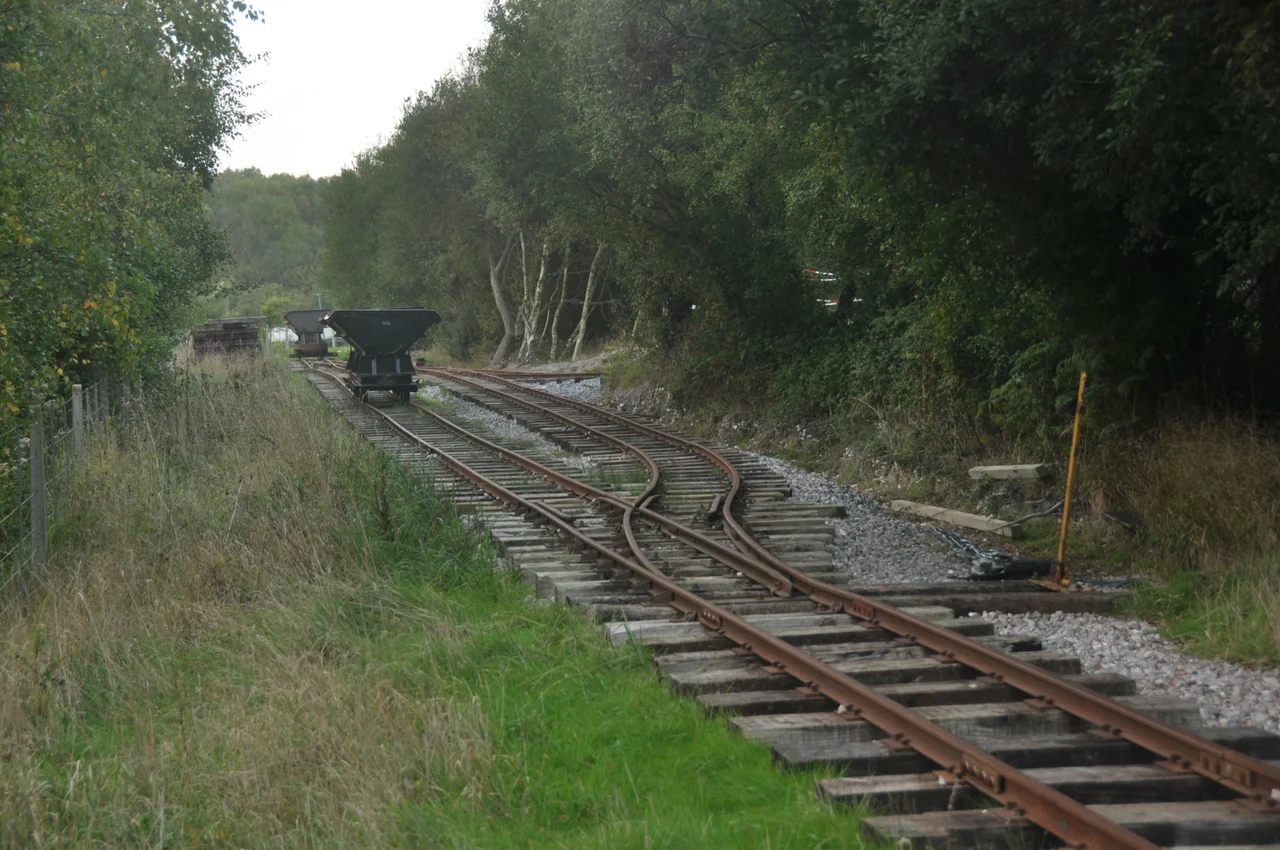
The Purbeck Mineral and Mining Museum was formed to preserve and interpret this industrial history. It sits next to Norden station on the heritage Swanage Railway, on the site of the old Norden Clay Works. The redundant Norden No. 7 mine structure has been rebuilt here, with a narrow gauge railway laid around the site and a new engine shed for the three resident locomotives and the restored wagons that once carried clay across the Purbeck heaths. The museum opens weekends, Bank Holidays and most school holidays from late March to early November. Among the planned additions is a new building to house Secundus, a larger steam locomotive, along with wagons, artefacts, a library and an education centre. There are also plans to extend the narrow gauge across the Swanage line via the old Bridge 15, a temporary skew bridge built in 1885 and still standing, though damaged in a more recent incident.
Why Clay Mattered
Ball clay is unglamorous. It does not sparkle like coal in lamplight, and there is no romance in the work of digging it. But it built the teacups of the British Empire, the white sanitary ware that turned Victorian cities habitable, the laboratory ceramics that supported a century of chemistry. Wedgwood and Spode and Royal Doulton all worked Purbeck clay into their finished pieces. The men who dug it, the boys who led the horses across Hartland Moor, the families in the Newton cottages who pumped water for Tiny, made it all possible. The museum at Norden is what is left of them. Stone sleepers in the heath, a blocked tunnel under a country road, a small steam engine still capable of pulling visitors around a circuit on a Saturday afternoon. The Iron Rail Way did its work for 101 years, and the work survived it.
From the Air
Located at 50.65 degrees North, 2.06 degrees West, beside Norden station on the Swanage Railway. The museum sits on the eastern edge of the Isle of Purbeck, with the heaths and old clay pits stretching south and west. Bournemouth Airport (EGHH) is 12 nm east-northeast. Best viewed at 2,000 to 4,000 feet on a clear day; Corfe Castle's ruined keep is the unmistakable landmark less than 2 nm south.
Nearby Stories
- Maiden Castle, Dorset 2.1 km away
- Battle of Portland 6.1 km away
- Carisbrooke Castle 7.1 km away
- Winchester Castle 11 km away
- Wardour Castle 13 km away
- Fleet Air Arm Museum 14 km away
- HMS Warrior (1917) 22 km away
- D-Day: The Longest Day 157 km away