.jpg)
Quobba
A weathered wooden sign stands near the cliff edge, and its message is three words long: KING WAVES KILL. It is not decoration. Along this stretch of the Gascoyne coast, the Indian Ocean throws sudden surges over the rocks without warning, and the warning exists because people have been swept away and drowned here. Yet visitors keep coming, because Quobba is one of the most extraordinary coastlines in Western Australia, where the sea performs and threatens in the same breath.
Where the Ocean Breathes
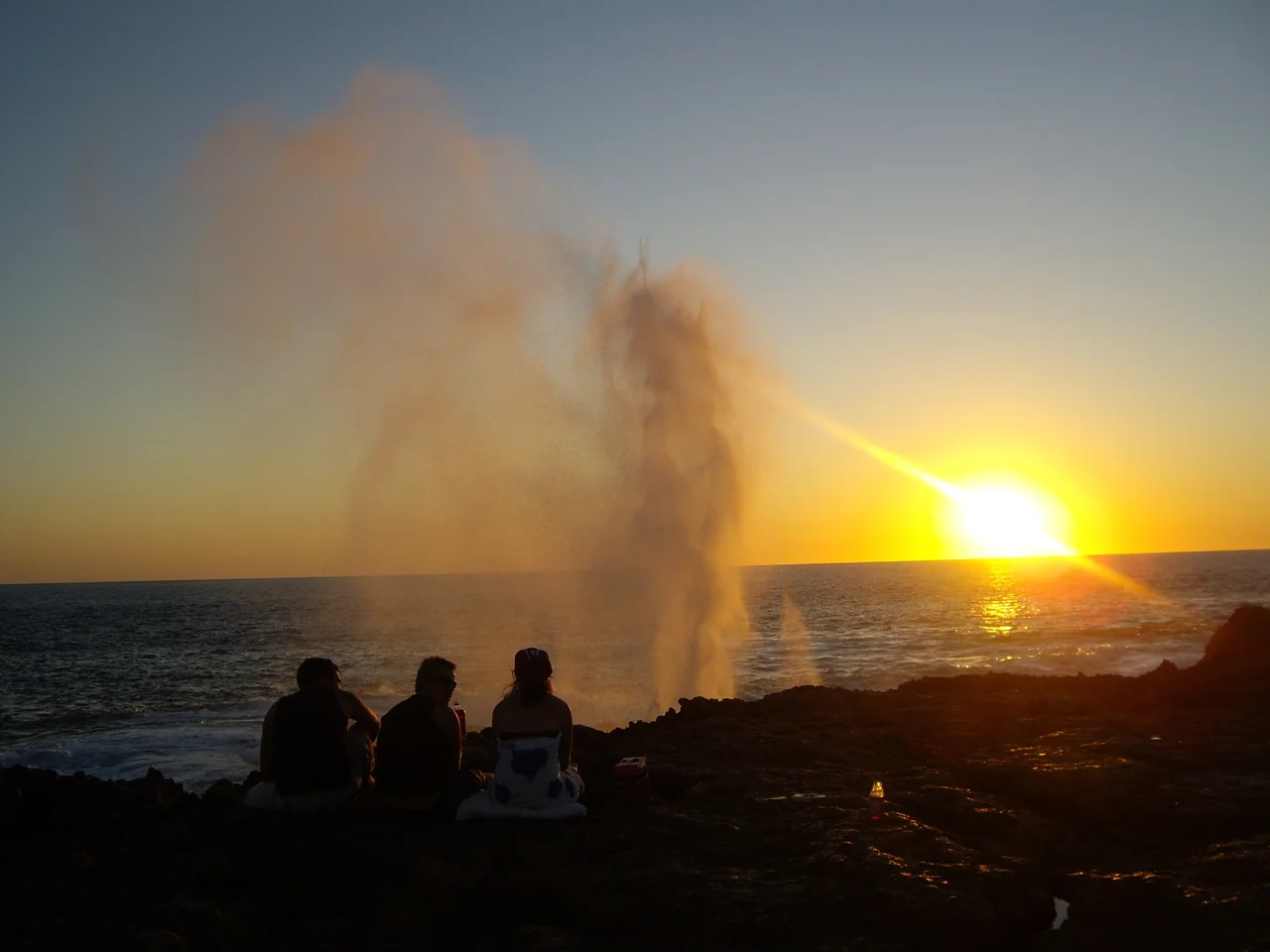
Just south of Point Quobba, the swell finds its way into sea caves beneath a low rock platform and has nowhere to go but up. The result is the Quobba blowholes, dozens of vents in a single shelf of stone that fire jets of seawater as high as twenty metres into the air. They perform best on a rising tide, the spray catching the light before the wind tears it apart; at the very top of the tide the vents themselves submerge and the show subsides. The rhythm is hypnotic and slightly menacing, a reminder that the same force making the spectacle is the one the sign warns you about. Nearby, a lighthouse built in 1950 that stands roughly eleven metres tall and sits eighteen metres above sea level still keeps watch by the road junction, and a sheltered snorkelling spot called the Aquarium hides among a chain of low islets. This is a coast that does not pretend to be tame.
The Most Westerly Run
Quobba Station spreads along the coast roughly sixty kilometres north of Carnarvon, its boundary tracing the shoreline for about 180 kilometres. It is the most westerly station in Australia, a run of coastal rangeland stitched together from saltbush, acacia and buffalo grass. The land was first taken up in the late 1890s and named Point Charles after Charles Augustus Fane. Ownership passed through a chain of pastoralists, and by 1925 more than eight thousand sheep were being shorn here each season. The Meecham family took over in 1977 and shifted the operation from merino wool to Damara sheep raised for meat, running a flock of around ten thousand. Tourism, driven by the fishing and surfing, has steadily grown alongside the sheep since the 1970s, and the station now welcomes visitors as readily as it once welcomed shearers.
When the War Washed Ashore
In November 1941, the deadliest moment in Australian naval history reached this remote shore. The light cruiser HMAS Sydney, a Leander-class vessel launched in 1934 and fresh from action in the Mediterranean, met the disguised German raider Kormoran off the coast on 19 November. In a brief, savage gun battle, both ships were destroyed. Every one of the 645 men aboard Sydney was lost. Of the Kormoran's crew of 399, some 318 survived, drifting ashore by lifeboat near Quobba and Red Bluff. A station stockman raised the alarm, and the owner alerted the authorities; the Germans, exhausted and adrift, did not resist capture. For decades, disbelief that the smaller raider had sunk a better-armed cruiser fed wild theories, but the wrecks, found in deep water far offshore in 2008, confirmed the plain and terrible truth. A simple cairn on the station now commemorates Sydney and her crew.
Surf, Sharks and Self-Reliance
Since the 1970s, fishing and surfing have drawn a steady trickle of travellers willing to make the drive. Just up the coast, Red Bluff offers a famous left-hand break peeling over reef, a wave spoken of with reverence by surfers and respect by everyone else. In 2012 a surfer was mauled by a shark there and survived, dragged from the water by fellow surfers in a rescue that became local legend. There are no shops to speak of and no safety net beyond the people around you. Out here you bring your own water, mind the tides, read the sky, and understand that the ocean sets the terms.
From the Air
Quobba Station sits on the Western Australian coast at approximately 24.40 degrees south, 113.41 degrees east, about 60 km north of Carnarvon. From the air the coastline reads as a pale ribbon of cliff and saltbush meeting deep ocean blue, with the Point Quobba lighthouse and blowhole platform marking the southern end. The nearest airport is Carnarvon Airport (ICAO YCAR), roughly 60 km south. Learmonth Airport (YPLM) near Exmouth lies well to the north. A recommended viewing altitude is 3,000 to 5,000 feet for the cliff line and blowhole spray; coastal visibility is typically excellent, though afternoon sea breezes and salt haze can soften the horizon.
Nearby Stories
- Gnaraloo 33 km away
- Bernier Island 36 km away
- North West Coastal Highway 67 km away
- Kennedy Range National Park 119 km away
- Shark Bay 132 km away
- French Western Australia 134 km away
- The Silent Wave: Java's 1994 Tsunami Earthquake 1513 km away
- The Ghost Casino at the Edge of the World 1719 km away