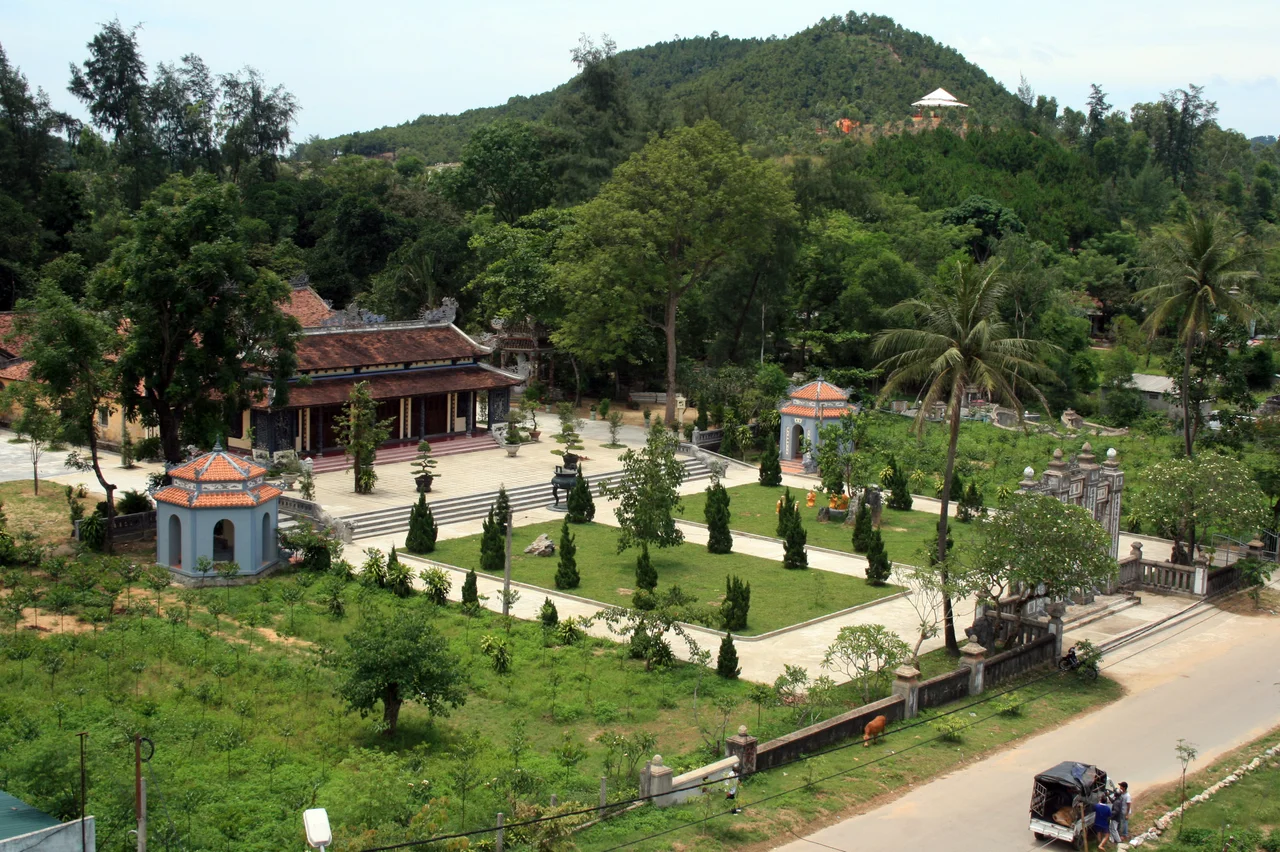

Quốc Ân Temple
In 1677, a Buddhist monk named Thích Nguyên Thiều left Guangdong province in southern China and sailed to Vietnam. He was thirty years old and carrying nothing but his robes and his training in the Lâm Tế school of Zen Buddhism. Over the next eight years, he would found three temples. The last of them — built on a hillside near the Ngự Bình mountain district outside Huế — eventually became Quốc Ân Temple, the seat of a Buddhist lineage that most practitioners in central and southern Vietnam trace back to him today.
A Monk Who Traveled South
Thích Nguyên Thiều was born in 1648 in Guangdong, China, and trained under Thích Khoáng Viên before making the crossing to Vietnam. He arrived first in Bình Định, in what is now south-central Vietnam, where he founded the Chùa Thập Tháp Di-đà — the Temple of the Ten Towers of Amitabha. From there he traveled the region, teaching the dharma as he went.
His path eventually led to Huế, where the Nguyễn lords had established their seat of power. He founded the Hà Trung Temple in the Vinh Hà district, then moved south of the city to the Ngự Bình mountain area to build the Vĩnh Ân Temple — the structure that would eventually become Quốc Ân. The Nguyễn lords were the dominant political power in central Vietnam, and their patronage gave the temples Thích Nguyên Thiều founded both protection and resources. But the monk's influence ran deeper than political sponsorship: as the 33rd patriarch of the Lâm Tế Zen School, he was transmitting a lineage that reached back through centuries of Chinese Buddhist scholarship.
Named by a Lord, Exempted from Taxes
In 1689, the Nguyễn lord Nguyễn Phúc Trân issued two formal marks of imperial recognition. He changed the temple's name from Vĩnh Ân to Quốc Ân — meaning, roughly, "national grace" or "grace of the nation" — and granted it an exemption from the land taxation system that applied to most properties in the realm. These were significant gestures from a ruling house that was simultaneously building its political legitimacy and its religious one.
After Thích Nguyên Thiều died in 1728 at the age of eighty, the Nguyễn lord Nguyễn Phúc Trú had him posthumously invested with imperial titles — an honor reserved for individuals the ruling family wished to formally acknowledge as having served the realm. A plaque praising the founder's spiritual achievements, erected in 1729, still stands in the front yard of the temple. In the main hall, a banner bearing the lord's verse of praise remains on display.
Two Centuries of Imperial Renovation
The Nguyễn dynasty, which formally came to power in 1802, did not invent its connection to Quốc Ân — it inherited it from the Nguyễn lords who had preceded it. Throughout the nineteenth century, the temple received a succession of imperially funded renovations.
In 1805, Princess Long Thành, the elder sister of Emperor Gia Long, personally funded a renovation project. In 1822, Emperor Minh Mạng — Gia Long's son and successor — sponsored another. In 1825 an abbot died and a stupa was built in the garden to house his remains. Between 1837 and 1842 came another phase of expansion, and from 1846 to 1863 workers added a triple gate and further shrines. Each renovation enlarged the compound and deepened its physical connection to the dynasty that ruled from the nearby citadel. The Nguyễn emperors rebuilt their capital's temples as persistently as they rebuilt their palaces.
The Compound Today
Quốc Ân Temple sits on a small hill in the ward of Trường An, about two kilometers from the Phú Cam bridge over the Perfume River. The layout follows a traditional Vietnamese Buddhist arrangement: the main ceremonial hall at the front, the patriarch hall at the rear, and the monks' quarters along the sides. In the main hall, a shrine commemorates the birth of Prince Siddhartha, the historical figure who became Gautama Buddha.
The temple's significance to Vietnamese Buddhism is difficult to overstate. The lineage that Thích Nguyên Thiều brought from China and transmitted at this site has propagated through generations of teachers and students across central and southern Vietnam. His arrival by boat in 1677, the temples he built at the edge of Nguyễn territory, the patronage he cultivated from the lords who ruled here — all of it converged at this hill. The triple gate, the garden stupas, the old plaque in the courtyard: these are the material remains of a tradition that continues in every temple and monastery that traces its lineage back to the thirty-third patriarch of the Lâm Tế school.
From the Air
Quốc Ân Temple is located at 16.4427°N, 107.5873°E on a small hill in the southern part of Huế, in the Trường An ward. At 2,000–3,000 feet, the temple sits in a dense residential area south of the Perfume River, about 2 km from the Phú Cam bridge. The hilltop position makes the compound slightly distinguishable from surrounding rooftops. Phủ Cam Cathedral's hill is visible roughly 500 meters to the north. Phú Bài International Airport (VVPB) is approximately 10 km to the south. The Ngự Bình mountain, which gave the original temple district its name, rises as a low, distinctive prominence to the southwest.
Nearby Stories
- Battle of Fire Support Base Ripcord 4 km away
- Sơn Trà Mountain 5.8 km away
- Quảng Trị Citadel 7.3 km away
- Battle of Nam Dong 10 km away
- Hội An wreck 56 km away
- Battle of Cua Viet 65 km away
- Saravan 100 km away
- Hainan Island Incident 342 km away