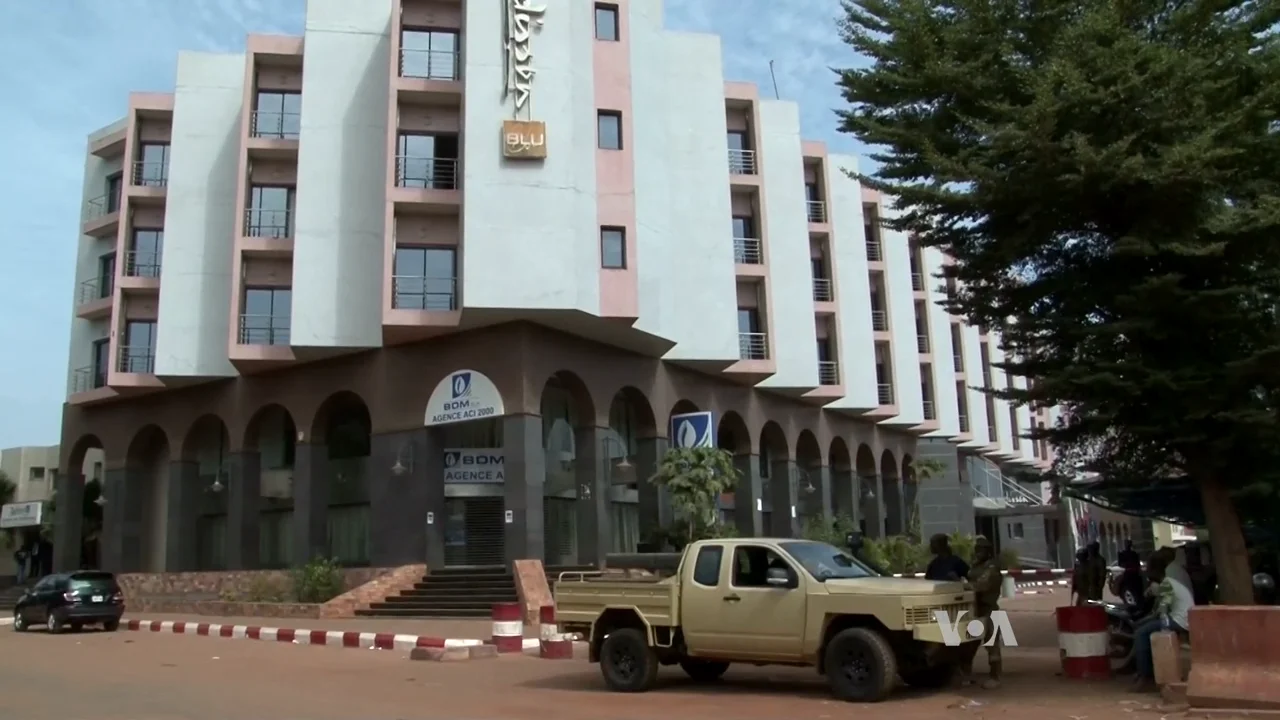

Radisson Blu Bamako Attack
It was an ordinary Friday morning at the Radisson Blu hotel in Bamako. Air France crews had bunked overnight. Mining executives, diplomats, aid workers, and a Russian flight crew were starting their day. A delegation of the international Francophonie organization was in the building. Then, between 7 and 7:30 a.m. on 20 November 2015, two gunmen drove up in a vehicle bearing diplomatic plates, stepped out, and began to shoot. Over the next nine hours, the hotel in this quiet embassy district became the scene of one of Mali's darkest days. Twenty hostages would not leave alive.
The People in the Building
The Radisson Blu sat in a business district near the embassies, frequented by foreign professionals and government staff. By the hotel operators' count, 125 guests and 13 employees were inside when the siege began. The dead came from many nations and many walks of life. Six were Malians. Six were Russians, members of a flight crew, mourned later in Russia's Ulyanovsk Oblast, which declared a day of mourning. Three were Chinese executives from the China Railway Construction Corporation. Geoffrey Dieudonne was a Belgian regional parliamentary counselor. Shmuel Benalal was an Israeli education consultant. Among the Americans killed was an aid worker who had devoted her career to women's health. These were not statistics. They were colleagues, parents, and travelers caught in an ordinary place on an ordinary morning.
Seven Hours
Witnesses said the attackers spoke a language that was neither Arabic nor a local tongue. The Guinean singer Sekouba Bambino was in the hotel and managed to escape. A Malian journalist, Kassim Traore, reported that some hostages were released after reciting the shahada, the Islamic declaration of faith. In the chaos of the first minutes, many people fled, but around 170 were trapped. As the hours dragged on, Malian special forces moved floor by floor through the building to reach the survivors, backed by French and American personnel and by UN peacekeepers reinforcing the perimeter. More than a hundred hostages were freed. Twelve Air France crew were extracted safely. Two Canadian mining executives were among the last brought out alive.
Those Who Went In
Amid the terror, ordinary courage answered. American service members assisting in Mali joined the rescue. U.S. Army Sergeant First Class Kyle Morgan later received the Distinguished Service Cross for exceptional heroism that day; Gunnery Sergeant Jarad Stout received the Silver Star. Another helped run the Joint Operations Center set up to coordinate the response. By the U.S. Africa Command's account, a further twelve American citizens were rescued by Malian security forces. The names of the soldiers are remembered alongside those of the Malian forces who led the assault. Investigators later determined that, despite early reports of a larger cell, only two attackers had carried out the killing. The militant group Al-Mourabitoun claimed responsibility, saying it had acted jointly with al-Qaeda in the Islamic Maghreb.
A Nation in Mourning
President Ibrahim Boubacar Keita declared three days of national mourning. Senegal, Mauritania, and Guinea joined in observance, and the chairman of the West African bloc ECOWAS, Senegalese President Macky Sall, traveled to Bamako to stand with Mali. "Mali will never be alone in this fight," he said. "We are all committed because we are all involved." On 27 November, Malian special forces arrested two men on the city's outskirts, linked to the attack by a mobile phone left at the scene. The siege came as Mali was already enduring a long conflict that had begun in the north years earlier, a war whose violence had now reached the capital. The hotel reopened in time, but the morning of 20 November 2015 remains a wound in the city's memory, carried by the families of the twenty who did not come home.
From the Air
The Radisson Blu hotel stands in Bamako's ACI-2000 business district near 12.64 degrees N, 8.03 degrees W, west of the city center on the north bank of the Niger River. The nearest airport is Bamako-Senou (Modibo Keita) International, ICAO GABS, about 15 km to the south. This is a memorial site rather than a scenic destination; from the air the district reads as a geometric grid of modern buildings set back from the river.
Nearby Stories
- Narena 23 km away
- Koulikoro 37 km away
- Nyamina 69 km away
- Kangaba 69 km away
- Niagassola 79 km away
- Morila Gold Mine 91 km away
- Boucle du Baoulé National Park 147 km away
- Tukulor Empire 154 km away