
RAF Burtonwood
Drivers on the M62 motorway between Liverpool and Manchester sometimes notice strange shapes in the fields beside the road. Old bunker outlines, faint runway scars, the geometry of an airfield half-erased. They are looking at what is left of the largest American airbase in wartime Europe. In its peak years RAF Burtonwood housed 18,000 American servicemen. The roar of aircraft engines tested in its sheds could be heard for miles, especially at night. The British government leased the land to the United States; the Americans famously paid the rent in tobacco. By the end of the war, Burtonwood's mechanics were repairing aircraft from four different US Army Air Forces and the airfield was the beating mechanical heart of the Eighth Air Force's bomber campaign. The base officially closed in 1991. Nearly all of it has been demolished. The Heritage Centre that remains works to keep something of the place from disappearing entirely.
From British Maintenance Unit to American Depot
Burtonwood airfield opened on 1 January 1940 as RAF Burtonwood, two miles northwest of Warrington in Cheshire. It was conceived as a servicing and storage centre for modifying British aircraft, and during its first two and a half years was operated by No. 37 Maintenance Unit RAF. The transfer to the United States Army Air Forces came in June 1942, when Burtonwood became Base Air Depot 1, or BAD 1, serving the Eighth, Ninth, Twelfth, and Fifteenth Air Forces. An RAF Police presence continued on the site until the mid-1960s, providing security alongside the Americans. The base expanded continuously through the war. New hangars went up, more test beds were built, and personnel numbers climbed steadily until 18,000 American servicemen were stationed there. Some sources later claimed Burtonwood was placed strategically beyond Luftwaffe bomber range, but that was wishful thinking; the Luftwaffe carried out several air raids on the facility, and the same bombers had reached Belfast in 1941, which lay considerably farther from occupied Europe.
Tobacco Houses and Two Worlds
A small purpose-built village rose to house the American servicemen, complete with its own school and shop. The buildings were known locally as the Tobacco Houses, because the lease for the land had been paid with American tobacco. During leave periods, American servicemen from Burtonwood virtually took over the centre of nearby Warrington, their pay-packets and accents transforming the local economy. Among the units stationed at Burtonwood during the war were the 27th Air Transport Group; the 310th, 311th, and 312th Ferry Squadrons; the 325th Service Group; the 401st Air Depot; the 18th Weather Squadron; the 494th Anti-Aircraft Artillery Gun Battalion; the 1289th and 890th Military Police Companies; and the 55th Field Hospital. A separate, more painful story sits within that history. There were roughly 46,000 American GIs in Britain in the early 1950s, many of them at Burtonwood and across East Anglia, and a meaningful number were African American soldiers. Relationships between Black GIs and local British women drew intense public and official scrutiny, with the children born of those relationships sometimes referred to in the period as "brown babies." The mothers and children faced social isolation, official obstruction in many cases, and lifelong consequences from the racism of both the US military's segregated structure and British post-war society. The Heritage Centre includes their stories alongside the GI brides and the personal histories of servicemen.
The Berlin Airlift and the Cold War
Control of Burtonwood was returned to the RAF in June 1946 and became an equipment depot operated by No 276 Maintenance Unit. The American departure was brief. In November 1946 six B-29 Superfortress bombers from the USAAF Strategic Air Command's 43d Bombardment Group arrived as a so-called "training deployment." The cover story was thin. The real purpose was to establish a permanent strategic air force presence in Europe, and additional B-29s followed in May 1947. When the Berlin Airlift began in 1948, Burtonwood became a maintenance hub for the C-54 Skymasters that flew supplies into the besieged city. On 7 November 1953 the USAF 53rd Weather Reconnaissance Squadron began operating from the base, flying first the WB-29 and then the WB-50D Superfortress and feeding weather data to the Military Air Transport Service and the US Weather Bureau. Through the 1950s, Burtonwood overhauled European-based USAF aircraft including F-84 Thunderjets, F-84F Thunderstreaks, and F-86 Sabres. MATS used the base as a transatlantic cargo and passenger hub until 1958. Major USAF operations ended in April 1959 when the flightline closed, though gliders of the RAF Air Training Corps continued to use the runway.
What the M62 Drivers See
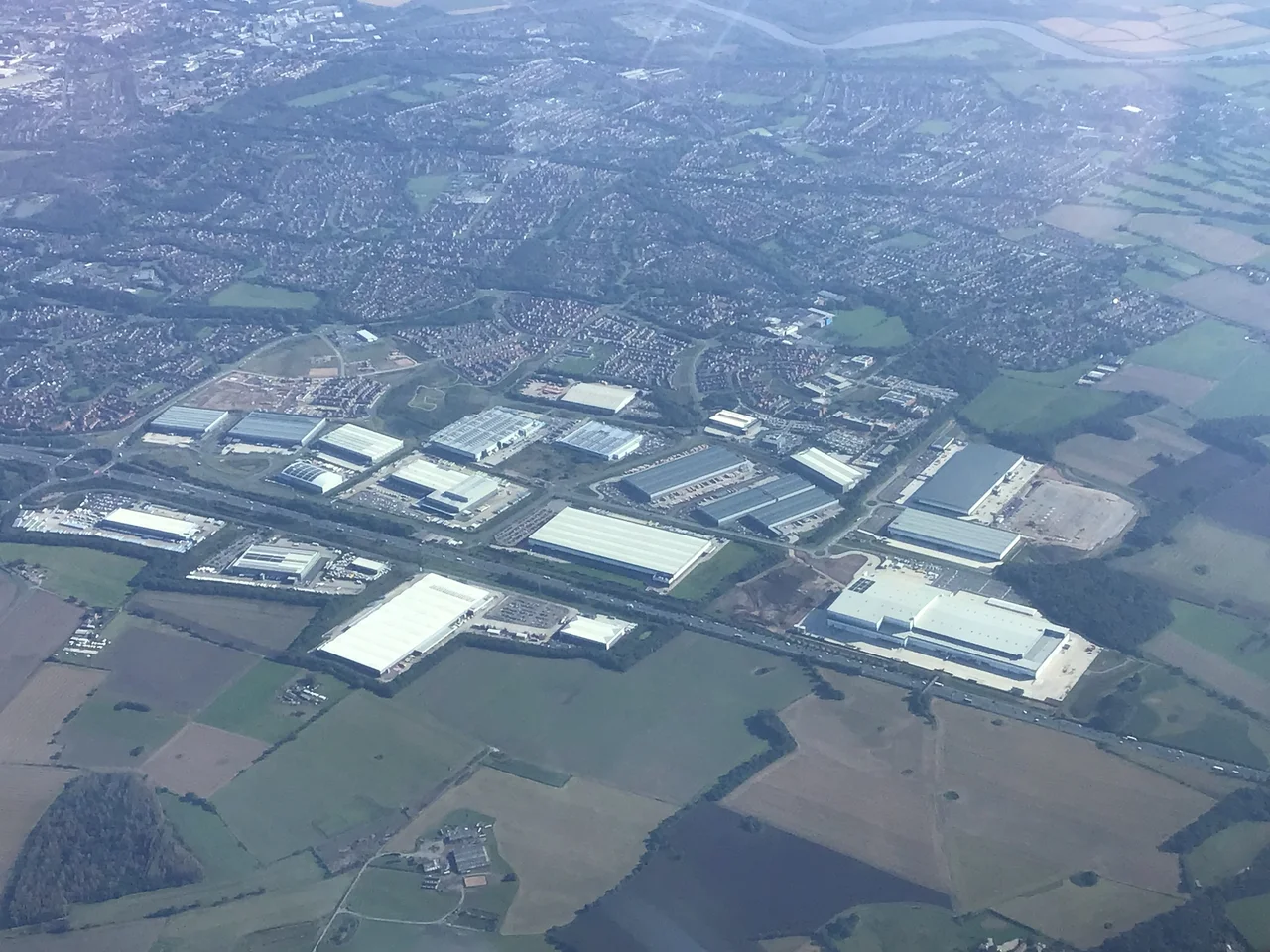
The USAF returned the station to the British Ministry of Defence in 1965. During the 1970s the US Army made limited use of the site for transiting DHC-1 Beavers, with at least one Bell UH-1 Iroquois helicopter typically based there. In the 1970s and 1980s, the Territorial Army, Cadet units, and various MoD civil contingency exercises used the grounds. The runway and most associated buildings were demolished from the late 1980s onward, with the final bunkers coming down in 2009. New construction since 2015 has largely obliterated even those traces, though sections visible from the M62 motorway still show the geometry of the old airfield. The RAF Burtonwood Heritage Centre, opened on part of the former base, focuses on the lives of the servicemen, the war years, and the aircraft that flew out of here. Five exhibit areas cover the GI brides, the planes (including a B-17 Flying Fortress, P-47 Thunderbolt, and B-29 Superfortress in representation), entertainment and personal stories, everyday life on base, and the living history of Burtonwood. A selection of Pratt & Whitney Wasp series engines stands as evidence of the mechanical work that filled the test beds. The roar is gone. The names remain.
From the Air
Located at 53.41°N, 2.65°W, two miles northwest of Warrington in Cheshire. From the air, the M62 motorway runs directly through the former base area, and faint outlines of runways and dispersal bunkers can still be made out in the surrounding agricultural and industrial land, particularly when low-angle morning or evening sunlight throws shadows across the disturbed ground. The Gulliver's World theme park occupies part of the southern edge of the old base. The Chapelford Urban Village development covers much of the central area. Recommended viewing altitude 1,500–3,000 ft. Nearest airports: Liverpool John Lennon (EGGP) 10 nm west, Manchester (EGCC) 15 nm east, Warton (EGNO) 25 nm northwest. The flat, low-lying land made Burtonwood ideal for heavy bomber operations during WWII.
Nearby Stories
- Anson Engine Museum 1.3 km away
- West Kirby 2.9 km away
- Battle of Nantwich 6.2 km away
- Winter Hill Air Disaster 8.3 km away
- Horseshoe Pass 8.8 km away
- Caverswall Castle 12 km away
- Murder of Lindsay Rimer 15 km away
- Piel Castle 50 km away