
RAF Cottesmore
The hunting horn on the station badge was earned. RAF Cottesmore opened on 11 March 1938 on land that had been Cottesmore Hunt country for centuries, and the squadron's heraldic emblem (a hunting horn over an inverted horseshoe with an American star on top) reads as a compressed three-line autobiography of the place. Hunt country. Rutland horseshoe. American visitors. The motto, granted in 1948, was 'We rise to our obstacles', which was a fox-hunting reference and also something an airfield does on a morning take-off. For seventy-three years aircraft flew off these runways. The last formal departure was on 31 March 2011. In April 2012 the army took it over, renamed it Kendrew Barracks and parked tanks on the dispersals.
Wellesleys, Hampdens, and the Phoney War
The station's earliest residents flew the Vickers Wellesley, an angular monoplane bomber notable mainly for its geodesic airframe construction (the lattice-work design Barnes Wallis later refined into the Wellington). They quickly converted to Fairey Battles, three-seat light bombers that proved tragically obsolete the moment they faced German fighters. By the time war broke out in September 1939, Cottesmore was a Bomber Command training station; its operational squadrons were dispersed northwards out of fear of German air attacks that, in the southern half of England, did not yet come. When the threatened attacks failed to materialise, the Hampdens returned in the spring of 1940. No. 14 Operational Training Unit took over the work of preparing aircrew for combat. Cottesmore's Hampdens flew their first wartime operation as leaflet droppers over northern France, an early Bomber Command speciality that killed almost no one but used up a great deal of paper. Training continued through three years and three months, the Hampdens and Herefords giving way to Wellingtons in 1942, until the unit moved on to RAF Market Harborough in August 1943.
The 316th Troop Carrier Group
In September 1943 the United States Army Air Forces took over the facilities as USAAF Station 489. Thirty-two Airspeed Horsa gliders were delivered for storage in July, well before the Americans arrived, in anticipation of what was coming. The 316th Troop Carrier Group flew in from Sicily on 15 February 1944 with fifty-two C-47 Skytrains and C-53 Skytroopers, the workhorses that would carry the airborne divisions to Normandy and Holland and Germany. On the night of 5/6 June 1944, the 316th took off from Cottesmore with paratroopers of the 82nd Airborne Division and dropped them into Normandy ahead of the seaborne invasion. The crews flew without escort into anti-aircraft fire, holding formation across the dark Channel and the dark Cotentin coast at low level so the paratroopers could jump close to their drop zones. Many died doing it. The men they dropped held key bridges and crossroads at Sainte-Mère-Église and the Merderet River until the seaborne forces reached them. Three months later the same group flew into Operation Market Garden over Holland. The American star on the Cottesmore badge remembers them.
V-Bombers and Tornadoes
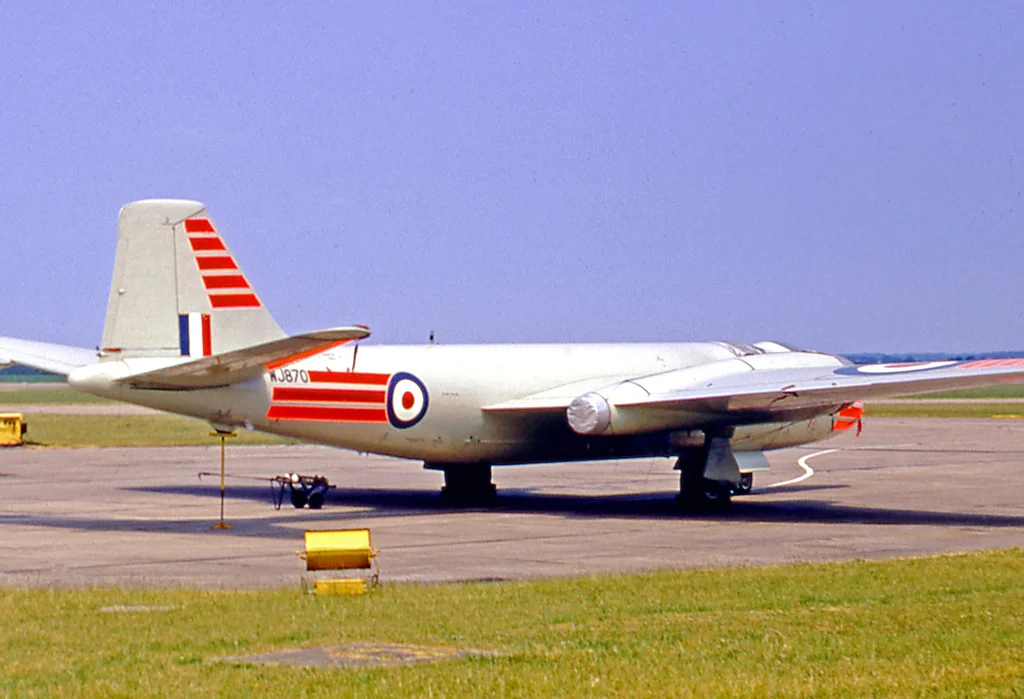
The RAF returned on 1 July 1945. The station spent the late 1940s and the 1950s training basic and advanced pilots on Prentices, Harvards and Boulton Paul Balliols. The Cold War repurposed it: No. 10 Squadron reformed in 1958 flying the Handley Page Victor, one of the three V-bombers of the British nuclear deterrent. Cottesmore performed Quick Reaction Alert duties with Victors and later Vulcans through the early years of mutually assured destruction. No. 360 Squadron, an electronic countermeasures unit flying Canberras, arrived in 1969 and stayed until 1975. The big change came in July 1980 with the establishment of the Tri-National Tornado Training Establishment, jointly run by the air forces of Britain, West Germany and Italy to train aircrew on the swing-wing Panavia Tornado. The TTTE produced thousands of pilots and navigators across nearly two decades, the Italian and German aircrew lodging in the Rutland villages and learning English as they learned the Tornado's complex weapons systems. The school closed in 1999.
The Last Harriers and the Tanks
After refurbishment, Cottesmore became home to the British Aerospace Harrier IIs of Nos 3 and 4 Squadrons, later joined by 800 and 801 Naval Air Squadrons to form Joint Force Harrier. The Harrier, with its capacity for vertical and short take-off and landing, had been the United Kingdom's most distinctive aircraft for forty years. In December 2009 the defence secretary Bob Ainsworth announced the entire Harrier force would be retired and Cottesmore closed; the 2010 Strategic Defence and Security Review confirmed the decision over the protests of senior naval officers. The Harriers flew out in 2010. The formal closing ceremony on 31 March 2011 included a civic parade and flypast. Defence Secretary Liam Fox announced in July that the site would not be abandoned: it became Kendrew Barracks, named after Major-General Sir Douglas Kendrew, and the 2nd Battalion of the Royal Anglian Regiment moved in from Cyprus in 2012, followed by the 7 Regiment Royal Logistic Corps in 2013. The hunting horn on the badge survived the transition. The locomotive 60163 Tornado was named after the aircraft that trained here, and when presented in 1995 carried the station crest on its nameplate; the crest has since been replaced as Cottesmore is no longer an active RAF station.
From the Air
RAF Cottesmore (now Kendrew Barracks) sits at 52.7294 degrees north, 0.6514 degrees west, in farmland between the villages of Cottesmore and Market Overton in Rutland. From 3,000 feet AGL the disused runways, control tower and four C-type hangars are still clearly visible, with grass dispersals and the remains of the perimeter track marking the old airfield boundary. ICAO code was EGXJ. Nearest active airports: RAF Wittering (EGXT) 9 nm south-east, East Midlands (EGNX) 28 nm west. Class G airspace; respect the Wittering MATZ.
Nearby Stories
- 2022 Leicester Unrest 3.7 km away
- Trent Bridge 6 km away
- Ancaster, Lincolnshire 6.7 km away
- Murder of Una Crown 9.9 km away
- Wellingborough 15 km away
- RAF Witchford 16 km away
- Batemans Brewery 26 km away
- Canons Ashby House 27 km away