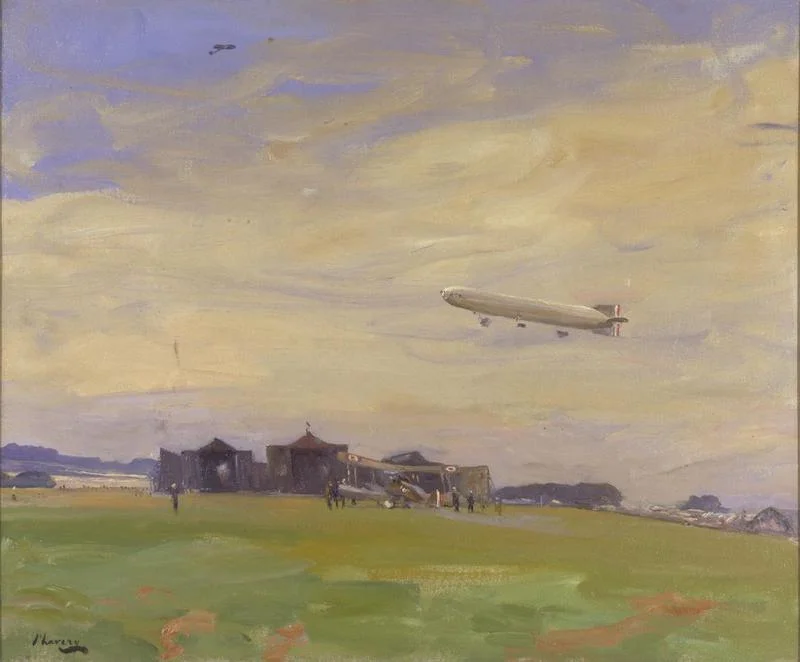

RAF East Fortune
On 2 July 1919 the British airship R34 lifted from East Fortune carrying 30 men, two carrier pigeons, and a cat named Whoopsie that one of the crewmen had smuggled aboard. Four days and twelve hours later, after fighting headwinds the whole way, she moored at Mineola, New York, having made the first east-to-west aerial crossing of the Atlantic. A few days after that she flew back, completing the first return Atlantic flight as well. Sixty-five years before she became the home of Scotland's national aviation museum, before the Concorde G-BOAA arrived in her permanent hangar, this East Lothian airfield was where the British made transatlantic aviation happen. The fact that R34 was a hydrogen-filled airship rather than a heavier-than-air craft only emphasizes how much of that story has been quietly forgotten.
Before the RAF Existed
East Fortune was a flying station before the Royal Air Force was created. The site was first designated as a fighter and airship airfield in 1915 and became a Royal Naval Air Service station in August 1916. By early 1918 it was one of 66 Training Depot Stations charged with training pilots for operational squadrons; East Fortune was TDS No. 208. In July 1918, after the RAF's inauguration, No. 22 (Training) Group RAF was activated here. The group still exists, one of the few from the RAF's founding year still operating. Late in 1918 a prototype Sopwith Snipe was trialled at East Fortune, and the Torpedo Aeroplane School opened on the base in August. The R34 flight came less than a year later, and then, with the war over, the airfield emptied. The hangars were demolished and the domestic site was sold to be used as a tuberculosis sanatorium.
Night Fighters and Mosquitoes
Reactivation came in June 1940. The land was requisitioned as a satellite airfield for nearby RAF Drem, but planners decided to develop East Fortune as a night fighter operational training unit. On 4 June 1941, 60 OTU arrived from RAF Leconfield, equipped initially with single-engined Boulton Paul Defiant night fighters and Miles Master trainers. As the Defiant became obsolete the unit converted to twin-engined Bristol Blenheims and Bristol Beaufighters. By June 1942, with the Luftwaffe's bombers diverted east and south, the night fighter need diminished and part of 60 OTU was reassigned to Coastal Command daylight strike training. On 24 November 1942 the unit was disbanded and 132 OTU formed in its place, training crews for coastal strike. By late 1944 the unit was flying de Havilland Mosquitoes, which became the main type used by war's end.
The Cost of Training
The Wikipedia record of East Fortune's wartime accidents reads as a long, sober catalogue. Crashes at North Berwick Law. Crashes into the Firth of Forth off Fidra and the Isle of May. Crashes at Athelstaneford, Haddington, Lauder, Crail. A Mosquito of 132 OTU that exploded shortly after takeoff on 22 October 1944 and crashed into Beech Hill House, killing both aircrew and four civilians inside, two of them a niece and nephew of Field Marshal Haig. A Beaufighter that crashed at the airfield on 2 December 1943 into the motor transport shed and exploded, killing both crew. Inexperienced aircrew flew tired, war-weary aircraft on night exercises and low-level coastal strikes, with little margin for engine failure. Many of those who died are buried at St Martin's New Burial Ground in Haddington. The trained crews who survived went on to operational squadrons. The aircraft that survived eventually went to other units or to scrap.
A Brief Career as Edinburgh's Airport
After the war the runways went over to local private aviation, but the airfield had one last operational fling. In the summer of 1961, while Edinburgh's Turnhouse airport was being rebuilt, scheduled airliners were diverted to East Fortune. A BEA Viscount overshot the runway on a wet Sunday in April and ended up in the grass. A few weeks later, on 26 May, an RAF Percival Pembroke dropped off two Air Vice-Marshals returning from a NATO meeting in Paris, suffered an engine fire on takeoff, and crash-landed near North Berwick. Both crew survived. The airfield was then quietly handed back to private use. In 1976 the Scottish Museum of Flight opened on the technical site, and East Fortune became, in retirement, what perhaps it had always wanted to be: a place to remember everything that had flown from it.
From the Air
RAF East Fortune lies at 56.00N, 2.72W in East Lothian, immediately south of the village of East Fortune. From the air the original runway pattern remains clearly visible, with the National Museum of Flight's hangars on the eastern side housing Concorde G-BOAA and the rest of the collection. Edinburgh Airport (EGPH) is 18nm west; Dundee Airport (EGPN) sits 20nm north across the Firth of Forth. North Berwick Law (613ft) and Bass Rock are 3nm north. The airfield is closed to fixed-wing aircraft. Best viewed at 2,000-3,500ft.
Nearby Stories
- Leith 0.8 km away
- Crail 1.4 km away
- Falkland Palace 2.8 km away
- Peebles 8 km away
- Mellerstain House 9.9 km away
- Eyemouth Disaster 11 km away
- Battle of Homildon Hill 19 km away
- River Dee Ferryboat Disaster 99 km away