.jpg)
RAF Honiley
Originally it was called Ramsey. It was an unremarkable name for an unremarkable patch of Warwickshire farmland near the village of Wroxall, seven miles southwest of Coventry, until August 1941, when the Air Ministry renamed the place RAF Honiley and turned it into one of the night-fighter stations that guarded the West Midlands during the worst years of the Blitz. Coventry had already been gutted by the Luftwaffe in November 1940. Birmingham's industrial heart was burning regularly. The Honiley pilots flew up into the dark to intercept what they could.
Hurricanes Over the Midlands
The squadrons rotated through Honiley with the rhythm of wartime necessity. No. 257 Squadron arrived from Coltishall in November 1941 flying Hawker Hurricanes - the workhorse fighter that had borne much of the Battle of Britain - and stayed seven months before moving on to High Ercall. No. 32 Squadron took over in September 1942 with their Hurricane IIBs and IICs. No. 135 Squadron passed through briefly in 1941 before being shipped to the Far East. The Midlands needed defenders because the Midlands was a target: Coventry's car factories had been turned to military production, Birmingham's metal trades were forging tank components and aircraft parts, and the night skies overhead were what the German bomber streams crossed to reach them.
Beaufighters, Mosquitoes, and the Bear
By late 1942 Honiley was specialising in night-fighter work. No. 96 Squadron arrived flying Bristol Beaufighters and the new de Havilland Mosquito XII, the wooden wonder that turned out to be one of the fastest aircraft of the war. From August 1943 No. 63 Operational Training Unit set up at the airfield to teach airborne interception techniques - the art of finding bombers in total darkness with the help of early airborne radar, then closing to within visual range and shooting. A more eccentric unit was 1456 Flight, equipped with Douglas Boston light bombers fitted with the Turbinlite - a vast searchlight in the nose intended to illuminate enemy bombers for accompanying Hurricane night-fighters to attack. The Turbinlite scheme was largely a failure, but it had been worth trying when the alternative was letting bombers cross unmolested. Spitfires came too: No. 91 Squadron with Spitfire XIIs in April 1943, No. 130 and No. 234 Squadrons that summer.
The County of Warwick
After the war Honiley became something more local. In May 1946 No. 605 County of Warwick Squadron, originally raised in 1926 as an Auxiliary Air Force unit, returned from B.80 Volkel in the Netherlands and made Honiley its home base. They flew Mosquito night-fighters initially, then transitioned to the jet age with the de Havilland Vampire - the second jet fighter to enter RAF service - in the F.1 and FB.5 variants. The Auxiliary squadrons drew their pilots from civilian volunteers, mostly local men who flew at weekends and during summer camps. For eleven years 605 Squadron remained at Honiley until the entire Royal Auxiliary Air Force fighter branch was abolished in March 1957 as part of the Sandys defence cuts that ended manned fighter procurement for the home defence role.
From Runways to Test Track
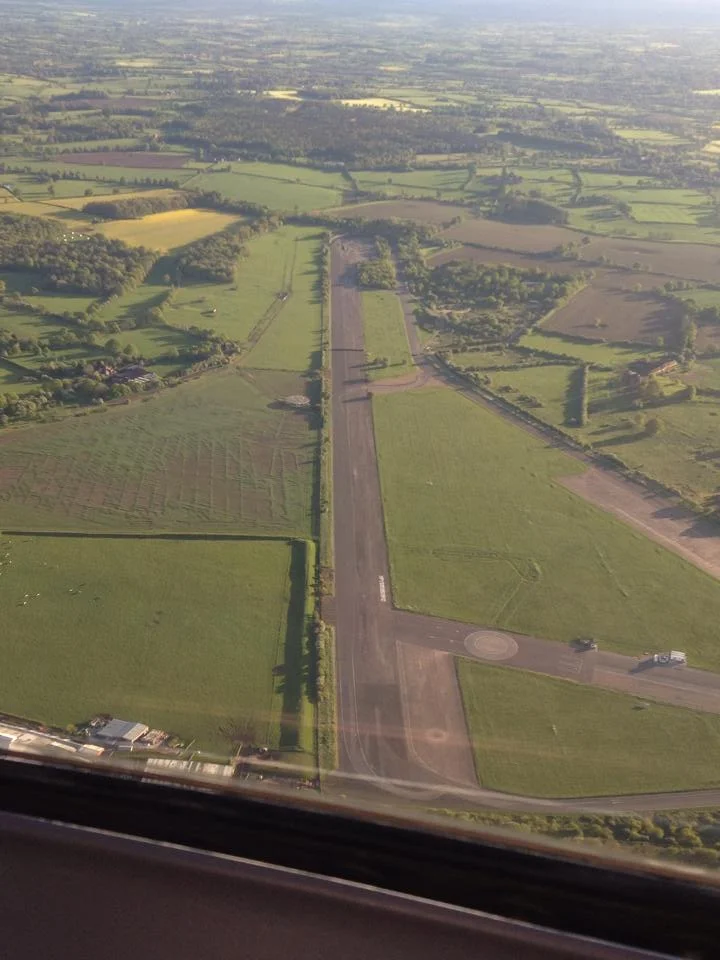
Honiley closed in March 1958, its runways still in good condition. Various uses followed - a motor vehicle test track, then a long stretch of dormancy. In the 2000s the Prodrive Formula One team obtained planning permission to develop the site as their Fulcrum test and development facility; the project was cancelled. Since September 2014 the site has been operated by Jaguar Land Rover as the Fen End heritage driving experience, where customers can drive classic Jaguars and Land Rovers around the perimeter taxiways and across the runways. The old airfield outline is still visible from the air, three converging strips of concrete in the Warwickshire countryside, where Mosquitoes once landed at night and weekend volunteers learned to fly Vampires.
A Square of Quiet Countryside
The control tower is gone. The hangars are gone. Of the wartime infrastructure little remains beyond the runways themselves and the field pattern that an airfield imposes on the countryside around it. The village of Wroxall sits to the north, Beausale to the south, the woods of the old Stoneleigh estate to the east. Kenilworth is four miles further on. The flying that Honiley produced - some 13,000 hours of operational sorties between 1941 and 1945 alone - is recorded in squadron diaries and pilot logbooks in archives now, the airfield itself returned to a quieter purpose.
From the Air
Located at 52.36N, 1.66W in north Warwickshire, seven miles southwest of Coventry near the village of Wroxall. The former runway pattern remains visible from low altitude as three converging concrete strips, now used as the Fen End Jaguar Land Rover heritage test track. Nearest airports: EGBE (Coventry, 5nm NE), EGBB (Birmingham, 13nm NW), EGBJ (Wellesbourne, 11nm S). Best viewed at 1,500-2,500 ft AGL.
Nearby Stories
- Stowe House 2.5 km away
- Wolverhampton 3 km away
- Althorp 3.9 km away
- Droitwich Spa 4.3 km away
- Tewkesbury 5.4 km away
- Tamworth Castle 11 km away
- Uppingham School 23 km away
- Woodstock Palace 26 km away