.jpg)
RAF Lossiemouth
Thoir an aire. The station motto translates from Scottish Gaelic as 'Be careful' - a piece of practical advice for an airfield where four fast-jet squadrons share two runways with maritime patrol aircraft, where the weather changes in minutes, and where the alarm to scramble can come from anywhere along a five thousand mile arc of NATO's northern airspace. Since RAF Leuchars closed to fast jets in 2015, Lossiemouth has been the only operational Royal Air Force station left in Scotland. Everything that comes south from Russia by air comes past here.
The Quick Reaction Alert
At the northern dispersal, in a pair of hardened shelters, two Eurofighter Typhoon FGR4 fighters wait at a few minutes' readiness, twenty-four hours a day, three hundred and sixty-five days a year. This is QRA North - the airborne sentry that responds when an unidentified aircraft approaches British airspace. Sometimes it is a civilian airliner that has stopped answering its radio. Sometimes it is a pair of Russian Tu-95 Bear bombers - giant four-engined turboprops, in service since the 1950s but updated repeatedly, probing the limits of allied airspace and the response times of the squadrons that watch it. The Bears are met in international airspace, escorted past, and returned. Tu-160 Blackjacks, supersonic strategic bombers, get the same treatment. The Lossiemouth Typhoons fly from four squadrons: No. 1, No. 2, No. 6 and No. 9. All four share the QRA(I)N duty in rotation.
From Bomber Command to the Cold War
The airfield opened on 1 May 1939, on 540 acres of requisitioned farmland - five farms, including Coulardbank and Smithfield, demolished to make way for runways. The first hangars were finished in August 1939, just in time for a fatal mid-air collision between two Airspeed Oxfords that killed three crew. The Luftwaffe bombed Lossiemouth on 26 October 1940 - three Heinkel He 111s wrecked two Blenheims and damaged hangars whose holes from cannon fire are still visible today. One Heinkel crashed on the airfield; its crew of four are buried in a local churchyard. Throughout the Second World War the station served Bomber Command, then the Fleet Air Arm took over in 1946 as HMS Fulmar - a training and strike base that flew Seafires, Sea Hawks, Sea Furies, and finally Blackburn Buccaneers. The Royal Air Force took it back in September 1972.
Tornado and the Long Transition
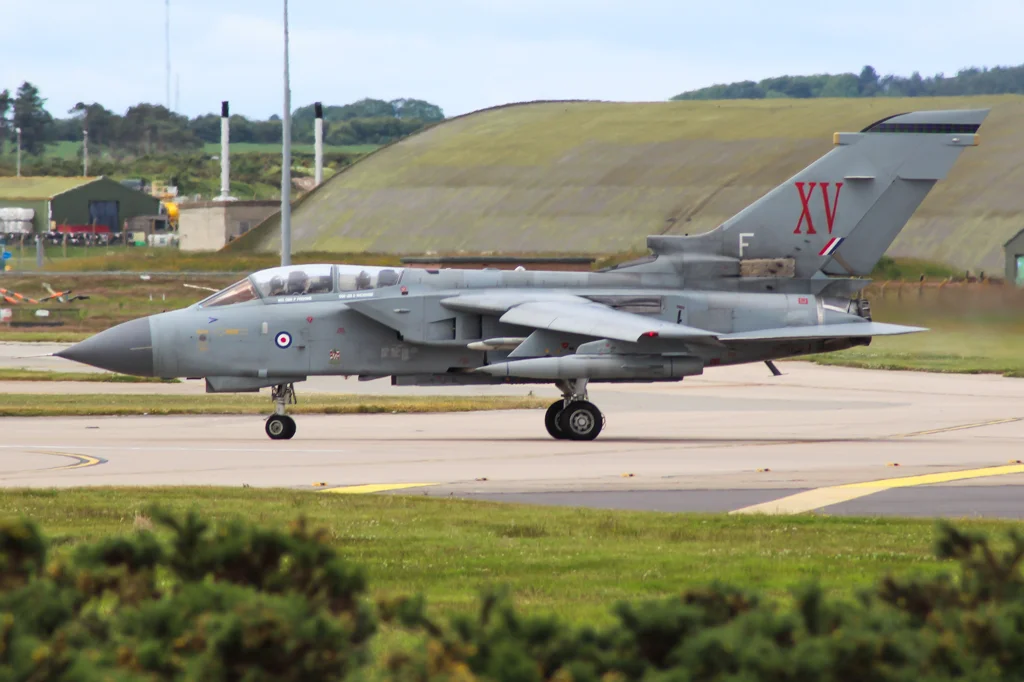
For the next four decades Lossiemouth was a Tornado base. The Buccaneers had been a long Cold War mainstay - Lossiemouth Buccaneers had bombed the wrecked supertanker Torrey Canyon off the Cornish coast in 1967 to ignite its oil and prevent a worse disaster - but the Tornado replaced them through the early 1990s. The 2010 Strategic Defence and Security Review cast doubt on the station's future. The F-35 was promised, then awarded to RAF Marham. Closure rumours brought 7,000 people out to a rally in Lossiemouth on 7 November 2010, with Scotland's First Minister Alex Salmond among them - the local economy depended on the base. A petition with more than 30,000 names was delivered to Downing Street. In July 2011 the Ministry of Defence relented: Lossiemouth would stay, and the QRA mission would move there from the doomed RAF Leuchars.
Typhoon and Poseidon
The Typhoons arrived from 2014, the first nine flying in from Leuchars in the shape of a number 6 - the emblem of the unit transferring. Then came the Poseidon. The Boeing P-8A Poseidon MRA1 is a maritime patrol aircraft built on the 737 airframe - long-range, fast, and packed with submarine-hunting sensors. The UK ordered nine in 2015 to replace the cancelled Nimrod MRA4 programme, and Lossiemouth was chosen as their home. £350 million of investment built the Atlantic Building, the new Poseidon Strategic Facility, completed in 2020. Resurfaced runways. Seven new accommodation blocks named after lost north-eastern airfields - Brackla, Dalcross, Dallachy, Dyce, Inverness, Milltown and Peterhead. No. 120 Squadron and No. 201 Squadron now fly the Poseidon. The Boeing Wedgetail AEW1 airborne early warning aircraft is due from 2026, replacing the retired Sentry fleet and bringing No. 8 Squadron back to Lossiemouth.
Inside the Wire
The station spreads across 580 hectares on the western edge of the town. The Engineering and Logistics Wing keeps the aircraft flying. The Operations Wing runs the day-to-day flying programme. No. 5 Force Protection Wing handles base security, including No. 51 Squadron RAF Regiment and the Royal Auxiliary No. 2622 (Highland) Squadron. The RAF Lossiemouth Mountain Rescue Team runs out of one of the old Sea King hangars. The mascot is Dee, a retired RAF Police explosives detection dog given the rank of Sergeant in 2017. The Lossie Lighthouse magazine, named for the Stevenson tower up the coast at Covesea, is the in-station paper. A spaniel, a magazine, a memorial to crash victims at Smithfield, and a pair of fighters always ready in their shelters - the texture of a Cold War station that the Cold War has refused to let fade.
From the Air
RAF Lossiemouth (ICAO: EGQS) is at 57.71 N, 3.34 W, on the south shore of the Moray Firth at the western edge of Lossiemouth town. Two runways: 23/05 at 2,890 metres and 28/10 at 1,820 metres. The airfield elevation is 42 feet. RAF Lossiemouth is the parent station for Tain Air Weapons Range, 25 nautical miles north-west, where Typhoons train against ground targets. Other airports in the region: Inverness (EGPE) 30 nautical miles west, Aberdeen International (EGPD) 60 nautical miles south-east, Wick (EGPC) 50 nautical miles north. Watch for Typhoon QRA scrambles and Poseidon MRA1 climbs to maritime patrol altitudes over the North Atlantic. The station is heavily NOTAM'd - check current restrictions before transiting the area.
Nearby Stories
- Cardhu Distillery 1.5 km away
- Clynelish Distillery 1.8 km away
- Hilton of Cadboll Chapel 3.1 km away
- Huntly Castle 3.4 km away
- Findlater Castle 6.3 km away
- Culloden Viaduct 12 km away
- Helmsdale 23 km away
- HMS Exmouth (H02) 39 km away