_at_2018_Cotswold_Airport_Revival_Festival,_Gloucestershire,_England_29Sept2018_arp.jpg)
RAF Towyn
On 8 July 1944 a Boeing B-17 Flying Fortress of the 569th Bomber Squadron, USAAF, came in low over the Welsh coast looking for somewhere to land. The pilot's intended destination was RAF Llanbedr to the north; he was nowhere near it. RAF Towyn lay below, three short grass runways squeezed between the beach and a railway line, none of them anywhere near long enough for the four-engined bomber bearing down on them. The pilot put her down anyway. The B-17 ran out of runway, crossed the Cambrian Coast Railway tracks, and finally came to rest inside an air raid shelter on the airfield's edge. All fifteen crew survived. The shelter, presumably, did not. RAF Towyn never received Spitfires or bombers; it existed mostly so the Royal Artillery had something to shoot at. The B-17 that crashed there is its most famous accidental visitor.
The Drone and the Tow
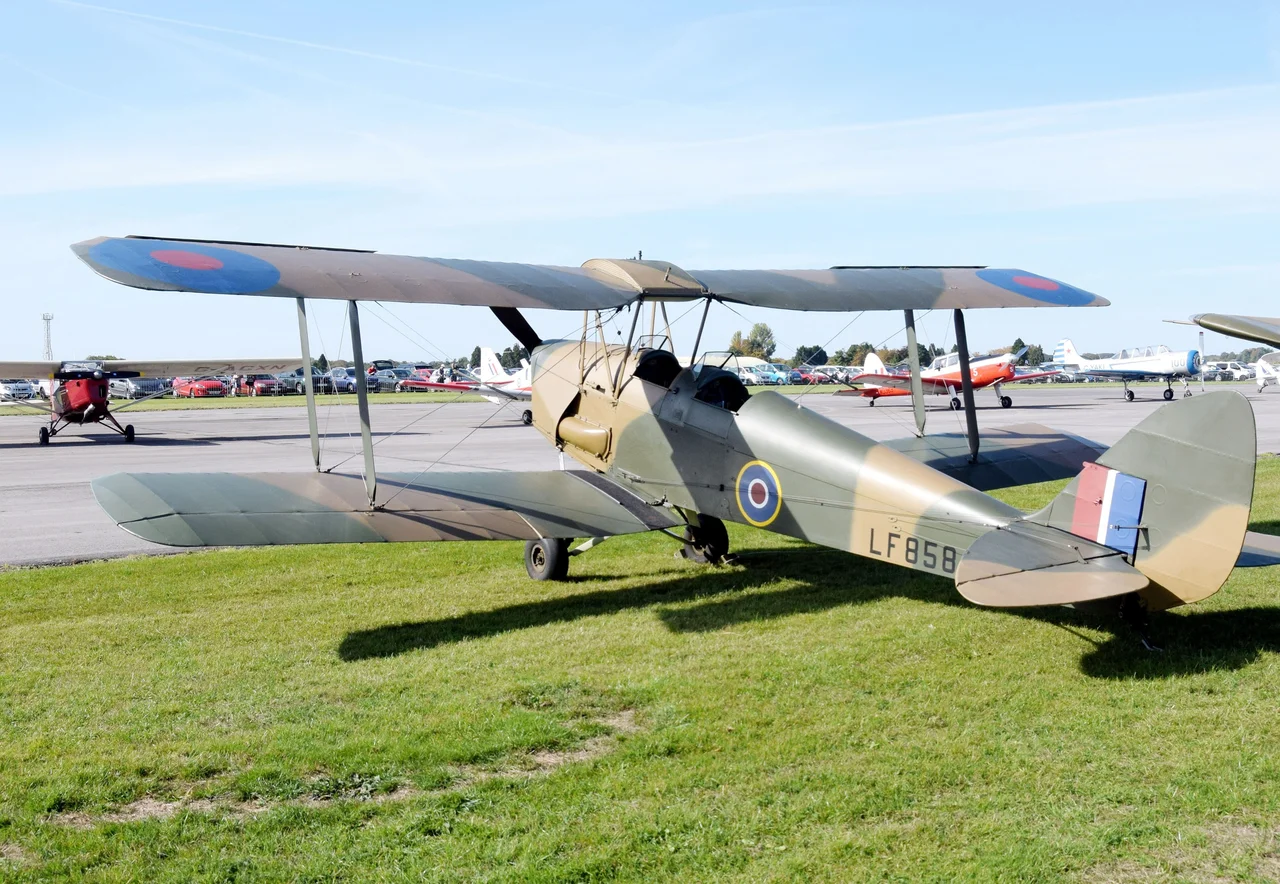
Towyn opened in 1940 as a satellite for the Royal Artillery Anti-Aircraft Practice Camp at Tonfanau just up the coast. Its purpose was simple and slightly absurd: to provide targets, both pilotless and towed, for gunners learning how to shoot at aircraft. From September 1940 the airfield was home to U Flight of No. 1 Anti-Aircraft Co-operation Unit, equipped with the de Havilland DH.82B Queen Bee. The Queen Bee was a radio-controlled version of the Tiger Moth biplane, the world's first practical drone, designed in 1935 specifically so that anti-aircraft gunners could practise on something that flew like the real thing rather than on a sock dangled behind another aircraft. C Flight of the same unit arrived in June 1941 with Hawker Henleys, towing fabric targets for the guns to perforate. The crews who flew tugged targets back to Tonfanau called it the most boring job in the RAF. The gunners disagreed.
Maycrete Huts and Bessonneau Hangars
The station design was wartime expedient. Three grass strips, the longest 1,189 metres, the shortest only 640. A control tower built to specification 952/40, a standard small-airfield drawing rolled out by the Air Ministry. The main site was Maycrete huts (prefabricated concrete posts holding up pitched roofs filled with sawdust-concrete panels) and Nissen huts, with two Bessonneau canvas hangars to keep aircraft out of the weather. Two Bellman hangars and a couple of Blister hangars were added later, along with a concrete apron. The whole site was meant to last five years. Most of the buildings were demolished after the war ended; the apron has been broken up; the hangars are gone. A few support buildings still stand, mostly vacant, behind a perimeter fence on the northern edge of Tywyn town.
Emergencies on the Welsh Coast
Towyn was designated as a diversionary airfield for Cardigan Bay. When aircraft over the sea ran into trouble, Towyn was the first piece of dry runway they could find. Twelve Lockheed P-38 Lightnings of the 97th Fighter Squadron landed in formation on 16 December 1943, all in trouble, all running short of fuel. One crashed into a gun post on landing. The airfield was unusable for two days. A Bristol Beaufort from No. 217 Squadron diverted in with engine problems on 11 November 1940. A Hawker Henley crashed half a mile from the airfield on 3 June 1940. The Aberystwyth University Air Squadron operated out of Towyn for a year during 1943 to 1944, training Welsh undergraduates in the basics of flight before they were posted to operational squadrons. Most of the Towyn airmen never saw combat. They flew targets, tugged drogues, and were shot at every day by their own side.
Morfa Camp and What Came After
In December 1943, U Flight and 1605 Flight were combined into No. 631 Squadron RAF, the unit that did most of the station's flying for the last eighteen months of the war. In May 1945 the squadron moved to RAF Llanbedr (the airfield the B-17 had been trying to find the year before), and Towyn was transferred to RAF Technical Training Command. The flying stopped in July 1945. The army took over the site as Morfa Camp, a name that has stuck. For the rest of the 20th century the camp was used intermittently for training exercises, accommodation, and the long slow process of dismantling whatever the RAF had built. Today the airfield site sits between the Cambrian Line railway and the long curve of Tywyn beach, recognisable from the air mostly by the ghost outline of its perimeter track. The Queen Bee drones are gone. The gunners are gone. Only the geometry remains.
From the Air
Located at 52.59N, 4.10W on the northern outskirts of Tywyn, between the Cambrian Coast Railway and the long sandy beach of Cardigan Bay. From the air, look for the faint outline of the old airfield as cleared ground north of Tywyn town, with the Dysynni estuary opening just beyond. Cadair Idris (893m) rises sharply to the north-east. Nearest airports: Llanbedr (EGFD) approximately 12nm north; Caernarfon (EGCK) approximately 30nm north; Welshpool (EGCW) approximately 35nm east. Recommended viewing altitude: 1,500-2,500 ft for the coastal strip and the remains of the airfield perimeter. Westerly winds build sea state across the bay; mountain wave conditions are common in the Cambrian hills inland.
Nearby Stories
- Penrhyndeudraeth 2.7 km away
- Cwmhir Abbey 11 km away
- Battle of Maes Moydog 13 km away
- HMS Whirlwind (R87) 14 km away
- Strata Florida Abbey 18 km away
- Bardsey Lighthouse 19 km away
- HMS H5 22 km away
- Llangollen Railway 23 km away