
RAF Valley
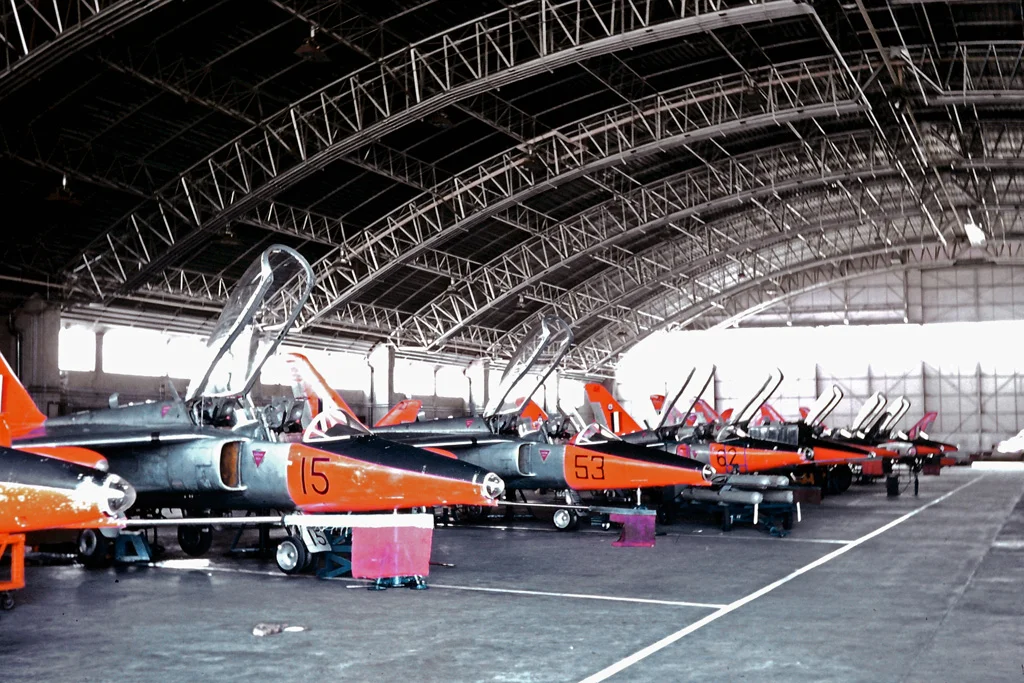
If you become a fast-jet pilot in any branch of the British armed forces - Royal Air Force, Fleet Air Arm, Army Air Corps - you will at some point land at this airfield on the western edge of Anglesey. The runway 13/31 here is two and a half kilometres of concrete laid out at the foot of the holy mountain Mynydd Twr, with the Irish Sea breaking just beyond the western threshold. Two-thirds of British fast-jet training happens here: ab-initio courses on the Beechcraft Texan T.1, then advanced flying on the BAE Hawk T.2 with No. 4 Flying Training School. Generations of Typhoon, F-35 and Harrier pilots learned the basics of pulling Gs and shooting low here first.
1941: A Hurried Beginning
The field opened on 1 February 1941 as a Fighter Sector Station under No. 9 Group RAF, with the unglamorous task of covering England's industrial northwest and Irish Sea shipping. The first detachments were Hawker Hurricanes of No. 312 Squadron - Czechoslovak airmen who had fled the German occupation of their country and were now flying for the RAF - and No. 615 Squadron AAF. Bristol Beaufighters of No. 219 Squadron provided night-fighter cover. In June 1941, No. 456 Squadron of the Royal Australian Air Force formed at Valley, eventually flying Beaufighter IIs on night patrols over the Irish Sea until they moved south in March 1943. The Irish Sea was an unforgiving training environment - so many aircraft went down that No. 275 Squadron formed at Valley in October 1941 specifically to fly Westland Lysander and Supermarine Walrus air-sea rescue missions for them.
The Atlantic Ferry
From June 1943, RAF Valley became the British end of the USAAF Atlantic ferry route. American bombers crossing the ocean - B-17 Flying Fortresses, B-24 Liberators, C-47 Skytrains, C-54 Skymasters - landed here before fanning out across Europe. The numbers became extraordinary. On 17 August 1943, eleven US Navy B-24s arrived from Iceland. On 18 February 1944, sixty-two C-47s came in from North Africa via the southern route through the Azores and Marrakesh. The single busiest day was 17 September 1944, when ninety-nine USAAF Flying Fortresses and Liberators landed at Valley in a single day, the runway barely cooling between movements. Airmen of every rank then continued to London on the LMSR's Irish Mail train from Holyhead. After Germany surrendered, the flow reversed: over 2,600 bombers passed through on their way back to the United States, each carrying twenty passengers and crew.
Jets, and a Prince
Valley reopened in April 1951 as No. 202 Advanced Flying School, training fighter pilots on de Havilland Vampires and Gloster Meteors. The school became No. 7 FTS in 1954, then No. 4 FTS in 1960 - and No. 4 FTS is still there. Folland Gnats arrived in 1962 and gave way to the BAE Hawk T.1 in 1976 and the Hawk T.2 in the 2010s. From 1976 to 2015, Valley hosted C Flight of No. 22 Squadron, flying Westland Sea King HAR.3 helicopters on search and rescue. The Duke of Cambridge - now Prince William, heir to the throne - served as a Sea King pilot at Valley from 2010 to 2013. He flew his last operational shift on Tuesday 10 September 2013. In October 2015 the RAF's SAR responsibility passed to Bristow Helicopters, now operating from nearby Caernarfon Airport.
A Working Base
Valley today is a busy training establishment. No. 4 FTS flies the Hawk T.2; No. 72 Squadron, which stood up at Valley on 28 November 2019, flies the Beechcraft Texan T.1 in the basic flying training role with a fleet of ten aircraft. No. 202 Squadron operates three Airbus Jupiter HT.1 helicopters for maritime and mountain flying training, sending Royal Navy crews on toward the anti-submarine Merlin and Wildcat fleets. There have been losses - in March 2018, a Red Arrows Hawk crashed during a training detachment, killing Corporal Jonathan Bayliss. The civilian airline service to Cardiff, which used Valley's terminal from 2007, was permanently axed by the Welsh Government in June 2022, leaving the airport terminal disused. The fast jets keep flying. From any kitchen window in Holyhead or Trearddur Bay, you can hear them - the long buzz of a Hawk pulling through a low pass over the dunes.
From the Air
RAF Valley (EGOV / Anglesey Airport) lies at 53.248N, 4.535W on the western edge of Anglesey, between Llyn Penrhyn and the Irish Sea. The main runway is 13/31, with crossing 19/01. Civilian airline service has been suspended since June 2022; the field is active military with extensive Hawk T.2, Texan T.1 and Jupiter HT.1 movements. Restricted airspace applies. RAF Mona (EGOQ) is 7 nm east and serves as relief landing ground. Caernarfon Airport (EGCK) is 14 nm southeast across Caernarfon Bay. Holyhead Mountain (Mynydd Twr, 220 m) is a useful visual landmark 6 nm to the northwest.
Nearby Stories
- Wakestock 1.7 km away
- Trefriw 3.8 km away
- Irish Sea 8.7 km away
- Irish Sea Bridge 20 km away
- East–West Interconnector 30 km away
- Machynlleth 36 km away
- HMS Tyler 41 km away
- New Brighton Lifeboat Station 54 km away