_(19765614018).jpg)
RAF Woodvale
Woodvale was built to fight a battle that was already over. The airfield's purpose, in the planning documents of 1940, was to put night fighters within minutes of Liverpool, a port the Luftwaffe had identified as one of the most important targets in Britain. By the time Woodvale opened on 7 December 1941, the Liverpool Blitz had peaked seven months earlier in the appalling raids of May 1941, and the Germans had largely moved on to other cities. So Woodvale became something different. It became a rest station, a training base, a place where pilots from squadrons exhausted on the south coast could be rotated north for a few weeks of relative calm, fly Spitfire patrols over the Irish Sea, and remember how to sleep.
Polish Wings Over Merseyside
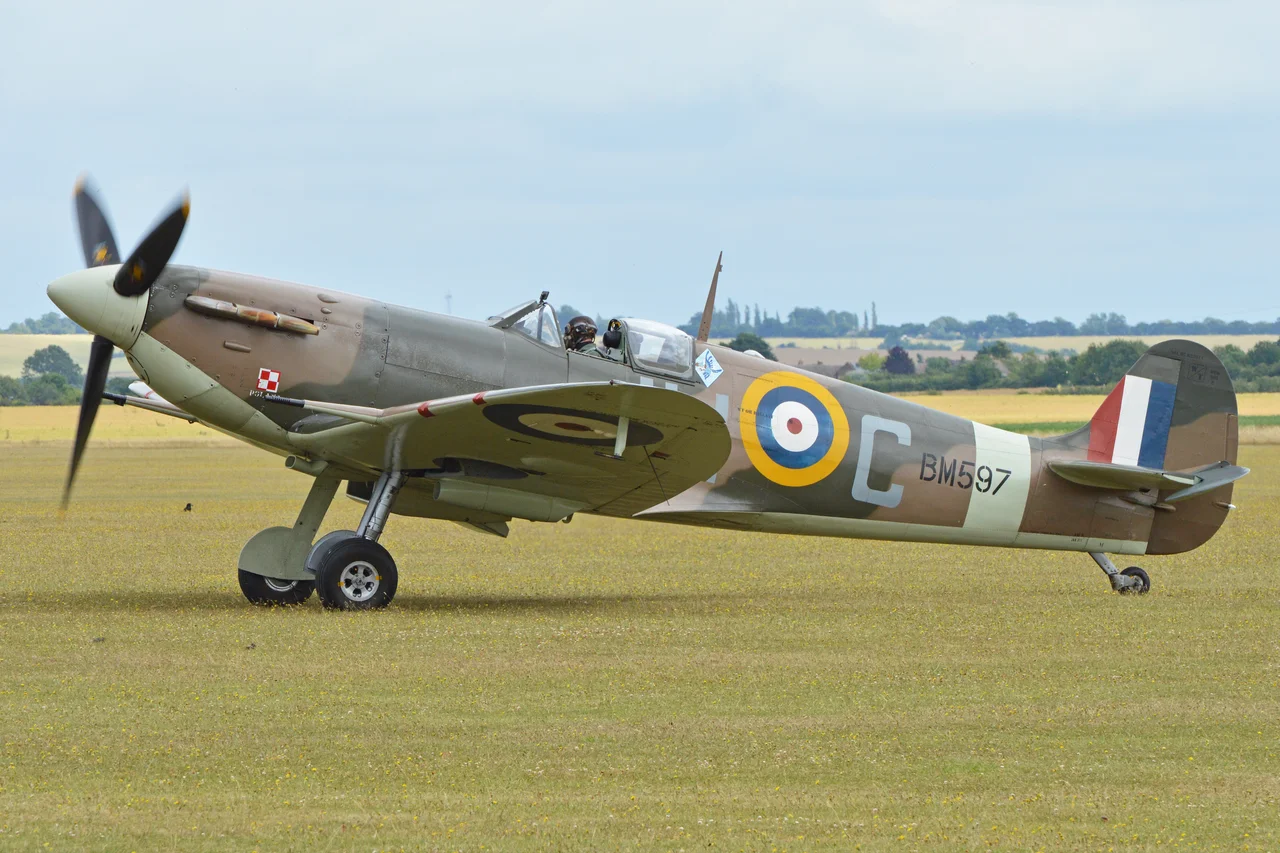
The first squadron to arrive, on 12 December 1941, was 308 (Krakowski) Squadron, a Polish Air Force unit that had been formed by men who had escaped Poland after the 1939 invasion, made their way to France, then to Britain after France fell. They flew Spitfire IIs and Vbs out of Woodvale until 1 April 1942. After them came 315 (Deblinski) Squadron and 317 (Wilenski) Squadron, both Polish, both made of men whose homes were under German occupation and whose families they could not contact. The Polish pilots were among the best in the RAF, frequently topping the kill tables, flying with a ferocity that British officers sometimes had trouble accommodating. At Woodvale they had a quieter sector, time to train new arrivals, and a brief respite from the funeral letters.
The Last Spitfire Flight
When peace came, Woodvale fell quiet for a while. It reopened on 22 July 1946 as the home of No. 611 (West Lancashire) Squadron of the Royal Auxiliary Air Force, weekend warriors flying Spitfire Mk.14s out of Liverpool's Speke airport. They re-equipped with Spitfire Mk.22s in 1949, then briefly with Gloster Meteor jets in 1951 before the unit moved on. The Temperature and Humidity Flight kept Spitfires and Mosquitos at Woodvale from 1953 to 1958, mostly for meteorological work. In 1957 the last operational flight by an RAF Spitfire was made from Woodvale, almost certainly on a meteorological sortie. The Spitfire had come into RAF service in 1938. Twenty-one years later, the type's working life with the Royal Air Force ended on a runway between the dunes south of Southport.
Training Ground for a New Generation
Since 1971 Woodvale has been a training station, and on most weekdays you can hear Grob Tutor light aircraft buzzing over the Sefton coast as undergraduates learn to fly. Liverpool University Air Squadron, Manchester and Salford Universities Air Squadron, and 10 Air Experience Flight are all based here. The students, mostly in their early twenties, get something rare: real flying time in a real military environment, in aircraft that descend from a long lineage of British training types. A BAe Hawk T1A, tail number XX247, sits as gate guardian at the entrance, installed in November 2017 in place of the older Jet Provost that had marked the spot for decades.
The Rally That Started as a Model Show
From 1971 onward, Woodvale hosted one of the great summer fixtures of the Lancashire calendar. The Woodvale International Rally began as a model aircraft show, then grew to include classic cars, vintage vehicles, and military displays, drawing tens of thousands on the first weekend of August. It ran for forty-one years on the airfield itself before safety concerns about asbestos in buried wartime structures forced it to move to Victoria Park in Southport in 2012. The fiftieth rally was held in 2018, and a dispute with the park's management led to the event's cancellation in 2019. It does not return, which is the kind of small loss that adds up to a quieter Lancashire.
The Helicopter, the Petrol, the Quiet
For some years the Merseyside Police helicopter was based at Woodvale, which made the airfield an occasional target for the people the helicopter was used to chase. In October 2009 a window was smashed and petrol poured inside the aircraft, grounding it. In May 2010 four masked intruders broke in around four in the morning and did minor damage. The aircraft, G-XMII, was retired from Merseyside service in July 2011 and leased a year later to the Norwegian Police Service, which needed reinforcement after the Utoya massacre of 2011. Woodvale today is a quieter place, a working training station in a peculiar landscape: pine woods, sand dunes, a Tudor town a few miles north, and the broad sands of the Sefton coast running away toward Liverpool Bay.
From the Air
Coordinates 53.5817 N, 3.0556 W between Formby and Ainsdale, ICAO EGOW. Active military training airfield: check NOTAMs and contact ATC for transit clearance. Runway 09/27 is the main hard runway. Recommended overflight altitude not below 3,000 feet to stay clear of light training traffic. Nearby airports: Liverpool John Lennon (EGGP) 11 nautical miles southeast, Blackpool (EGNH) 12 nautical miles north, Hawarden (EGNR) 19 nautical miles south. The airfield sits in coastal pinewoods immediately east of the Sefton dune system.
Nearby Stories
- Blackpool Pleasure Beach 4.4 km away
- Whalley Abbey 4.8 km away
- Worsley 5.4 km away
- Second Battle of Middlewich 7.7 km away
- Chester Zoo 7.9 km away
- Llanrwst 23 km away
- Abergele Rail Disaster 27 km away
- Sea Lion Rocks railway station 73 km away