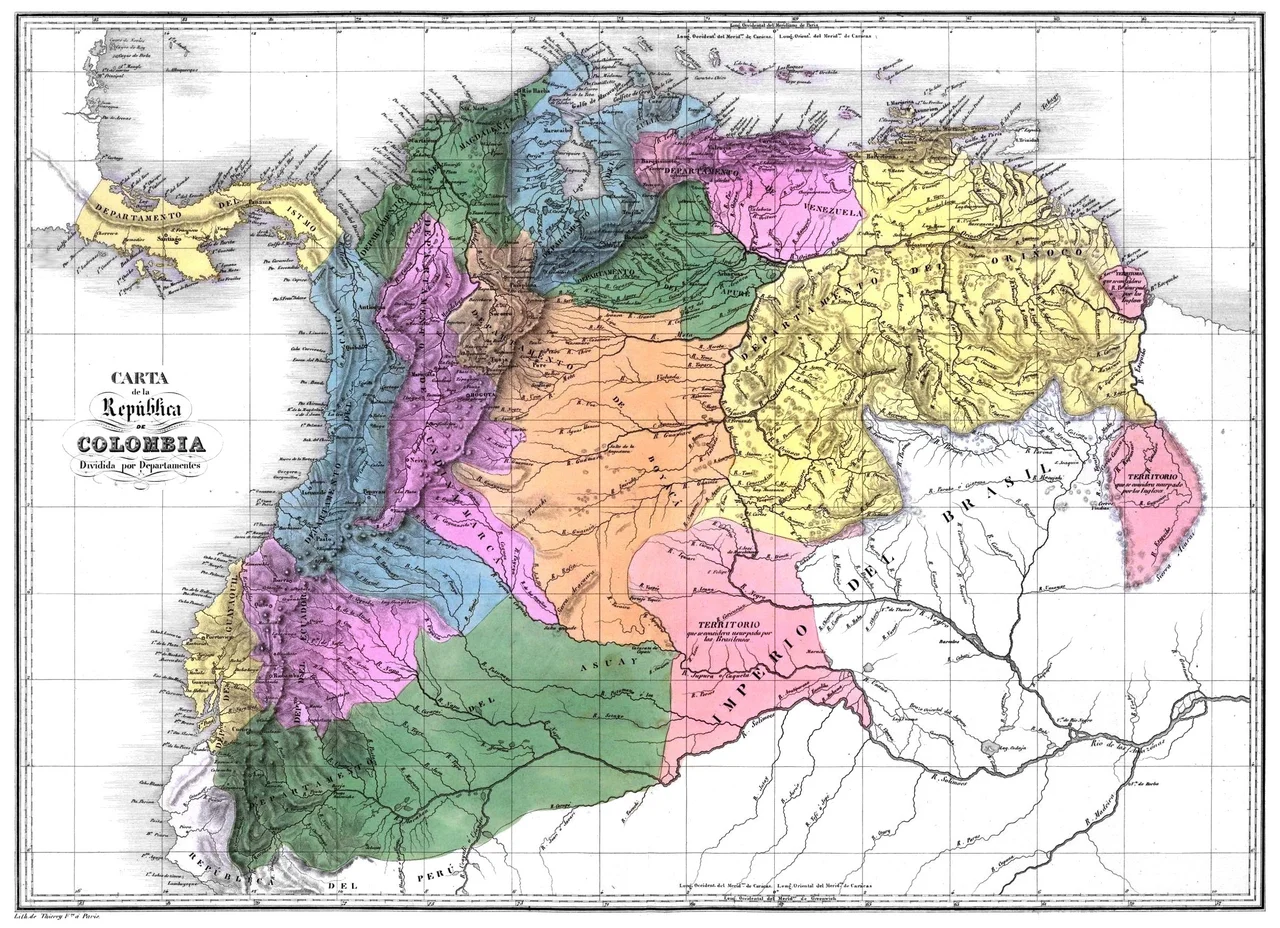

Real Audiencia of Quito
On 29 August 1563, in the Castilian town of Guadalajara, Philip II of Spain signed a decree creating a new colonial government in a city he had never seen. Quito sat more than 9,000 kilometers away, perched at 2,850 meters in the Andes, and his order would give it jurisdiction over a territory the size of Western Europe. The Real Audiencia of Quito was a court, a capital, and a cartographic assertion. Its boundaries ran from the Pacific coast inland across what is now Ecuador, swept south into northern Peru, north into the Colombian highlands, and east into the unmapped Amazon. For 259 years, this piece of parchment defined a country that did not yet exist.
A Court in the Mountains
The Audiencia was part court, part cabinet, part royal pretender. Its structure was specified in exacting detail: a president, four oidores who served as civil judges and doubled as alcaldes del crimen for criminal cases, a crown attorney known as the fiscal, an alguacil mayor who enforced judgments, and a lieutenant of the Gran Chancellor to authenticate the documents. The decree itself reads like a surveyor's notebook, listing the towns of Jaen, Valladolid, Loja, Zamora, Cuenca, La Zarza, and Guayaquil, tracing coastlines toward Panama and Lima, reaching inland to Pasto and Popayan and Cali. The southern border ran through the Port of Paita, the northern through Buenaventura, the western was simply the South Sea, and the eastern was a frank admission: the provinces still not yet pacified nor discovered.
Effective Autonomy
In theory the Audiencia answered to a viceroy. In practice, the viceroy was too far away to matter. When the Audiencia was founded, its nominal superior was the Viceroyalty of Peru, headquartered in Lima, roughly 2,000 kilometers of mountain and jungle distant. A message took weeks to travel between capitals. A dispute could take years to resolve. Power drained naturally toward the people who were actually in the room when decisions had to be made. The president of the Audiencia became, in effect, a governor. The judges became his cabinet. The crown attorney became the local voice of Madrid. When the Viceroyalty of Nueva Granada was created in 1717, Quito was reassigned to Bogota. Six years later that viceroyalty was abolished and Quito reverted to Lima. In 1739 Nueva Granada was revived and Quito joined it again. The reshuffling continued right up to independence.
The Presidents
Forty-one men held the presidency of the Real Audiencia between 1563 and 1822. The first was Hernando de Santillan, who served eight years and drafted the foundational ordinances for the court. Antonio de Morga, a Spanish jurist and chronicler who had served in Manila and written one of the earliest histories of the Philippines, held the position for nearly two decades beginning in 1615. The final peacetime president was Luis Hector de Carondelet, a Flemish nobleman and Spanish military engineer who arrived in 1799 after a turbulent term as governor of Spanish Louisiana. He commissioned the Carondelet Arch at the Quito Cathedral before dying in office in 1807. His successor, the Count of Ruiz de Castilla, would preside over the collapse.
Revolution and Reconquest
On 10 August 1809, a group of Quito creoles deposed Ruiz de Castilla and established the First Autonomous Junta under Juan Pio Montufar. It was one of the earliest independence movements in Spanish America, predating most of the famous declarations by years. Royal forces from Lima and Bogota crushed the junta within months, and Ruiz de Castilla returned to power. A second junta formed in 1811 under the bishop Jose Cuero y Caicedo. It too was defeated, in 1812, and the Audiencia spent another decade under royalist governors named Montes, Ramirez, and Aymerich. Then Antonio Jose de Sucre arrived from the north with Simon Bolivar's army. On 24 May 1822, Sucre defeated the royalists on the slopes of Pichincha, a volcano visible from the cathedral where the Audiencia had sat for centuries. Melchor Aymerich signed the capitulation. The Audiencia dissolved into the new Republic of Gran Colombia, and eight years later into an independent Ecuador, its borders still roughly tracing the lines Philip II had drawn on parchment in 1563.
From the Air
The administrative seat of the Real Audiencia was in central Quito, near 0.25 S, 78.58 W. Altitude 2,850 m, elevation in the Andean valley. Recommended viewing altitude 4,500 to 5,500 m to appreciate the full basin of Quito between Pichincha volcano to the west and the Guayllabamba valley to the east. Nearest airport is Mariscal Sucre International (SEQM). The historic center, preserved as a UNESCO World Heritage Site, marks where the Audiencia's courts, cathedral, and government palace once formed the administrative heart of an empire stretching from the Pacific to the Amazon.
Nearby Stories
- Pululahua Geobotanical Reserve 13 km away
- Illiniza 21 km away
- Baeza 28 km away
- La Mana 48 km away
- Quinindé Canton 56 km away
- Tena 57 km away
- Guandera Biological Station 76 km away
- Valencia, Ecuador 82 km away