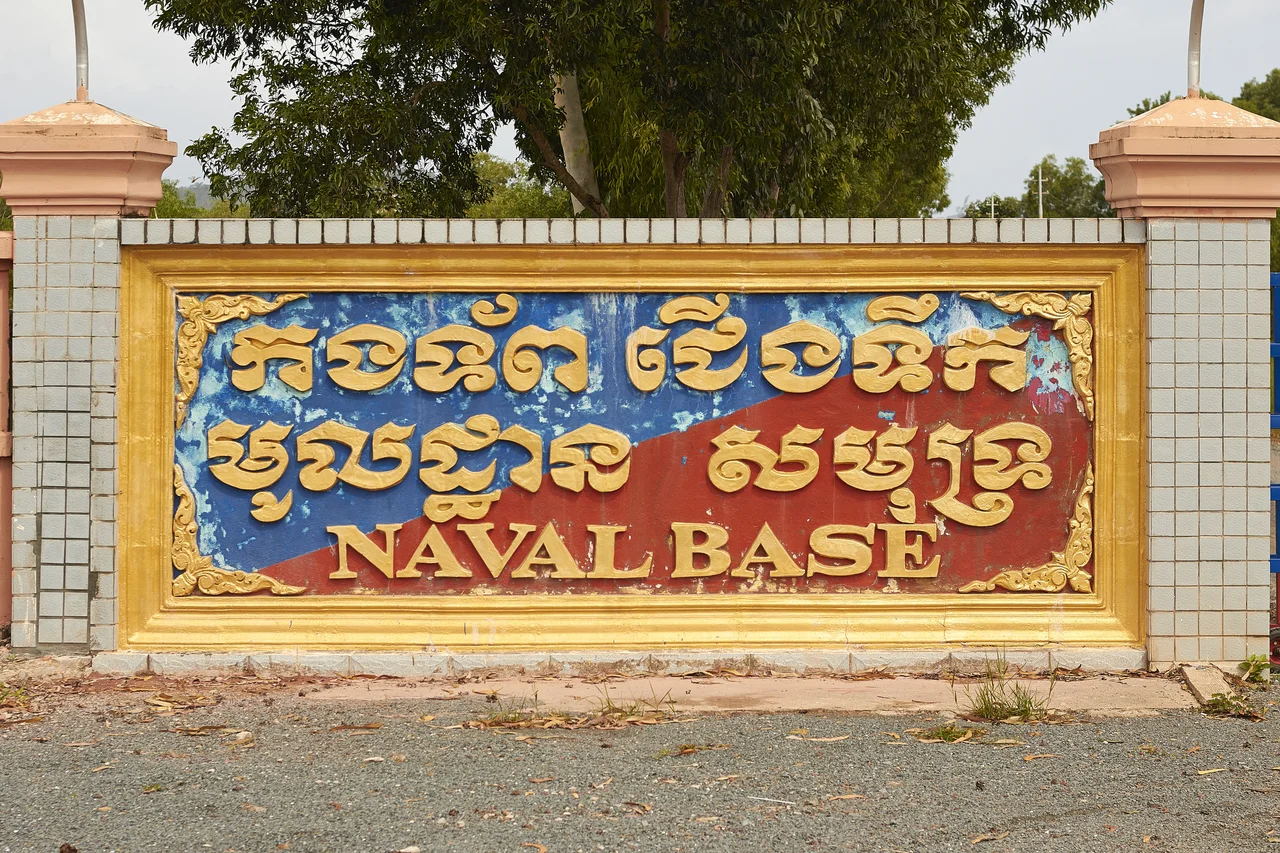

Ream Naval Base
In September 2020 a building came down at Ream that the United States had paid for. It was not much of a structure, one of two American-funded facilities on the base, but its removal was noticed in Washington and has been quoted in nearly every account of the place since. Ream Naval Base occupies roughly 190 acres on a peninsula southeast of Sihanoukville, hemmed between the Gulf of Thailand and a national park full of mangrove channels and dugongs. For a facility that modest, it has generated an extraordinary volume of satellite imagery, official denial and diplomatic unease. The New York Times eventually reached for the only headline that fit the situation: 'The Chinese Base That Isn't There.'
A Navy Nobody Had Time For
Cambodia's civil war was fought on land, and the navy paid for that. When the 1970 coup installed Lon Nol, Ream amounted to a single pier in appalling condition, no working logistics system and almost no capacity to repair anything. What happened over the next four years is one of the odder footnotes of the era: Lon Nol's government, the Khmer National Navy and the British Royal Navy together rebuilt the place. Twenty radar-equipped Swift Boats were procured, four river patrol boats were stationed up the coast in the Kompong Som port area, every heavy craft in inventory was overhauled, and a refurbished floating drydock arrived. The Ream Repair Facility was re-equipped, a supply system was installed, and a modern pier and support complex were finished. For the first time the Khmer National Navy could patrol its own coastline instead of subcontracting the job to the South Vietnamese. A power plant and larger patrol craft were still on the drawing board when the Khmer Republic fell in 1975.
Dredgers in the Channel
The base came back slowly after the Khmer Rouge were driven out in 1979, modernised again under the restored monarchy and commanded in recent years by Rear Admiral Ouk Seyha, deputy commander of the Royal Cambodian Navy. Then, in July 2019, American officials said they had seen a secret agreement granting the People's Liberation Army Navy exclusive use of roughly a third of Ream for up to thirty years. Cambodia called the report fake news, and has repeated the same position ever since: the base is Cambodian, any foreign military presence is rotational rather than permanent, and the constitution forbids anything more. In October 2020 Vice-Admiral Vann Bunlieng confirmed that dredging was under way to let larger ships in, carried out by the China Metallurgical Group Corporation with Chinese backing. The defence minister said in 2021 that China's help came with no strings attached. Sam Rainsy, Cambodia's former opposition leader, argued in Foreign Affairs that a Chinese armed presence would threaten regional stability and breach both the constitution and the 1991 Paris Peace Agreements.
Two Reams
The expansion finished in April 2025, and the ceremony said as much as the concrete did. A new joint training centre opened on 5 April with Prime Minister Hun Manet, Chinese ambassador Wang Wenbin and Cao Qingfeng, a deputy chief of staff from China's Central Military Commission, all present. Analysts at the Center for Strategic and International Studies concluded that the base had effectively split in two: roughly half the port facilities appear reserved for Cambodian and Chinese use, the other half open to everyone else. Two Chinese Type-056A corvettes have been continuously berthed since December 2023 - Wenshan and Bazhong first, replaced in July 2024, then probably Panzhihua and Guangyuan from February 2025. The Chinese ships lie at the large new northern pier. Visiting Japanese and Vietnamese vessels have used the smaller southern wharf beside the new dry dock and ship ramp. Photographs released by Cambodian sources, the analysts noticed, almost never show the northern half.
The Guest List
Cambodia's answer to all of this has been to invite people. Ream hosted joint exercises with the United States under the CARAT programme in 2010 and 2012, back when the argument had not yet started. Since the renovation, the visits have resumed and been publicised carefully: the USS Savannah on 18 December 2024, the Canadian frigate HMCS Ottawa from 1 to 4 February 2025, and the USS Cincinnati in January 2026. When Phnom Penh announced the reopening in March 2025, it made a point of saying a Japanese warship was expected to dock first. Whether an open guest list at one pier resolves the question hanging over the other is precisely what nobody outside the fence can answer, which is why so much of this story is told through satellite photographs rather than statements.
Dugongs and Dredge Spoil
It is easy to forget, in all this, what Ream is surrounded by. Ream National Park was established in 1993 and covers 210 square kilometres - 150 on land, 60 at sea - only about 18 kilometres from Sihanoukville. Mangrove forest, freshwater wetland, seagrass beds, evergreen forest and coral reef sit inside its boundary, cut through by the Prek Teuk Sap river, and the species list includes dugongs, dolphins, sea turtles, rhesus monkeys, pelicans and the Sarus crane. Koh Thmei and Koh Seh make up the park's eastern third. Around thirty thousand people live in the five communes that overlap or border it, fishing and farming, and the official accounting of competing pressures on the park names loggers, fishermen, land speculators - and the navy. Seagrass beds are where dugongs feed, and dredging a channel deep enough for corvettes has to put the spoil somewhere.
From the Air
Ream Naval Base lies at 10.507N, 103.612E on a peninsula on Cambodia's Gulf of Thailand coast, southeast of Krong Preah Sihanouk. From the air the site is unmistakable: a long new pier reaching from the northern shoreline, a smaller original pier and wharf to the south, a dry dock and ship ramp between them, and a dredged approach channel showing as a darker lane through pale shallows. Mangrove and the green mass of Ream National Park press in behind the base; Koh Thmei and Koh Seh lie offshore to the east. Sihanouk International (VDSV/KOS) sits at 10.580N, 103.637E, elevation 40 ft, roughly 9 km north-northeast with a 3,300 m runway - departures and arrivals routinely give a clear view of the peninsula. Recommended viewing altitude 3,000-7,000 ft. Dry-season visibility from November to April is excellent; May to October brings monsoon cloud, rain and haze off the Gulf. Note that this is an active military installation.
Nearby Stories
- Kampot 19 km away
- Koh Poulo Wai 33 km away
- Dara Sakor International Airport 40 km away
- Cambodian campaign 53 km away
- Phú Quốc Prison 55 km away
- Koh Kong Island 68 km away
- Tonle Sap–Mekong Peat Swamp Forests 105 km away
- Koh Kong 129 km away