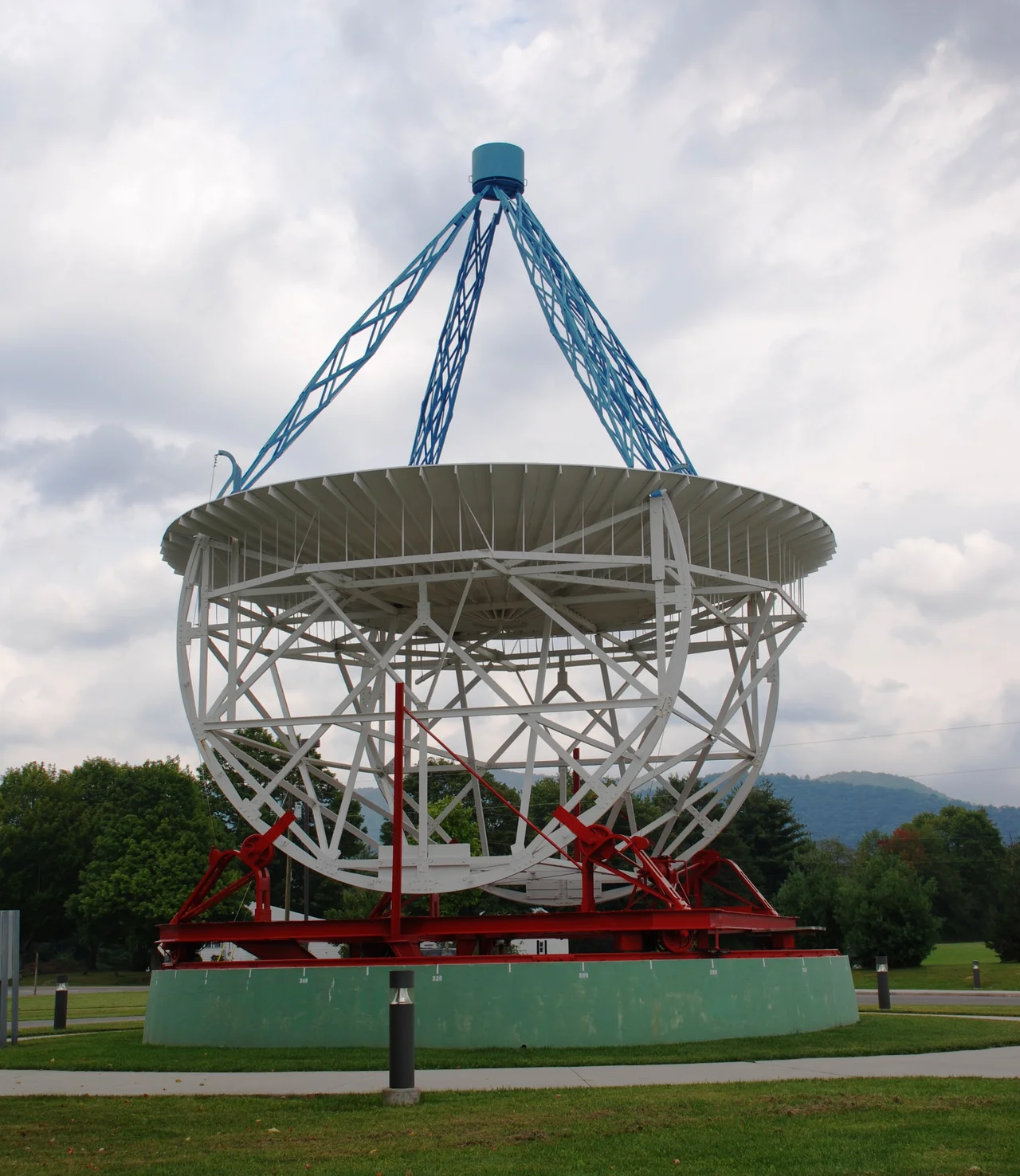

Reber Radio Telescope
For most of the years between 1937 and the late 1940s, Grote Reber was the only practicing radio astronomer in the world. He had read Karl Jansky's papers about strange radio waves coming from the Milky Way, and he wanted to follow up. He could not interest any university or observatory in helping him. So in the summer of 1937, in his backyard in Wheaton, Illinois, he built the world's first purpose-built parabolic radio telescope - 31 feet across, 72 radial rafters covered in 26-gauge iron sheeting, mounted on railroad wheels so he could tilt the dish to track sources across the sky. The whole structure now stands at the Green Bank Observatory in West Virginia, where pilgrim radio astronomers come to look at the dish that started everything.
An Amateur's Telescope
Grote Reber was a 25-year-old radio engineer in Wheaton, Illinois, working at a Chicago-area radio receiver manufacturer when he became interested in Karl Jansky's 1933 discovery of cosmic radio waves. He applied to Bell Labs for a job working under Jansky and was rebuffed. He approached universities about funding for a follow-up telescope and was rebuffed. The Great Depression had observatories cutting back rather than expanding into mysterious new fields. So Reber decided to build the telescope himself, in his back yard, with money he earned from his day job. The dish design was a parabola - the same shape that focuses light in a flashlight reflector, only scaled up and tuned for radio wavelengths. Reber fabricated the 72 radial rafters in a Chicago metal shop and assembled them at home. The dish was 31 feet in diameter, with a focal length of 20 feet, mounted on a pair of arched rails set on railroad wheels so he could tilt it up and down through the sky.
What He Found in the Backyard Sky
Reber spent the next decade conducting the first systematic survey of cosmic radio emissions. He worked at night - radio interference from cars and home appliances during the day swamped his signals. He could not observe the planets, the moon, or even the sun usefully with his equipment because they were too radio-quiet at the wavelengths he could detect. But what he could see was extraordinary: the same Milky Way radiation Jansky had discovered, mapped now in unprecedented detail, plus discrete radio sources that nobody had known existed. Cassiopeia A. Cygnus A. The first contour maps of the radio sky, published in The Astrophysical Journal in the early 1940s. The astronomy establishment finally took notice. Reber's papers were among the first peer-reviewed work in what would become a major scientific field. He was, for at least a decade, a one-person discipline.
Three Moves to Green Bank
Reber eventually sold the telescope to the U.S. National Bureau of Standards. The dish was moved from Wheaton to Sterling, Virginia, for further research. When the National Radio Astronomy Observatory took ownership, the telescope was moved again - this time to Boulder, Colorado. Its final move brought it to Green Bank, West Virginia, where it now stands on the observatory grounds as a working monument to the origins of radio astronomy. The 31-foot dish is dwarfed by the 100-meter Green Bank Telescope nearby, which is essentially a vastly larger version of the same design. The same parabolic geometry that focused Reber's signals in 1937 focuses signals from the Ophiuchus Superbubble and PSR J0740+6620 today. The principle has not changed. Only the scale.
A Lineage of Dishes
Reber's backyard dish was the prototype for every parabolic radio telescope that followed. The Lovell Telescope at Jodrell Bank in England, completed in 1957. The 300-foot transit dish at Green Bank, completed in 1962 and collapsed in 1988. The 305-meter Arecibo Telescope in Puerto Rico, completed in 1963 and collapsed in 2020. The Green Bank Telescope itself, completed in 2001. The Five-hundred-meter Aperture Spherical Telescope (FAST) in China, completed in 2016. All of these descend, in design philosophy, from a dish that one man built in his backyard during the Great Depression on his own dime, because he could not get anyone else to pay him to do it. The Reber Radio Telescope was listed on the National Register of Historic Places in 1972 and declared a National Historic Landmark in 1989 - making it one of the very few National Historic Landmarks that started life in a residential subdivision.
From the Air
Located at 38.43 degrees north, 79.82 degrees west, on the grounds of the Green Bank Observatory in Pocahontas County, West Virginia, near the Robert C. Byrd Green Bank Telescope. The 31-foot Reber dish is dwarfed by the surrounding instruments but is identifiable as a smaller, older-looking parabolic dish on the observatory campus. Best viewed from VFR altitudes of 4,500 to 7,500 feet AGL. CRITICAL: The observatory is at the center of the U.S. National Radio Quiet Zone. Check NOTAMs for any restrictions on aircraft radio transmissions before transiting within 10 nautical miles of the observatory. The closest airport is Marlinton Municipal (W99) about 14 nautical miles south.
Nearby Stories
- Pendleton County, West Virginia 8.1 km away
- Mountains and Lakes Country 9.4 km away
- Fort Edward Johnson 12 km away
- Tygart Valley Homesteads Historic District 13 km away
- Fort Dinwiddie 14 km away
- 2020 Williamsburg Massacre 17 km away
- Richwood, West Virginia 21 km away
- Frontier Culture Museum 35 km away