.jpg)
Recoleta Cemetery, Asuncion
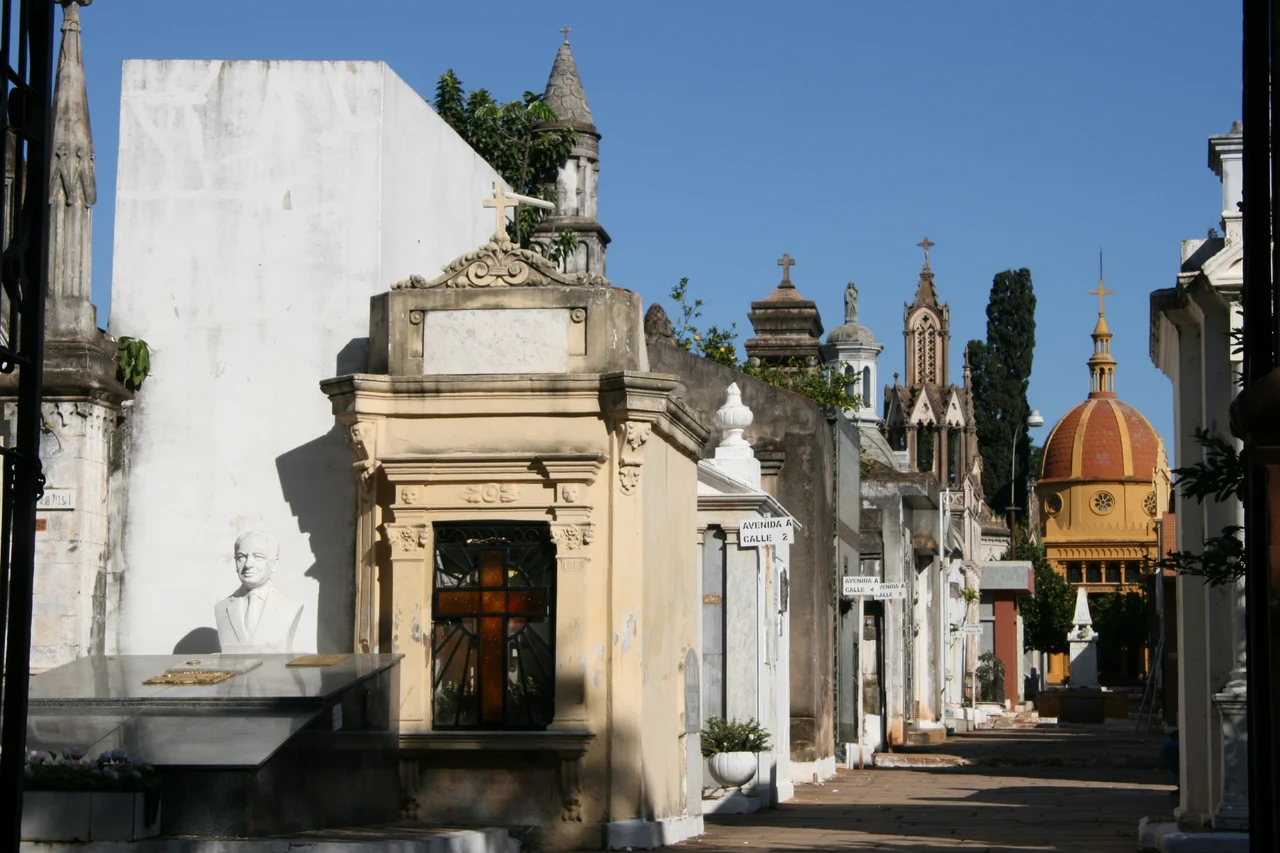
Before this place existed, the dead of Asunción were buried wherever there was room: inside churches, in the bare patios behind family homes. By 1842 the city had simply run out of space. On a parcel of ground where Franciscan friars had once kept a convent, the government opened Paraguay's first public cemetery, the first of its kind in the entire country. Nearly two centuries later, fourteen hectares of mausoleums hold the people who made the nation what it is: a dozen and a half presidents, its greatest novelist, its first female lawyer, its aviation pioneer, and a few whose stories are stranger than any fiction. To walk its lanes is to read Paraguay's history written in marble.
Ground Seized From the Church
The cemetery occupies the site of a Recollect convent, a Franciscan order whose property was nationalized by José Gaspar Rodríguez de Francia, the austere dictator who had appointed himself head of the Paraguayan church. Under President Carlos Antonio López and consul Mariano Roque Alonso, the land was formally established as a burial ground on October 20, 1842. It was the first general public cemetery in both the city and the nation, a quietly radical idea: a place where the dead belonged to the state and the people, not to a parish. The avenue running past it carries the name of Mariscal López, the marshal whose family now lies across the city in the National Pantheon.
The Uncrowned Queen
The most visited tomb belongs to Eliza Lynch, an Irishwoman who became the companion of Francisco Solano López and, in all but title, the first lady of Paraguay. She bore him six children and rode with the army through the catastrophic War of the Triple Alliance, then died in obscurity and poverty in Paris in 1886. There the story might have ended. But in 1961, the dictator Alfredo Stroessner had her remains exhumed from Paris, brought back to Asunción, and reburied here, proclaiming the once-scorned foreigner a national heroine. Her mausoleum is now a pilgrimage point, the resting place of a woman the country could never quite decide how to remember.
Poets, Pioneers, and a Prosecutor
The headstones read like a syllabus of Paraguayan culture. Augusto Roa Bastos, the nation's greatest writer, lies here; his novel I, the Supreme conjured the ghost of Dr. Francia, and in 1989 he won the Cervantes Prize, the highest honor in the Spanish language. Nearby rests Silvio Pettirossi, the aviation pioneer who gave his name to the country's main airport before dying in a crash in 1916. Serafina Dávalos, Paraguay's first female lawyer and an early feminist, is buried among them, as is Josefina Plá, a poet and playwright who shaped a century of letters. The most recent arrival carries a modern grief: Marcelo Pecci, an anti-mafia prosecutor gunned down on a Colombian beach in 2022 while on his honeymoon.
A Republic in Stone
More than a dozen presidents of Paraguay lie within these walls, a who's who of a turbulent young republic: Patricio Escobar, Cecilio Báez, Eduardo Schaerer, Higinio Morínigo, Federico Chávez, and many more, their numbered places in the line of succession etched into the marble. Among them too are the ethnologist León Cadogan, who devoted his life to recording the language and beliefs of the Guaraní, and the educator sisters Adela and Celsa Speratti, who helped build modern schooling in Paraguay. Walking the narrow lanes between family vaults, you read the country's whole turbulent history in dates and surnames. Wars, coups, reinventions, and revivals are all here, compressed into a few shaded hectares. The cemetery remains open to the public, a city of the dead that doubles as the clearest map Paraguay has of its own past.
From the Air
La Recoleta Cemetery lies in the Recoleta district of Asunción at 25.2927 degrees south, 57.5894 degrees west, along Avenida Mariscal López about 3 nautical miles southeast of the downtown waterfront. From the air the site reads as a dense pale grid of mausoleum roofs and walkways, roughly fourteen hectares set among the surrounding residential blocks, distinct from the green of nearby parks. Recommended viewing altitude is 1,500 to 2,500 feet. The Paraguay River to the northwest and the broad axis of Avenida Mariscal López are useful navigation references. The nearest airport is Silvio Pettirossi International (ICAO: SGAS, elevation 292 feet) in Luque, about 8 nautical miles northeast. Clear mornings offer the best visibility before afternoon haze builds in the humid season.
Nearby Stories
- Yaguarón 21 km away
- Río Pilcomayo National Park 22 km away
- New Australia 45 km away
- La Colmena, Paraguay 46 km away
- Nueva Germania 120 km away
- Pilar, Paraguay 155 km away
- Concepción 174 km away
- First Battle of Nanawa 241 km away