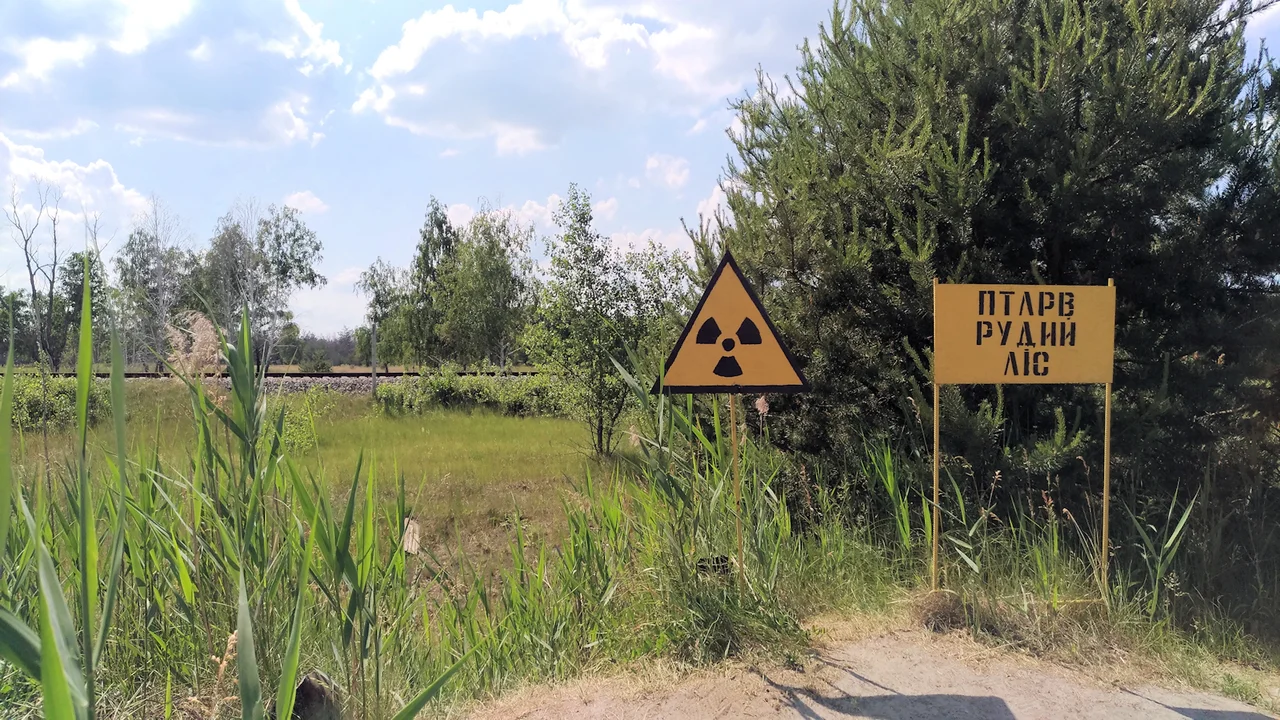

Red Forest
The pines did not fall all at once. In the days and weeks after the reactor blew, the needles of the forest closest to the Chernobyl plant slowly changed color, fading from green to a deep ginger-brown, until roughly ten square kilometers of woodland stood dead and rust-red against the Polesian sky. That color gave the place its name. Nearly four decades later, the Red Forest remains one of the most contaminated landscapes in the world, and one of the strangest: a poisoned ground where almost nothing human survives, yet where wild animals have returned in numbers no one expected.
The Color of a Lethal Dose
On 26 April 1986, the explosion and fire at the No. 4 reactor threw radioactive material across the surrounding land, contaminating soil, water, and air with a burden the sources compare to twenty times the fallout of the Hiroshima and Nagasaki bombings. The forest directly downwind absorbed the highest doses of anything living for miles. The trees took in so much ionizing radiation that they simply died, their needles curing to that unmistakable rust color before the branches went bare. To the liquidators who arrived to clean the zone, the woodland was not a landscape but a hazard. They bulldozed most of the poisoned pines, buried them in long trenches, blanketed the trenches with sand, and planted saplings on top. Everything green you see there now grew up afterward. Not a single mature tree in the Red Forest today was alive to be irradiated in 1986.
Where the Animals Came Back
The people left in 1986. The animals moved in anyway. With human hunting, farming, and traffic gone, the young forest filled with life across the years that followed: red deer and roe deer, wild boar and moose, wild horses and bison, brown bear, lynx, wolves, hares, beaver, otter, badger, mink, and polecats. Wild boar alone multiplied eightfold between 1986 and 1988. Biologists have documented stunted plants and disputed exactly what the radiation does to individual bodies, yet by many measures the sheer biodiversity of the zone has risen since the disaster. It is one of the hard paradoxes of Chernobyl: a place lethal enough to kill a forest turns out to be safer for large mammals than the presence of people ever was. The animals cannot read a dosimeter. They only know the woods are quiet.
A Forest That Cannot Rot
Something else is wrong with the Red Forest, and it took decades to notice. A 2014 study found that dead wood and leaf litter here decay far more slowly than in ordinary forests. The microorganisms that normally break down fallen trunks and fallen needles barely function in the contaminated soil, so the forest floor keeps accumulating dry, unrotted fuel. The result is a landscape primed to burn. In April 2015, a wildfire swept close to the abandoned power plant, raising fears that flames could loft old radioactive particles back into the air. In April 2020, fire tore through again. Each blaze is more than a wildfire; it is the threat of a contaminated forest lifting its poison skyward, held down only by luck and the crews who fight the flames.
Trespassers in a Poisoned Wood
In February 2022, at the start of the Russian invasion of Ukraine, military vehicles reportedly rolled convoys straight through the Red Forest, churning the radioactive dust back into the air. Workers who watched described soldiers moving without protective suits, some digging trenches into the most contaminated ground, some hunting the wildlife and fishing the plant's old cooling ponds. Alarming rumors of mass radiation sickness followed, and later reporting muddied them; the IAEA concluded the actual doses were likely modest, and a Zone tour guide admitted he had exaggerated the sickness story to frighten the occupiers. What is not disputed is the deeper truth the episode exposed. This is ground that punishes ignorance, a forest that has quietly outlasted every human who thought he could pass through it untouched.
From the Air
The Red Forest lies at 51.38 N, 30.05 E, hugging the Chernobyl plant and the ghost city of Pripyat within the Exclusion Zone. View from roughly 6,000 to 9,000 feet in clear weather; the reactor's New Safe Confinement dome and the geometric outline of Pripyat are the surest landmarks. The airspace is restricted; the nearest sizable airport is Kyiv Antonov (Hostomel) at UKKM, with Kyiv Boryspil (UKBB) farther south.
Nearby Stories
- Liubech 5.9 km away
- Slavutych 17 km away
- Oster 31 km away
- Malyn 46 km away
- 1995 Borodianka Mid-Air Collision 46 km away
- Ovruch 51 km away
- Battle of Listven 100 km away
- Nesvizh Castle 258 km away