
Republic of Upper Volta
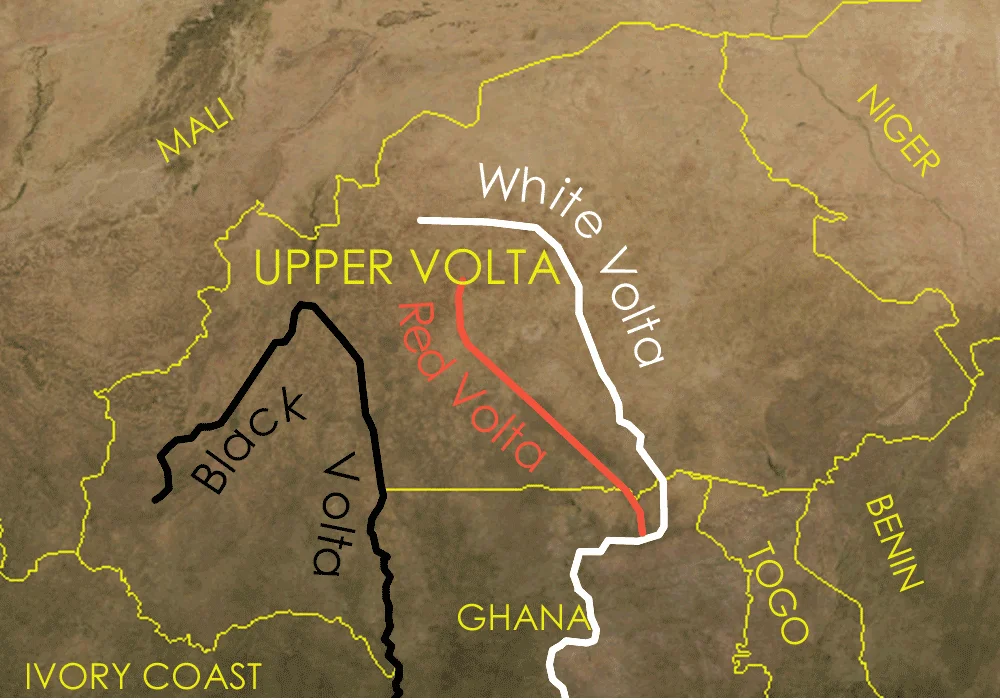
The country was named after a river it sat at the head of. Three branches of the Volta - the Black, the White, the Red - rise in this landlocked corner of West Africa, and when the French drew up their colony they called the place simply the Upper Volta: the upstream part. The name said nothing about the people who lived there. It described hydrology. For nearly a quarter of a century after independence the Republic of Upper Volta carried that borrowed, geographical name, until a young army captain decided a nation should be called something its own people had chosen. The country you find on the map today, Burkina Faso, is the same land - renamed.
A Nation in Stages
Upper Volta did not become a country all at once. On 11 December 1958 it was established as a self-governing state within the French Community, a halfway house between colony and nation. Full independence came on 5 August 1960. Maurice Yaméogo, born in the town of Koudougou and leader of the Voltaic Democratic Union, became the new republic's first president. A constitution ratified that same year promised universal suffrage, a National Assembly, and presidential terms - the full apparatus of a democracy. The promise did not last. Yaméogo soon banned every political party but his own, the product of an authoritarian instinct that had been hardening even before he took the top office, and opposition figures found themselves increasingly harassed.
The Years of Coups
What followed was a long sequence of soldiers in power. On 3 January 1966, the army chief Sangoulé Lamizana overthrew Yaméogo in a coup. Multiparty politics were nominally restored a few years later, but Lamizana dominated the country until he in turn was overthrown in 1980. A run of short-lived governments followed, the kind of instability that wears a country down. Then, on 4 August 1983, a charismatic young captain named Thomas Sankara seized power through yet another military coup and formed a National Council for the Revolution with himself at its head. Sankara was different - a Marxist, an ascetic, a man who sold off the government fleet of Mercedes and rode a bicycle, determined to remake the poorest nation he had inherited from the ground up.
A Country Renames Itself
Exactly one year after taking power, on 4 August 1984, Sankara changed the country's name. Upper Volta - the colonial label, the hydrological description - became Burkina Faso. The new name was stitched together from two of the nation's own languages, Mooré and Dioula, and it translates roughly as 'Land of Upright People' or 'Land of the Incorruptible.' It was a statement of purpose as much as a name, an assertion that the country would no longer be defined by the rivers a French mapmaker had noticed, but by the character its people aspired to. Few renamings in modern history have carried such deliberate moral weight. The Republic of Upper Volta ceased to exist not through conquest but through a choice about identity.
Upper Volta With Rockets
The old name lingers in one strange corner of history. During the Cold War, Western commentators sometimes mocked the Soviet Union as 'Upper Volta with rockets' - a barb coined by the journalist Xan Smiley, meaning a state that poured everything into its military while its ordinary economy stayed undeveloped. Upper Volta, then among the world's poorest nations, became shorthand for backwardness in a joke aimed at a superpower. It is a small, telling irony. The country that lent its name to that insult would soon rename itself for the upright character of its people, while the superpower being mocked would itself dissolve within a few years. The river-name is gone now, but its echo survives in an old piece of geopolitical wit.
From the Air
The former Republic of Upper Volta corresponds to present-day Burkina Faso, a landlocked country in West Africa centered near 12.1°N, 1.7°W, with its capital at Ouagadougou. The terrain is flat to gently rolling Sahelian savanna drained by the three Volta branches. The principal airport is Ouagadougou (DFFD); Bobo-Dioulasso (DFOO) serves the southwest. Best aerial visibility is in the dry season (November-February), though harmattan dust haze is common; the green of the brief July-September rainy season transforms the landscape.
Nearby Stories
- 1987 Burkina Faso Coup d'État 7.7 km away
- Koudougou 36 km away
- Nazinga Game Ranch 67 km away
- Royal Court of Tiébélé 77 km away
- Tenkodogo 80 km away
- Gwollu Defence Wall 89 km away
- Ancient Ferrous Metallurgy Sites of Burkina Faso 136 km away
- Dori, Burkina Faso 222 km away