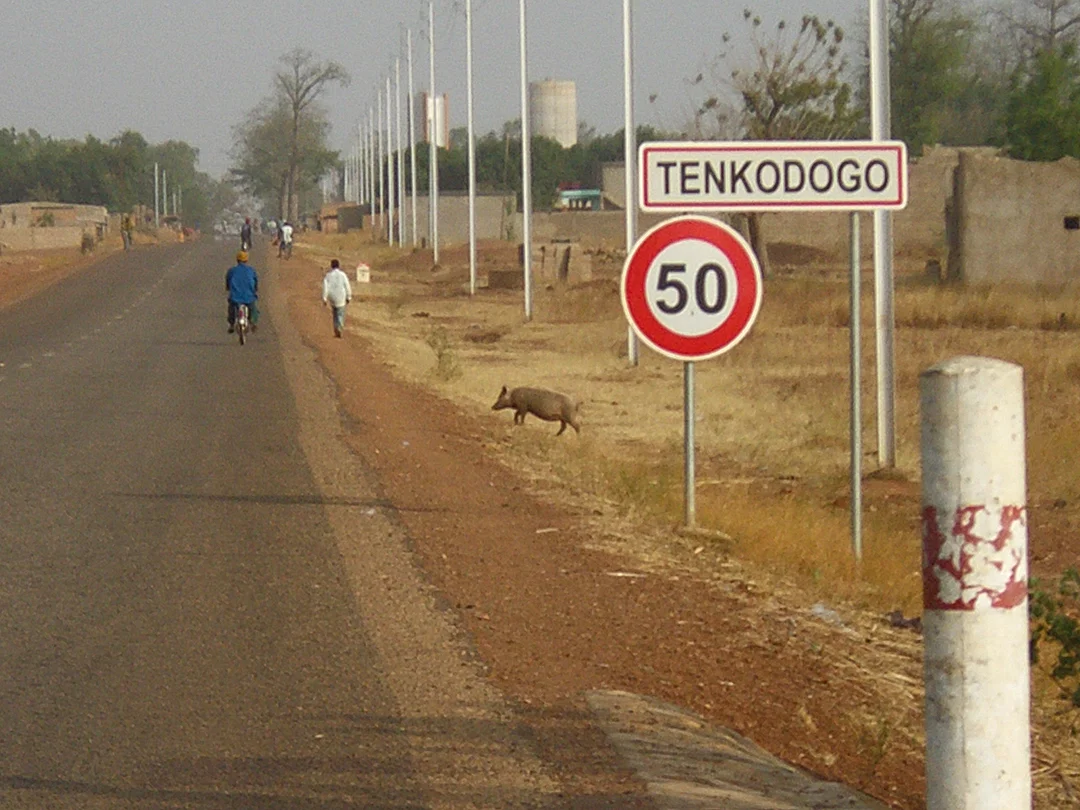

Tenkodogo
The name itself is a claim: Tenkodogo, in the Mooré language, means "ancient land." And the town earns it. Spread across the dry savanna of southeastern Burkina Faso, this market town of some 62,000 people is widely held to be the oldest of the Mossi kingdoms, the seed from which the others grew. According to Mossi tradition, a warrior named Ouédraogo founded the city around the year 1100, and from his descendants spread the dynasties that would rule much of the land between the rivers for the next eight centuries. Long before colonial maps drew Burkina Faso, there was Tenkodogo.
The Root of Kingdoms
Every Mossi king can, in theory, trace his lineage back here. The founding story begins not with a man but with a woman: Yennenga, a legendary princess and warrior whose son Ouédraogo is remembered as the first to build at Tenkodogo. From his line came the rulers of Fada N'gourma, Boussouma, Zondoma, and eventually the great kingdom of Ouagadougou itself. Tenkodogo never grew into the largest of the Mossi states, but it holds a different kind of authority - the authority of being first. To the Mossi, this is the ancestral hearth, the place the genealogies always return to. Whatever later kingdoms achieved in power or territory, they could not claim what Tenkodogo claims: to be the beginning.
The Na-Yiri
At the heart of town, close by the market, stands the Palais Royal de Tenkodogo - known locally as the Na-Yiri, the "king's house." The institution it represents has outlasted empires. When King Naba Saga died in 2016, he was counted as the twenty-eighth king of Tenkodogo in the traditional reckoning, succeeded in turn by Naba Guiguem-Pollé. Many descendants of the royal line carry the surname Sorgho and are known as the naabisi, the royals of the city. This is no museum-piece monarchy. The royal family still mediates disputes over land and family, and their word still settles arguments that courts cannot. In Tenkodogo, the past is not a closed chapter but a living office, occupied to this day.
Market Days
Life in Tenkodogo turns on a three-day rhythm. Every third day the main market fills - the Raaga, in Mooré, or the Daassi in the Bissa tongue spoken alongside it here, for this is a place where two peoples and two languages have long shared the same ground. Traders come in from the surrounding villages, where families raise cattle, goats, and sheep across the semi-arid scrub. The climate is hot and dry, a borderland between the savanna and something harsher. Between market days the town quiets, then swells again as vendors return with grain, livestock, and goods, the oldest commerce of the Sahel playing out under the same sun that warmed Ouédraogo's first walls.
An Ancient Land, Building New
For all its deep history, Tenkodogo does not stand still. Ahead of the 2019 celebrations of the 11 Décembre festival - Burkina Faso's national day, which the town has hosted - new roads and roundabouts were paved, and movement through the city quickened. The old dirt airstrip was cleared away to make room for a new neighborhood, the Cité 11 Décembre, rising with modern villas where planes once landed. Roughly 185 kilometers and three and a half hours by road from the capital, Ouagadougou, Tenkodogo remains connected to the wider country by a steady stream of buses. The ancient land, it turns out, is still being built.
From the Air
Tenkodogo sits at 11.78°N, 0.37°W in southeastern Burkina Faso, in the Centre-Est Region near the Boulgou plains. The nearest major airport is Ouagadougou (DFFD), roughly 185 km to the northwest. The town lies along the N15 highway connecting Koupéla and Bittou. Terrain is flat semi-arid savanna; the dry season (November to April) offers the clearest visibility, while the harmattan can carry dust haze from the Sahara. The market grid and Palais Royal anchor the town center, with the new Cité 11 Décembre neighborhood on the site of the former dirt runway.
Nearby Stories
- Opera Village Africa 52 km away
- Nazinga Game Ranch 66 km away
- Naa Gbewaa Shrine 71 km away
- Republic of Upper Volta 75 km away
- French Upper Volta 112 km away
- Oti-Keran National Park 170 km away
- Pendjari National Park 189 km away
- Tin Hinan Tomb 1302 km away