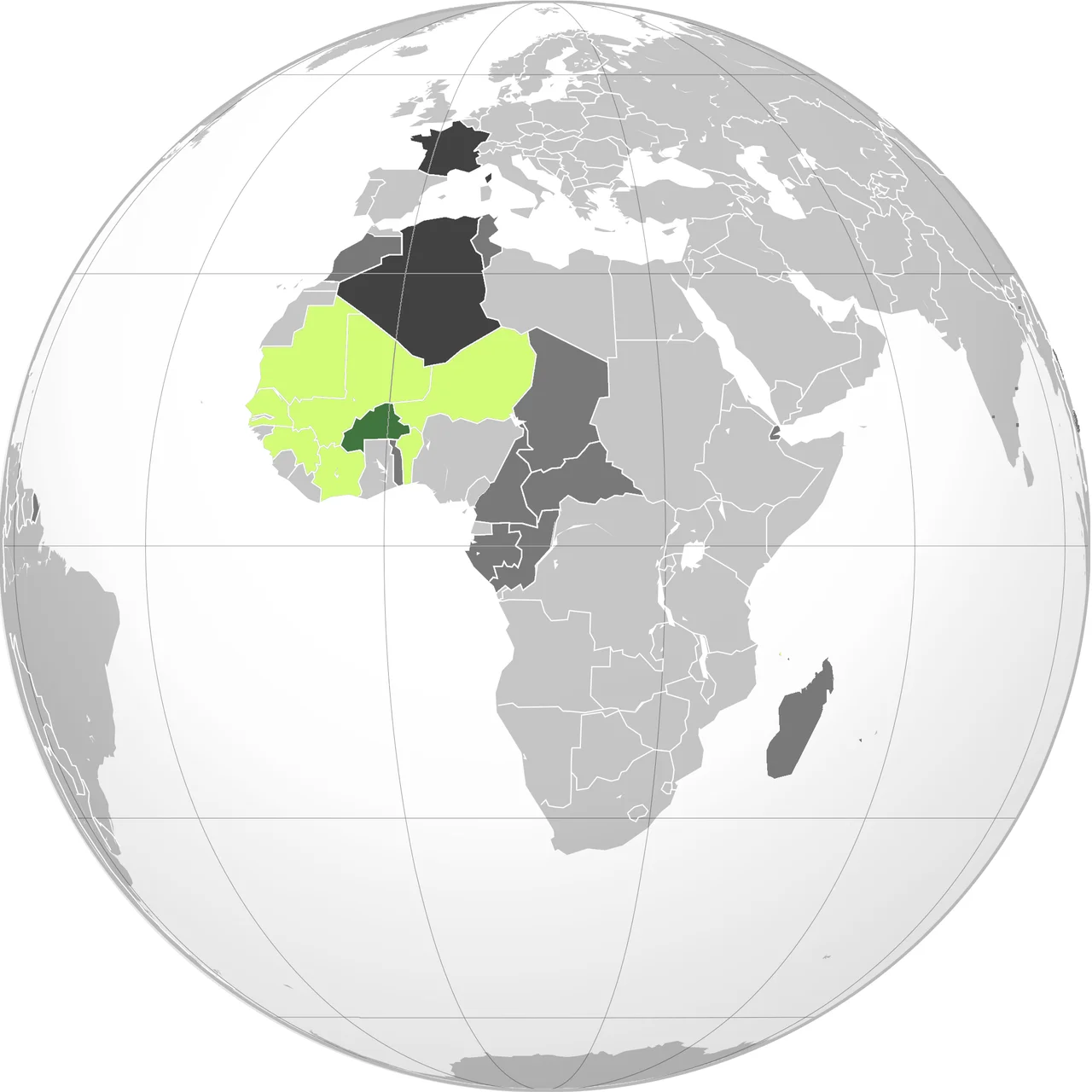
.png)
French Upper Volta
Few countries have been abolished by their own rulers - and fewer still have been abolished and then, years later, put back together again. Upper Volta was both. France carved it out of the West African interior in 1919, dissolved it in 1932 to economize, and then reassembled it in 1947 because the people inside its old borders would not let it stay forgotten. The name came from a river: the Volta, which rises here in three branches the colonists labeled Black, White, and Red.
An Old Kingdom Beneath the New Border
Long before any French surveyor drew a line across this plateau, the land belonged to the Mossi. Their kingdoms, built by people who had migrated up from what is now northern Ghana, dominated the region for centuries. The Mossi farmer was also a soldier, and that dual identity let them hold their ground - and their own religion and social order - against repeated pressure to convert to Islam from the north. When the French arrived and claimed the area in 1896, Mossi resistance collapsed only with the capture of their capital at Ouagadougou. The colony that followed was new on paper. The society beneath it was very, very old.
Drawn, Erased, Redrawn
On 1 March 1919, France stitched together provinces taken from neighboring colonies and called the result Upper Volta, with Édouard Hesling as its first lieutenant governor. It did not last. In September 1932, in a cost-cutting move, the administration simply dismembered the colony, parceling its territory out to the Côte d'Ivoire, French Sudan, and Niger. For fifteen years Upper Volta existed only as fragments under other flags. Then, after the Second World War, the Mossi renewed their campaign for separate status - and on 4 September 1947, Upper Volta was reconstituted with its old boundaries. A country had been switched off and switched back on, and it was its own people who flipped the second switch.
The Privileges of the Colonizers
Colonial rule here was not abstract; it reached into the smallest details of daily life. African children were forbidden to ride bicycles or pick fruit from trees - 'privileges' reserved for the children of European settlers - and a parent whose child broke these rules could be jailed. It is a small, almost petty cruelty, and that is exactly what makes it land. Independence movements are often told through grand declarations, but the daily indignities mattered just as much: a child told that a mango on a public tree was not for them, in a country named after their own river, on land their ancestors had farmed for a thousand years.
Toward a New Name
The path out of empire came in stages. The Loi Cadre of 1956 loosened France's grip on its overseas territories, and on 11 December 1958 Upper Volta became a self-governing republic within the French Community. Full independence followed on 5 August 1960. For the next twenty-four years the country carried the name its colonizers had given it - until 1984, when the revolutionary president Thomas Sankara renamed it Burkina Faso, the 'Land of Upright People.' The river name was finally retired, replaced by a name the country chose for itself. Upper Volta, the colony that France kept inventing, had at last become something that invented itself.
From the Air
French Upper Volta covered the territory of present-day Burkina Faso, centered on the Sahelian plateau near Ouagadougou at 12.369°N, 1.527°W, roughly 300 meters above sea level. Thomas Sankara International Airport (ICAO: DFFD; IATA: OUA) serves the former colonial capital. The three branches of the Volta River - the Black, White, and Red Volta - drain the region southward toward Ghana. Visibility is best in the cool dry months from November to February, before the harmattan haze thickens.
Nearby Stories
- Republic of Upper Volta 13 km away
- Koudougou 32 km away
- Kaya 72 km away
- Tenkodogo 84 km away
- Yacouba Sawadogo 103 km away
- Gwollu Defence Wall 128 km away
- Royal Court of Tiébélé 145 km away
- Dori, Burkina Faso 189 km away