.jpg)
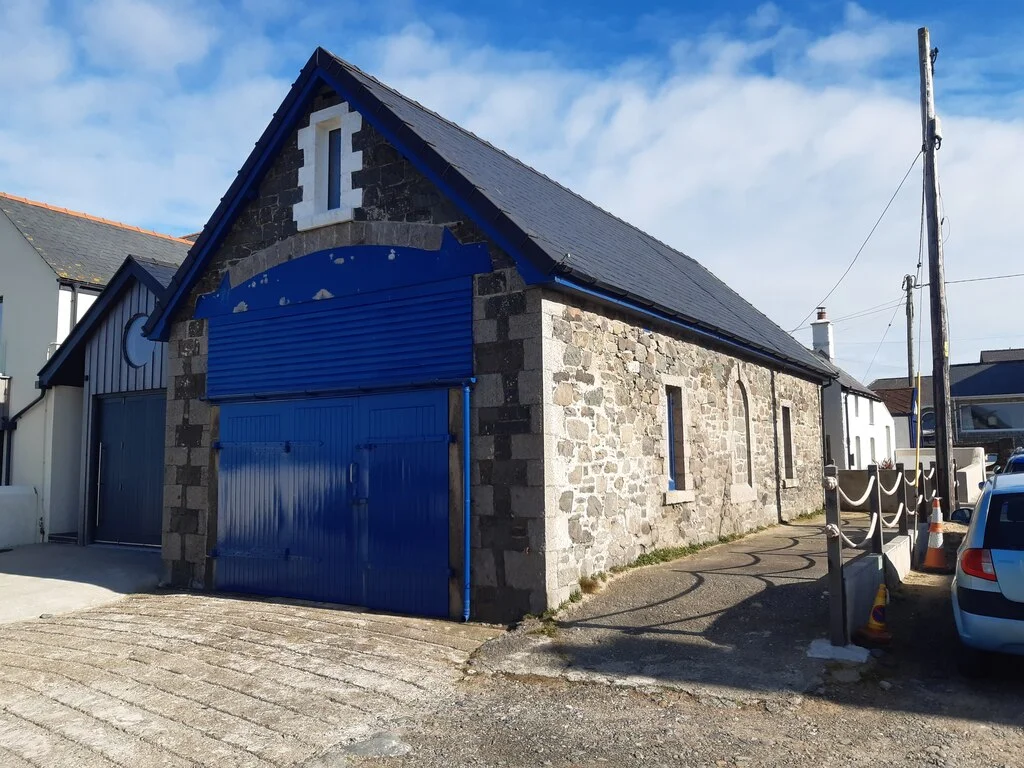
Rhosneigr Lifeboat Station
On 28 August 1942, a Polish-piloted Blackburn Botha crashed into the sea off Rhosneigr beach. Three airmen were trapped in the wreckage. Two schoolboys - John Stewart Wood and Derek Baynham, both seventeen - launched a small dinghy and reached the aircraft, pulling out the pilot before their dinghy was overturned. They survived. So did the pilot they had reached. By the time the day ended, eleven other men had drowned trying to row out to that wrecked Botha. The boys received the George Medal and the RNLI Silver Medal; General Sikorski, commanding the Polish forces in exile, sent each of them a cigarette case. Eleven RNLI Bronze Medals were awarded, seven of them posthumous. The lifeboat station itself had been closed for eighteen years by then. The rescue happened anyway.
1872: A Station for Rhosneigr Bay
Rhosneigr Lifeboat Station was established by the Royal National Lifeboat Institution in 1872, after a series of shipwrecks in Rhosneigr Bay convinced local residents to petition for a boat. Mrs Selina Lingham of Lower Norwood in south London donated 680 pounds to fund the station, in memory of her husband Thomas. The assistant Inspector of Lifeboats came up to assess, found enough volunteers willing to crew, and the application was approved on 4 April 1872. A 30-foot self-righting Pulling and Sailing boat - ten oars and a small sail rig - was ordered for 238 pounds 15 shillings. The boathouse cost 254 pounds. On 19 September 1872, the boat was paraded down to the beach and formally handed over. Mrs Lingham named her the Thomas Lingham, after her late husband, and the Rev R Williams blessed the work.
The Norman Court Rescue
The most extraordinary service the Rhosneigr boat ever attempted was on 30 March 1883, called out to the Greenock vessel Norman Court aground in heavy weather. The Rhosneigr crew launched into impossible conditions and lost one of their own washed overboard. A steam tug towed them out to the wreck; they could not reach it. The Rocket Brigade ashore tried to fire a line; they could not reach it either. The Rhosneigr crew launched a second time and were again beaten back, returning utterly spent. The Holyhead railway company arranged a special engine to bring fresh Holyhead crewmen down to Rhosneigr. In the same Rhosneigr boat, but with rested arms, the Holyhead men finally got alongside and took twenty men off the Norman Court. Coxswain Thomas Roberts of Holyhead was awarded the RNLI Silver Medal.
Decline and Closure
Rhosneigr saved forty-five lives in its first thirteen years, ten more in 1890 alone, and thirteen in the thirteen years following. Then the calls dried up. Improvements in ship construction, the gradual fading of sailing-vessel coastal trade, and the proximity of other stations meant that by the early 1900s Rhosneigr was launching rarely. In the twenty years before 1924, the boat had gone out just seven times and saved only two lives. The RNLI closed the station. A tragedy unrelated to wreck-rescue had also marked the station: on 28 December 1894 a young man named William Roberts was run over by the lifeboat carriage during a launch and died of his injuries days later.
1942: The Botha That Should Not Have Flown
The Blackburn Botha was one of the most unloved aircraft of the Second World War. Underpowered, unstable in some configurations, withdrawn from front-line use, it was nevertheless still in service for training in 1942. On 28 August one came down off Rhosneigr. The crew were Polish airmen attached to a unit training in north Wales. Stewart Wood and Derek Baynham were schoolboys on the beach. They rowed out, reached the wreckage, pulled the pilot aboard and capsized. Nine other men launched a boat after them and that boat capsized too. Some who tried to swim out drowned. The names on the RNLI Bronze Medal list read like a cross-section of wartime coastal life - gunners of the Royal Artillery, an aircraftman, a policeman, a coastguard boatman, a battery sergeant major, a merchant navy officer. A memorial outside Rhosneigr fire station was placed in 1991 to record the eleven who died trying. The lifeboat station that might have saved them had been gone for eighteen years.
From the Air
The site of the former Rhosneigr Lifeboat Station lies on the west Anglesey coast at 53.226N, 4.523W, on the beach immediately south of Rhosneigr village. RAF Valley (EGOV) is 2 nm north - the proximity matters historically; many wartime emergencies on this coast involved Valley-based training aircraft. The 1942 Blackburn Botha crash and memorial are tied to this stretch of coast. Look for the village's distinctive clock tower and the broad sandy curves of Traeth Llydan and Traeth Crigyll. Caernarfon Airport (EGCK) is 13 nm to the southeast.
Nearby Stories
- Wakestock 1.7 km away
- Trefriw 3.8 km away
- Irish Sea 8.7 km away
- Irish Sea Bridge 20 km away
- East–West Interconnector 30 km away
- Machynlleth 36 km away
- HMS Tyler 41 km away
- New Brighton Lifeboat Station 54 km away